The classroom assessment guide: from exit tickets to unit tests
Classroom assessment is useful when it changes what you do in the next lesson. This guide places 14 tools on the cycle of a unit: before it, to know where to start; during it, to know who understood; at its end, to know what to reteach. Each tool has its own post.
Which assessment tool, when
A free printable PDF, no sign-up.
- Definition
- Formative assessment: Assessment whose evidence is actually used to adapt the teaching to meet students' needs, as Paul Black and Dylan Wiliam define it.
Which tool, when: one table
In “Inside the Black Box” (Phi Delta Kappan, October 1998), Black and Wiliam write that assessment becomes formative “when the evidence is actually used to adapt the teaching to meet student needs”, and that the studies they reviewed show that strengthening this practice produces “significant and often substantial learning gains”. So the measure is not how many tools you use, but what they change in the next lesson.
Start from your question, not from the tool's name. The first column is what you want to know or do; the last is the post that explains the tool with an example and a printable. The times come from the posts themselves; where a post gives no time, we wrote when to use the tool.
| What you want | The tool | When, and how long | The post |
|---|---|---|---|
| To know where to start the unit | An 8-question diagnostic test | Before the unit: 20 minutes to write, about a quarter of an hour for students | The diagnostic test |
| To write down what you will measure | Measurable objectives | Before planning the unit | Learning objectives |
| For students to see the criteria before they hand work in | A rubric | With the task, before it is handed in | Rubrics |
| To decide mid-lesson: move on or reteach | A hinge question | An answer in under a minute, a decision within two | Hinge questions |
| To hear from every student in a large class | A/B/C/D cards, mini whiteboards and more | Any time: five minutes at most | Large classes |
| To know what stuck from today's lesson | An exit ticket | The last five minutes of the lesson | Exit tickets |
| To show a student their next step | Three-part feedback | While marking: 35 books in one sitting | Feedback phrases |
| To check a worksheet before printing | Eight rules | Before printing, then a five-minute final check | Worksheet rules |
| To check a few skills mid-unit | An 8-question short quiz | 10 minutes | The short quiz |
| To write questions at different levels of thinking | Depth of Knowledge levels | When writing the test | Depth of Knowledge |
| To share out the unit test's marks fairly | A table of specifications | Before writing the questions | The test blueprint |
| To catch mistakes before the copier | A 12-point checklist | Before printing the exam | Before you print the exam |
| To turn marks into a decision on each question | A 1-and-0 grid | After marking | Results analysis |
| To close a gap a diagnostic or test revealed | One plan per group | 10 minutes a lesson, for two weeks | The remedial plan |
The drawing at the top of the page places the same tools on a unit's cycle: three before it, six during it, five at its end, and an arrow from the remedial plan back into teaching. The cycle does not end with a mark; it ends with what you do next.
New to formative assessment? Four weeks
Do not start with all fourteen at once. We suggest one tool a week, in this order, each building on the habit of the one before:
Week one: an exit ticket every lesson
One question on the lesson's goal in the last five minutes, then three piles. It is the cheapest tool, and it builds the habit everything else rests on: reading the answers before you plan tomorrow.
Week two: one hinge question per lesson
Write it before the lesson, with a known misconception behind each wrong option. Have the whole class answer at once with A/B/C/D cards, not only those who raise a hand.
Week three: feedback instead of a mark alone
On one written task: what the student got right, one next step, and a task to do now in their book.
Week four: a short quiz and one grid
Eight questions in ten minutes, then a 1-and-0 grid that shows which question goes back to the whole class and which to a small group.
Then add the unit tools: the diagnostic test at the start, the blueprint and the results analysis at the end.
Before the unit: know where to start and what you will measure
Learning objectives. Every tool after this measures them; if they are vague, every test becomes a guess. A measurable objective is a sentence with one verb you can see on the student's page, a condition that says what they are given, and a criterion that says when it counts as met. The post has a verb table for each level of the revised Bloom's taxonomy and 12 objectives rewritten from unmeasurable to measurable: Measurable learning objectives.
The diagnostic test. In “Classroom Assessment: Minute by Minute, Day by Day” (ASCD, November 2005), Dylan Wiliam describes “range-finding” questions, designed to reveal what students know at the beginning of an instructional sequence. A good diagnostic test is short: one question per misconception you expect; eight questions are enough before a fractions unit, and a grid then splits the class into four groups for the first week: The diagnostic test before a unit.
The rubric. The first of the five strategies in Wiliam's article is “clarifying and sharing learning intentions and criteria for success”, and a rubric is those criteria written down: a short table with a few criteria, and for each level a number and a description students can recognise their own work in before they hand it in. The post has four ready to use: Rubrics students can read.
During the unit: ask the whole class, every day
Wiliam writes that we need more fine-grained assessments, and that we need to use what they show to modify instruction as we teach. These are the everyday tools:
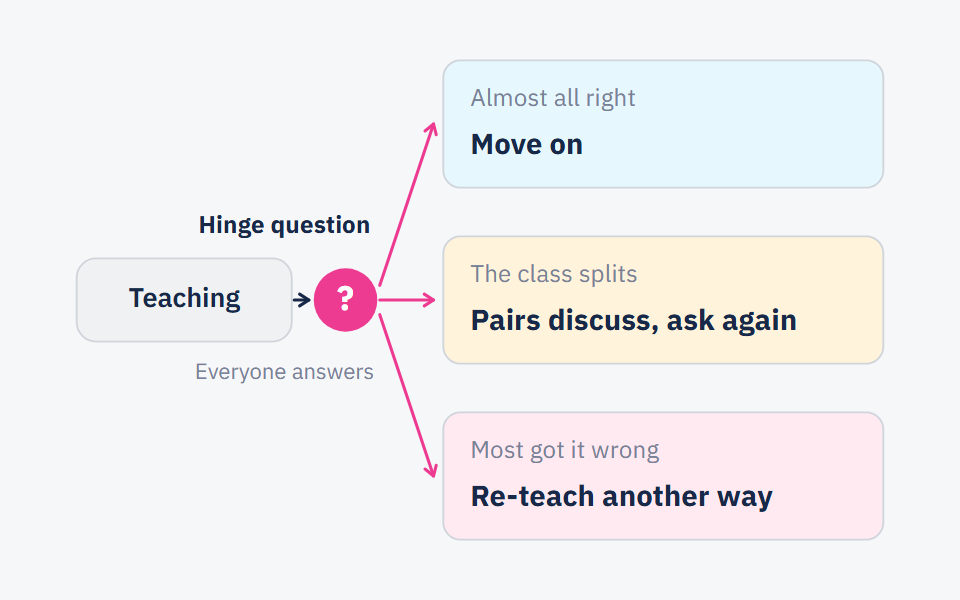
The hinge question. Wiliam calls it a hinge point because “the lesson can go in different directions, depending on student responses.” One question before moving to the next part of the lesson, with a known misconception behind each wrong option. The post suggests thresholds for the decision, as advice rather than a research finding: if 9 in 10 or more are right, move on; between half and 9 in 10, open a pair discussion; fewer than half, reteach another way: Hinge questions.
The large class. In a class of forty, “Does everyone understand?” tells you nothing. The post gives four ways for every student to answer at the same moment: A/B/C/D cards, mini whiteboards, a hinge question and an exit ticket, none taking more than five minutes: Checking what every student understood in five minutes.
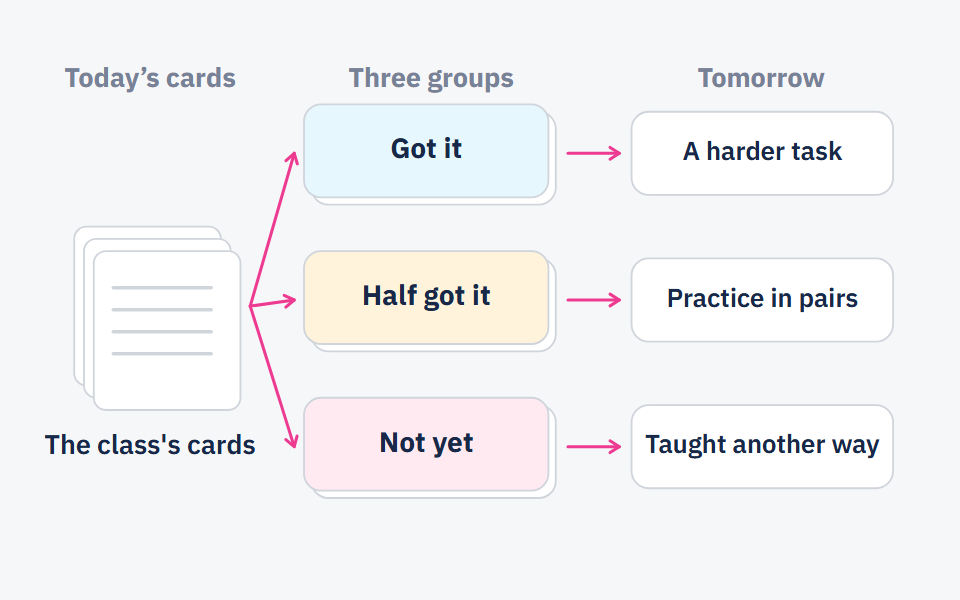
The exit ticket. Wiliam describes teachers who hand out index cards at the end of a lesson; students write their response to a question and turn it in before they leave. One question on the lesson's goal, then sort the cards into three piles, each with a step in tomorrow's lesson: Exit tickets, with 15 ready questions.
Feedback on work. Black and Wiliam write that research studies have shown that if pupils are given only marks or grades, they do not benefit from the feedback. And Wiliam writes in his article: “To be effective, feedback needs to cause thinking. Grades don't do that.” Feedback that moves a student has three parts: what is right, specifically; one next step; and a task to do now: 30 sentence stems for feedback.
The good worksheet. A worksheet is assessment too when it shows what a student has not understood, not only when it fills their time. Eight rules to check before printing, one of them an item that asks the student to explain, then a five-minute final check on a printed copy: Eight rules before you print.
The short quiz. Ten minutes, eight questions, one objective each, and before you print it you know what a wrong answer to each one means. The post's example is Grade 6 maths, and you can carry its method to your subject: A Grade 6 short quiz.
At the end of the unit: a fair test, and results that become decisions
Depth of Knowledge. Four levels that describe the thinking a question demands, not how hard it is: recall, then skill and concept, then strategic thinking, then extended thinking that takes days. The common mistake is confusing depth with difficulty. The post has 16 questions from one lesson, four per level: Depth of Knowledge.
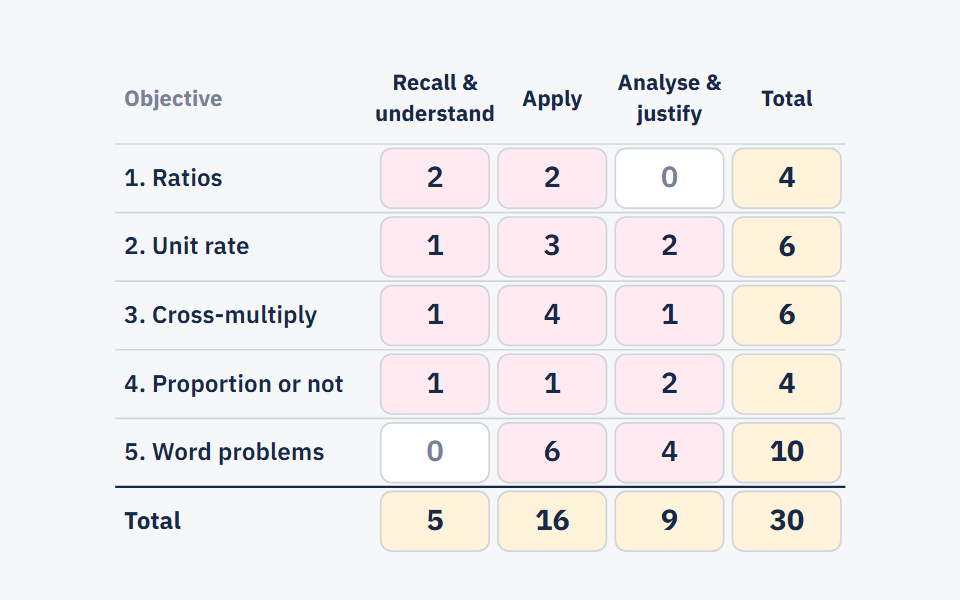
The table of specifications. It shares out a test's marks across the unit's objectives in proportion to the time spent teaching each, then across the levels of thinking they were taught at. Write it before the questions, not after. The post has a completed table for a sample 30-mark unit, the arithmetic step by step, and how to build a marking scheme: The unit test blueprint.
Before you print the exam. Twelve checks in four groups: content, clarity, fairness, and layout and marking. You need the blueprint, a printed copy you solve yourself, and a colleague who marks two questions with your scheme: Twelve checks before printing.
Results analysis. Mark each student 1 or 0 on each question, then work out the percent correct in each column: a question fewer than half the class got right goes back to the whole class, and one between half and 80% goes to a small group, by the thresholds the post suggests. Then group students by the questions they missed together, not by their totals: Analysing test results with a simple table.
The remedial and enrichment plan. One page per group, not per student: one misconception, a goal, ten short activities over two weeks, a check at the end that decides who leaves it, and an enrichment track for students who are ahead. This is where the cycle comes back to its start, and results become teaching: The remedial and enrichment plan.
When this guide will not help
Tools do not make assessment formative on their own. An exit ticket that is collected and never read, or a test that is marked and changes nothing in the next lesson, is extra paper, however good the tool. If you only have time for one tool, we suggest the exit ticket, as long as you read the cards before you plan tomorrow.
Nor does this guide replace your school's or ministry's forms if they require a specific blueprint or remedial-plan template. The posts here do not reproduce any official form, but they help you fill in the one you are given with what is useful for your class.
Frequently asked questions
- What is the difference between formative and summative assessment?
- Formative assessment happens during learning and its results are used to adjust teaching, like an exit ticket or a hinge question. Summative assessment measures what a student has learned at the end of a unit or term, like a unit test. The same test can do both if you analyse its results and act on them.
- Which classroom assessment tools does a teacher need?
- Four are enough to start: the exit ticket, the hinge question, written feedback, and the short quiz with its results grid. Then add the unit tools: the diagnostic test, the table of specifications and the remedial plan.
- What are the strategies of assessment for learning?
- Wiliam lists five: clarifying and sharing learning intentions and criteria for success; engineering effective classroom discussions, questions and learning tasks; providing feedback that moves learners forward; activating students as the owners of their own learning; and activating students as instructional resources for one another.
- How often should I use exit tickets?
- Whenever you want to know what stuck from today's lesson before you plan tomorrow's. We suggest starting with one every lesson for a full week, then deciding from what they show.
Sources
Every fact in this post that we did not produce ourselves comes from one of these sources.
- Inside the Black Box: Raising Standards Through Classroom Assessment (Paul Black, Dylan Wiliam) — Phi Delta Kappan (Kappan Online), 1998-10-01
- Classroom Assessment: Minute by Minute, Day by Day — ASCD, 2005-11-01
Written with String's editorial team: we use AI for research and first drafts, and a person checks every fact and every source before anything is published. How we write
Founder and CEO, String
“I grew up in a house of teachers.” I spent a year designing the STEM program for one of the largest school groups in Saudi Arabia, have written curriculum by hand, trained robotics coaches and sold software into schools, then left that job to build String in Amman.