Exit ticket template to print, with questions across subjects
Print the cards, cut them apart and copy a question that fits your subject. What your students hand in on the way out tells you where tomorrow's lesson should start.
Exit ticket
A free printable PDF, no sign-up.
- Definition
- Exit ticket: An exit ticket is a short question each student answers alone, in writing, in the last minutes of a lesson and hands in before leaving, so you can see where tomorrow should begin. It's also called an exit slip, and Dylan Wiliam calls it an exit pass.
How to print the cards and run them in the last few minutes
The PDF on this page is free, with no sign-up. It's a single A4 sheet of four tickets that you cut apart on the lines, each with a line for name, section and date, a space for the question and two lines for the answer.
A ticket only helps tomorrow if its question checks a single skill from today's goal and the answer fits on two lines. It also needs the student's name, because tomorrow you'll be grouping the students themselves.
Give it the last five minutes, which is only our suggestion. Write the question on the cards or on the board, and everyone answers alone, without asking a neighbour or checking their notebook. Collect the cards at the door as students leave, or from the desks if you're short of time.
Dylan Wiliam described the routine in Classroom Assessment: Minute by Minute, Day by Day (Educational Leadership, November 2005). Students answer the teacher's question on index cards and hand them in before they leave. Sometimes, he writes, it's a range-finding question that helps the teacher judge where to begin the next day.
No time to write the question? String drafts an exit ticket for your lesson that you edit, then print or send to your class. It's free for teachers.
Exit ticket questions to copy for your subject, and how to read the answers
Every question here is one we wrote ourselves, and none is from a textbook, so change the numbers and texts to fit your lesson, or take a problem from a worksheet your class has done, and check the terms against your own book. The Arabic rows stay in Arabic, the language students answer in, with a gloss in brackets. The last column is what a wrong answer usually suggests. If a mistake still puzzles you, ask the student who made it.
| Subject | Question | What to look for |
|---|---|---|
| Maths | Add and write the first step you took. | A student who writes has added tops and bottoms, so what a fraction means isn't settled yet. A slip only in the common denominator needs practice on that step |
| Maths | Which is bigger, or ? Explain in a sentence. | “45 is more than 5” usually means judging by the number of digits. Start with place value |
| Maths | Write a problem from your own life whose answer is . | Is it a sharing or grouping story, or a subtraction or multiplication story? |
| Science | Drops of water appear on the outside of a glass of cold water. Where did they come from? | “It leaked through the glass” suggests the water vapour in the air isn't clear yet |
| Science | Give an example of a physical change and an example of a chemical change, and say how they differ in a sentence. | Calling melting ice a chemical change usually means a change of shape is being taken for a new substance |
| Science | Draw an arrow showing which way heat moves between a hot cup of tea and your hand, and write why. | An arrow for “cold” moving from the hand to the cup means heat transfer needs another look |
| Arabic | في جملة "قرأَ الطالبُ القصةَ"، ما الفاعل، وما المفعول به، وكيف عرفت؟ (In “The student read the story”, which word is the subject and which is the object, and how do you know?) | “How do you know?” separates students who go by word order from those who go by the case endings |
| Arabic | اكتب الفكرة الرئيسة لنص اليوم في جملة واحدة. (Write the main idea of today's text in a sentence.) | A detail from the text instead of the idea. Ask what the whole text is about |
| Arabic | لماذا كُتبت الهمزة على نبرة في كلمة "سُئِل"؟ (Why is the hamza in this word written on a yā' seat?) | Weighing the hamza's kasra against the vowel before it shows the rule. “Because that's how it's written” shows a memorised word |
| English | Write one sentence about what you did yesterday. | Is it in the past simple? Is there -ed on an irregular verb, as in goed? |
| English | Write a sentence with an adjective that describes someone in your family. | An adjective after the noun, as in Arabic, points to word order |
| English | Use today's new word in a sentence about your own life. | Copying the textbook definition isn't using the word |
| Social studies | Give a reason people long ago settled near rivers, and explain it in a sentence. | “Water” on its own means the link between cause and effect is missing |
| Social studies | On a drawing of the globe, draw a line of longitude and a line of latitude and label each. | The drawing shows who mixes them up |
| Social studies | What's the difference between goods and services? Give an example of each from your neighbourhood. | Two goods means they know the definition but can't apply it yet |
How to write your own exit ticket question in five steps
Start from today's goal
Read the lesson's goal in your plan and pick the skill you want to check for every student. It's usually the one tomorrow builds on.
Pick a kind of question
Students solve a problem and show their step, explain why something happened or why an answer is right, or give an example of their own.
Make the expected mistake show
Word the question so the usual mistake lands on the card if a student makes it. Ask for the first step when adding two fractions, and anyone who adds tops and bottoms will write that down as their step.
Fix its time in the plan
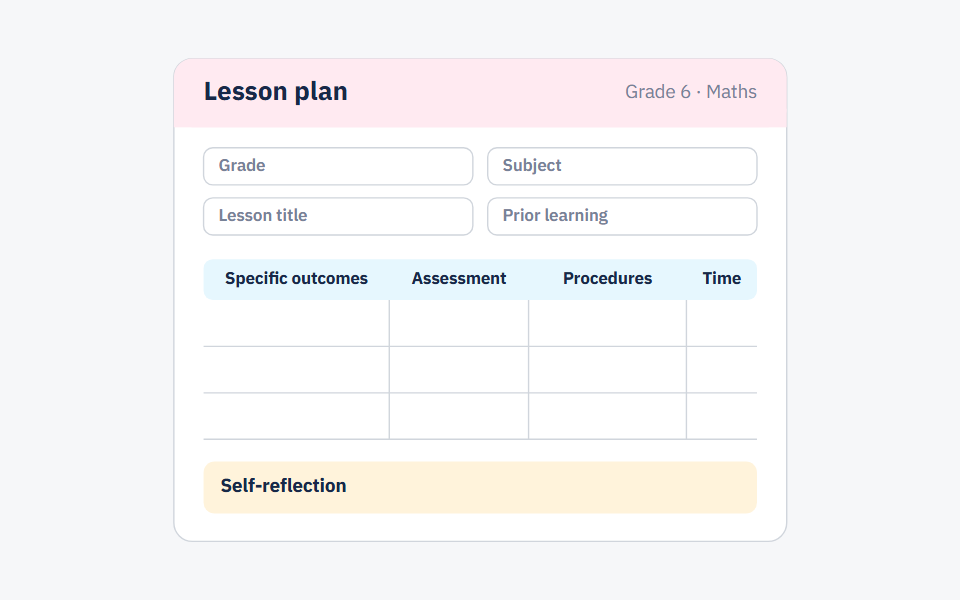
Make the ticket the last procedure in your plan, with its minutes, so it doesn't vanish when the explanation runs long. You'll find how to write procedures and time in our lesson plan template.
Read the cards the same day
Sort them before you plan tomorrow's lesson, as the next section shows.
How to sort the answers and decide how tomorrow starts
After the lesson, sort the cards into three piles by how much understanding each answer shows. A right answer with no step or reason goes in the middle pile. These groups are our own routine, and Wiliam doesn't describe them.
| Group | What it means | What you do tomorrow |
|---|---|---|
| Got it | The answer is right, and so is the step or the explanation | A harder task on the same skill. They skip the re-teach |
| Half got it | The method is right with a slip in a single step, or the answer is right with no explanation | Short practice in pairs on the missing step while you go round the room |
| Not yet | The mistake is in the idea itself, not in the arithmetic or the writing | A small group with you for the first ten minutes, with a new way in, such as a drawing, a concrete example or fraction strips |
For , a card with and the first step is got it, the right method with a slip in the common denominator is half got it, and is not yet. On the heat question, an arrow from cup to hand with a reason is got it, and the same arrow with no reason is half. Cold moving into the cup is not yet. The Arabic grammar question sorts the same way. Students who explain from the case endings have it, students who go by word order alone are halfway, and anyone who swaps the two isn't there yet.
What if not yet is the biggest pile? That usually means the explanation itself didn't land with most of the class. Teach everyone again a different way, and end that lesson with a fresh ticket on the same skill.
Leave the card unmarked. The reason we give comes from Paul Black and Dylan Wiliam, who wrote in Inside the Black Box (Phi Delta Kappan, 1998) that pupils given only marks or grades don't benefit from the feedback, and that assessment becomes formative when the evidence is used to adapt the teaching. The three groups are how we'd use that evidence tomorrow.
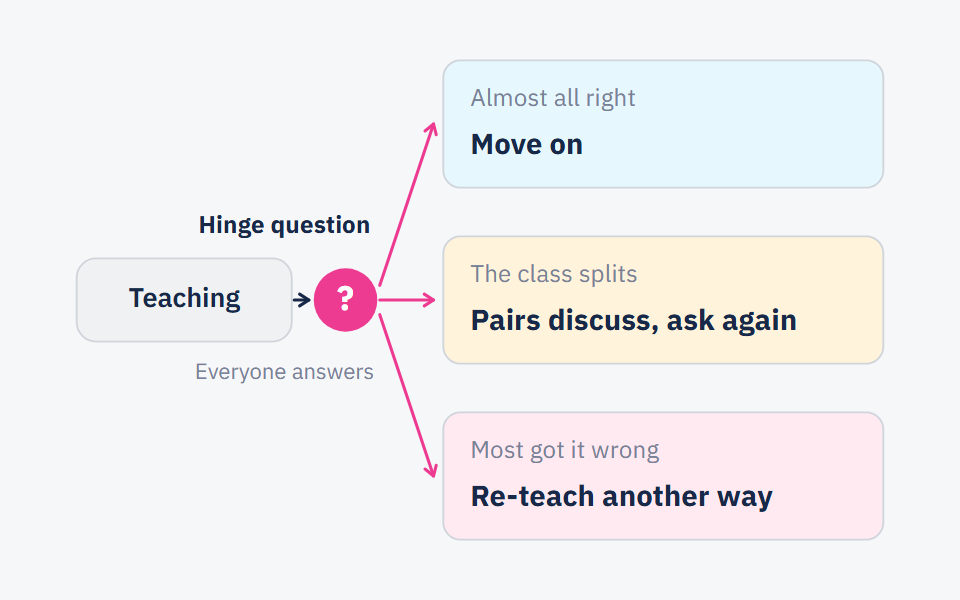
In the same 2005 article, Wiliam gives a version for the middle of a lesson. Each student has four cards marked A, B, C and D to answer a multiple-choice question, and if no one gets it right, he says, the teacher might reteach. There are examples in our post on hinge questions.
Where to write it in your lesson plan, and how to record the groups
Jennifer Gonzalez's How to Write a Lesson Plan on Cult of Pedagogy splits a lesson into opening, content acquisition, application, assessment and closing. If you plan that way, we'd put the ticket in the last two.
Jordan's ministry book wants more. Its booklet on assessment strategies and tools lists five strategies (performance-based, communication, self-review, observation, and pen-and-paper), and the exit ticket isn't one of them. We'd write pen-and-paper as the strategy, since students answer in writing, and a checklist as the tool, with yes or no for each outcome beside each name. If you'd rather describe levels in a few words, use a verbal rating scale.
The ministry's page on teaching and assessment strategies ends its concept-teaching steps with closing assessment (التقويم الختامي), where you check students have acquired the concept. It never names the exit ticket, but the ticket fits that step all the same. The field names we use in the table come from a 2014 blog repost of the plan book and from Oman's electronic lesson-preparation form (March 2024), so check them against your school's copy.
| What you write | Jordan (ministry book) | Oman (ministry form, 2024) | Any other plan |
|---|---|---|---|
| The ticket as a step of the lesson | Procedures (التنفيذ: الإجراءات), the last row, with its minutes under time (الزمن) | آلية التنفيذ (how the lesson runs) | The last activity of the lesson |
| How you gather the evidence | Assessment strategy (التقويم: الإستراتيجية), pen-and-paper (التقويم بالقلم والورقة), or 6 and a name you write yourself | التقويم التكويني or التقويم الختامي (formative or closing assessment) | The assessment column |
| What you record the results on | Assessment tool (التقويم: الأداة), checklist (قائمة الرصد), or verbal rating scale (سلم التقدير اللفظي) if you describe levels | التقويم الختامي (closing assessment) | The same assessment column |
| What tomorrow starts with | Suggestions for improvement (التأمل الذاتي: اقتراحات للتحسين), outcomes achieved (النتاجات المتحققة) | ملاحظات المعلم (teacher's notes), نشاط إثرائي/ علاجي (enrichment or remedial activity) | Notes or next steps |
Record the groups on your checklist against the specific outcome numbers (النتاجات الخاصة) and you can copy the ones reached into the outcomes achieved column of the daily follow-up table. Then write what each group starts with tomorrow under suggestions for improvement.
When an exit ticket won't help, and what to use instead
Ask what students learned today and you'll get a stack of answers that sound alike and won't show who understood. Rewrite the question around a single skill with the five steps above.
Cards you don't read for days change nothing in the next lesson. On days you know you won't get to them, skip collecting them.
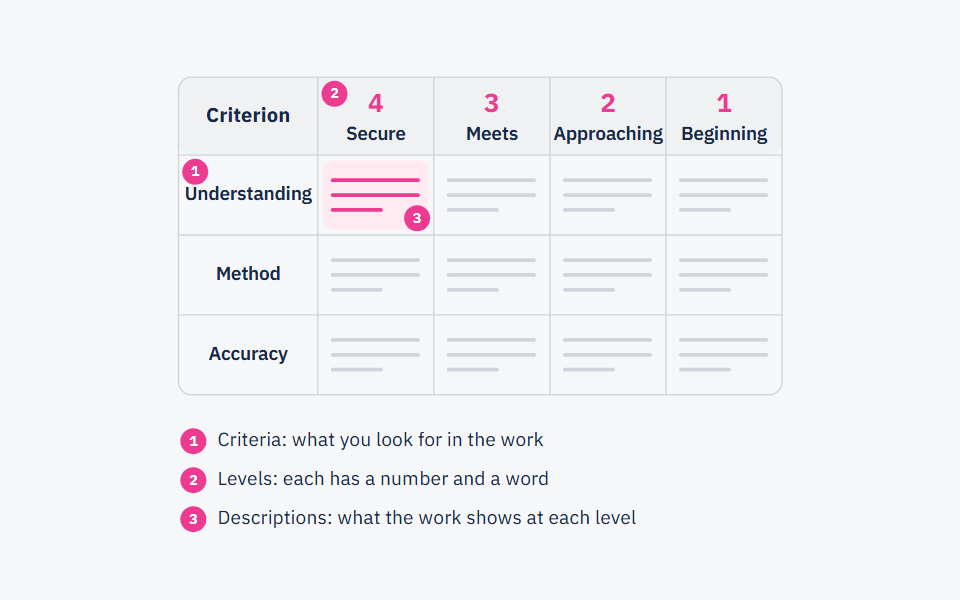
Some skills are too big for a card, like extended writing, an experiment or a project. A rubric suits those, since it describes each level of performance in a few words. You can build one with our rubric guide.
And if students copy each other, the identical cards tell you nothing. Write two versions with different numbers or examples and hand them out to alternate desks.
Frequently asked questions
- What are the steps of the exit ticket strategy?
- Write a question that checks the lesson's goal, give the last few minutes for students to answer alone, read and sort the answers into three groups the same day, and start tomorrow with a step for each group. In Wiliam's version, students hand in index cards before they leave. The five minutes is our suggestion.
- Is an exit slip the same as an exit ticket, and how is it different from a quiz?
- Yes, they're the same. Wiliam says exit pass, Jennifer Gonzalez says exit slip, and exit ticket is a third name for the same card. A quiz is usually marked and recorded. An exit ticket is a question or two, with no mark, that decides how the next lesson starts.
- Where does an exit ticket go in my lesson plan?
- In a US-style plan, under assessment or closing. In Jordan's ministry book, it's the last procedure with its minutes, with pen-and-paper as the strategy, a checklist as the tool, and tomorrow's start under suggestions for improvement. The ministry doesn't list it among its strategies, so that's our reading.
- How many questions should an exit ticket have?
- Usually just the one. Use two at most when you want to separate two steps, say finding the common denominator and then adding. Every extra question makes the cards slower to read and harder to sort.
- Should I grade exit tickets?
- No, in our view. Note each student's group on your checklist instead. Black and Wiliam wrote that pupils given only marks or grades don't benefit from the feedback, and students who know a card will be marked may write what they think you want. Whether you keep a record is your school's call.
Sources
Every fact in this post that we did not produce ourselves comes from one of these sources.
- Classroom Assessment: Minute by Minute, Day by Day (Dylan Wiliam) — ASCD, 2005-11-01
- Inside the Black Box: Raising Standards Through Classroom Assessment (Paul Black, Dylan Wiliam) — Phi Delta Kappan (Kappan Online), 1998-10-01
Written with String's editorial team: we use AI for research and first drafts, and a person checks every fact and every source before anything is published. How we write
Founder and CEO, String
“I grew up in a house of teachers.” I spent a year designing the STEM program for one of the largest school groups in Saudi Arabia, have written curriculum by hand, trained robotics coaches and sold software into schools, then left that job to build String in Amman.