The unit test: a table of specifications, marks and a marking scheme
A table of specifications shares out a test's marks across the unit's objectives in proportion to the time spent teaching each, then across the levels of thinking they were taught at. Here is a completed table for a sample 30-mark unit, the arithmetic step by step, and how its cells become questions and a marking scheme.
Table of specifications — blank, to print
A free printable PDF, no sign-up.
- Definition
- Table of specifications: A two-way table that links a unit's objectives to levels of thinking and sets the marks for the questions in each cell, so the test measures what was actually taught, in the proportion and at the depth it was taught. Also called a test blueprint.
Why the table comes before the questions
Helenrose Fives and Nicole DiDonato-Barnes open “Classroom Test Construction: The Power of a Table of Specifications” (Practical Assessment, Research & Evaluation, February 2013) with a complaint they describe as not uncommon in most classrooms: a student studied what the teacher emphasised in class, then found the test asking about a detail the class spent a moment on. The article names two problems: a test that does not match the content taught, and a test that matches the content but asks for different thinking from the thinking students practised — comparing two things in class, say, then a recall question on the test. The table is the tool the article proposes for both: it links objectives to the level of thinking they were taught at and to how much of the test should assess each one.
The completed table: a sample 30-mark unit
The unit is hypothetical, written for this post: ratio and proportion in Grade 7, five objectives taught over 15 lessons, and a test out of 30. It matches no particular textbook; put your own unit's objectives and lessons in its place.
| Objective | Lessons | Weight | Marks | Recall & understand | Apply | Analyse & justify |
|---|---|---|---|---|---|---|
| 1. Writes a ratio in different forms and simplifies it | 2 | 13.3% | 4 | 2 | 2 | 0 |
| 2. Finds a unit rate and uses it to compare two offers | 3 | 20% | 6 | 1 | 3 | 2 |
| 3. Solves a proportion by cross-multiplying | 3 | 20% | 6 | 1 | 4 | 1 |
| 4. Tells a proportional relationship from one that isn't, in a table or a situation | 2 | 13.3% | 4 | 1 | 1 | 2 |
| 5. Solves proportion word problems: scale, recipes and prices | 5 | 33.3% | 10 | 0 | 6 | 4 |
| Total | 15 | 100% | 30 | 5 | 16 | 9 |
Read the table both ways. The rows say what the test measures: objective 5 took a third of the lessons, so it gets a third of the marks. The columns say how deeply: 9 of the 30 marks go to questions where students analyse or justify, because the lessons asked them to. The weights are rounded to one decimal place, which is why, as printed, they add up to 99.9% rather than 100%.
The steps: from the unit plan to the table
List the unit's objectives and the lessons each one took
From the unit plan and your planning notes, not from memory. Each objective needs a measurable verb, as in writing learning objectives. Fives and DiDonato-Barnes say the objectives and the time come straight from the teacher's lesson plans and reflective notes. The article counts minutes; lessons are enough when they are all the same length.
Work out each objective's weight
Weight = the objective's lessons ÷ total lessons × 100. In the example: , and . The article's rule is plain: if you only spent 10% of the teaching time on an objective, it should only count for 10% of the assessment.
Turn the weight into marks
Marks = weight ÷ 100 × the test's total marks. In the example: , and . If a number doesn't come out whole, round it and check the total is still 30. In the article's own example the teacher rounds some objectives up and others down, and the article notes that not every objective needs to be assessed in every test.
Split each objective's marks across the levels by how it was taught
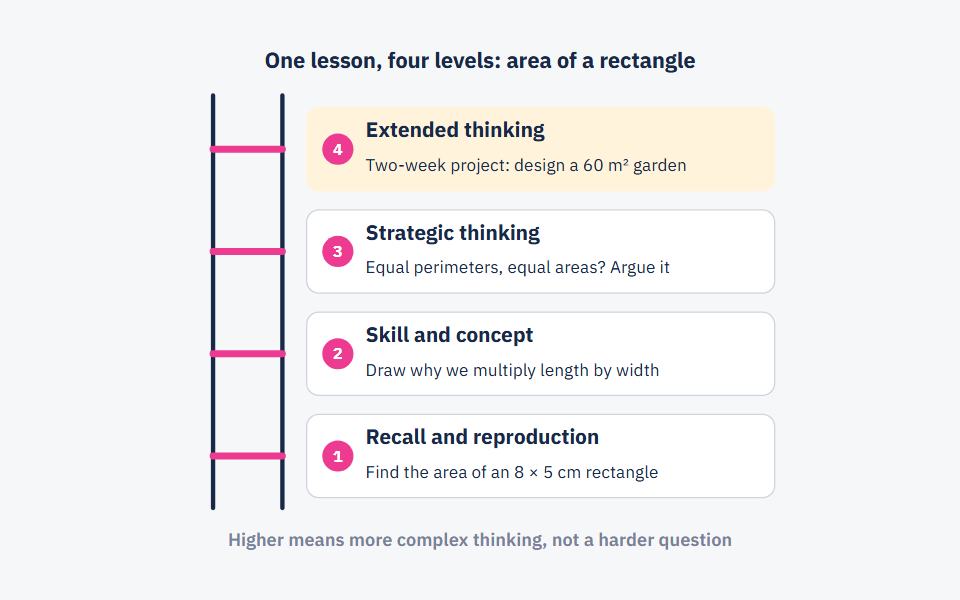
Ask how students practised this objective. If they memorised the definition of a ratio, a definition question belongs on the test. If they compared two offers in class, the test question is a comparison too. The article's point is that the thinking level of the items needs to match the thinking level of instruction. We use three levels here; the article simplifies to two, lower and higher, for practical reasons. For question levels in more detail, see depth of knowledge.
Add up the rows and the columns
Each row adds up to that objective's marks, and the columns add up to the test total. In the example: and . If the recall column takes half the test in a unit whose lessons went on problem solving, the table has caught the mismatch before your students do.
From the table to the test paper
Each cell of the table becomes one question or more. A question's format is a separate decision from its level: the article warns that people often confuse the type of item — multiple choice, essay — with the type of thinking needed to answer it. “Describe four causes of…” looks like a higher-level question, but it is recall if the four causes were taught word for word. Here is the paper map built from the table above:
| Question | Format | Objective | Level | Marks |
|---|---|---|---|---|
| 1 | Multiple choice | 1 | Recall & understand | 1 |
| 2 | Multiple choice | 1 | Recall & understand | 1 |
| 3 | Short answer: simplify two ratios | 1 | Apply | 2 |
| 4 | Multiple choice | 2 | Recall & understand | 1 |
| 5 | Short answer: unit rate in three situations | 2 | Apply | 3 |
| 6 | Compare two offers and justify | 2 | Analyse & justify | 2 |
| 7 | Multiple choice | 3 | Recall & understand | 1 |
| 8 | Solve two proportions | 3 | Apply | 4 |
| 9 | Find and fix the error in worked-out steps | 3 | Analyse & justify | 1 |
| 10 | Multiple choice | 4 | Recall & understand | 1 |
| 11 | Complete a proportional table | 4 | Apply | 1 |
| 12 | Judge a situation: proportional or not, with the reason | 4 | Analyse & justify | 2 |
| 13 | Two word problems | 5 | Apply | 6 |
| 14 | A multi-step scale-drawing problem | 5 | Analyse & justify | 4 |
| Total | 14 questions | 30 |
- Print each question's marks beside it, and an estimated time for the longer ones. That is what the University of Illinois guide “Improving Your Test Questions” recommends for essay items: indicate a point value or weight and an estimated time limit for answering.
- Check the timing: Fives and DiDonato-Barnes see the ideal test as one students can complete in the time allotted, with enough time to think through any writing and to check their answers before handing in. Our advice: do the paper yourself and multiply your time by about three to estimate a student's.
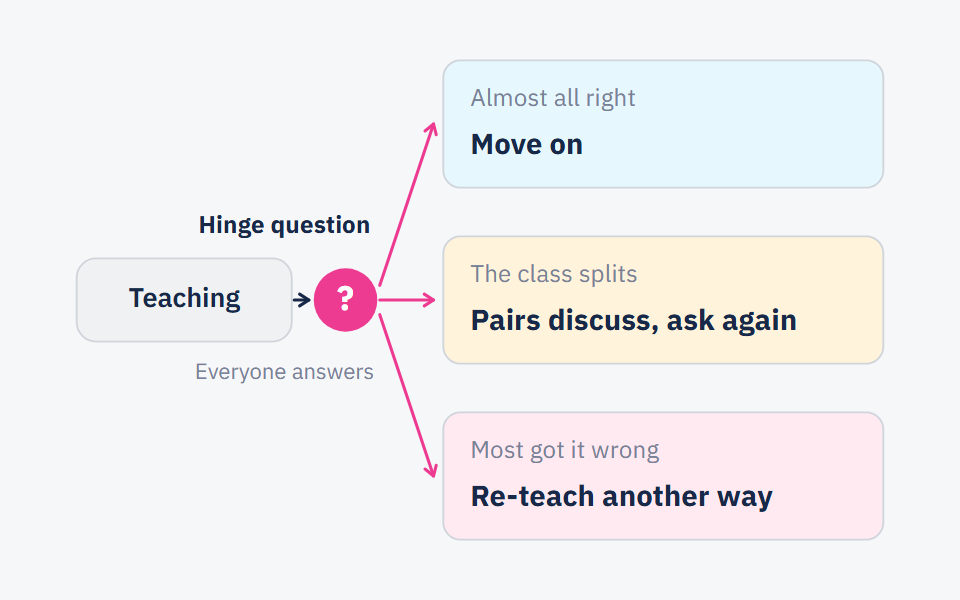
- Spread the right answers across the letters: the same guide recommends distributing the correct response across the option positions in roughly equal proportions. And make each wrong option a misconception some students hold, as in a hinge question.
- Order questions from easier to harder, so students start with what they know and don't stall on the first hard one.
The marking scheme: what it has to say
An answer key gives the result. A marking scheme says how a question's marks are shared across the steps of the working, so two different markers reach the same mark. The Illinois guide calls this “analytical scoring”: each answer is compared to an ideal answer, and points are given for the necessary elements in it. A marking scheme needs five things for each question:
- The question's full marks, as on the paper map.
- The steps that earn marks, and what each is worth.
- The acceptable forms of the answer: a fraction or a decimal, say, or another correct method.
- The expected mistakes and what they earn: the common wrong answers, and how much each is worth.
- The carried-error rule: if a student slips in one step, then works correctly from the wrong result, do the later steps still earn marks? Decide before marking, not halfway through.
A question written for this post to show the structure — not from a textbook, and not from the test above: A recipe uses 3 cups of flour for every 2 cups of milk. How many cups of milk do you need if you use 12 cups of flour? Show your working. (4 marks)
| What the student writes | Mark |
|---|---|
| Writes the ratio of flour to milk: or | 1 |
| Writes the proportion , or notes that the flour has been multiplied by 4 | 1 |
| Works out | 1 |
| Gives the answer with its unit: 8 cups of milk | 1 |
Acceptable forms: any correct method earns full marks — a table that scales both amounts up until the flour reaches 12, for instance, or the milk per cup of flour: .
Expected mistakes: an answer of 18 means the student flipped the ratio and worked out . An answer of 11 means additive thinking: the flour went up by 9 cups, so the milk went up by 9 too. Either earns the first mark if the ratio is written correctly, and not the proportion mark.
Carried error: a student who sets up the proportion correctly and then slips in the arithmetic, writing 9 say, earns the ratio and proportion marks, plus the unit mark if the unit is there: 3 out of 4.
When marking essay-type answers, the Illinois guide advises marking the whole class's answers to one question before moving to the next, marking without looking at students' names, and not letting things the objective doesn't measure — handwriting, spelling, neatness — affect the mark.
After marking, and when the table isn't enough
Keep the table after the test. When you total the class's marks objective by objective, you see which objective students have not mastered, and at what level: did they slip on applying, or on justifying? That is the first thing you need for analysing test results. And if the weak objective is one the next unit builds on, open that unit with a short diagnostic test.
When the table isn't enough: the table makes sure the test covers what was taught, at the depth it was taught, but it says nothing about the quality of the questions themselves. A vague question in the right cell is still vague; read the paper as a student would, or have a colleague sit it before the test, and run it through the exam checklist. If your school requires an official form for the table of specifications, work out your numbers this way and then copy them across; we do not reproduce any official form here.
Frequently asked questions
- What is a table of specifications?
- A table that shares out a test's marks across the unit's objectives in proportion to the time spent teaching each, and across the levels of thinking they were taught at, so the test measures what was actually taught.
- How do I calculate the weights in a test blueprint?
- Divide the objective's lessons by the unit's total lessons and multiply by 100, then divide the weight by 100 and multiply by the test's total marks. An objective that took 3 of 15 lessons, in a 30-mark test: marks.
- Does a unit test have to assess every objective?
- No. Fives and DiDonato-Barnes say not every objective needs to be assessed in every test, and that the table helps you make sure the most relevant objectives are assessed along with a sampling of less prominent ones.
- How many questions should a unit test have?
- The same article calls it a professional decision, based on the number of objectives, your students, the time for testing and the importance of the test. Longer tests allow sounder judgements when the questions are good, but students tire; the practical test is that students can finish in time and still check their answers.
- What is the difference between an answer key and a marking scheme?
- An answer key gives the final result. A marking scheme shares a question's marks across the steps, and lists the acceptable forms of the answer and the expected mistakes with what each earns.
Sources
Every fact in this post that we did not produce ourselves comes from one of these sources.
- Classroom Test Construction: The Power of a Table of Specifications (Helenrose Fives, Nicole DiDonato-Barnes), Practical Assessment, Research & Evaluation vol. 18, no. 3 — Practical Assessment, Research & Evaluation (full text via ERIC, EJ1005136), 2013-02
- Improving Your Test Questions — Center for Innovation in Teaching & Learning, University of Illinois Urbana-Champaign, undated (read 2026-10-22)
Written with String's editorial team: we use AI for research and first drafts, and a person checks every fact and every source before anything is published. How we write
Founder and CEO, String
“I grew up in a house of teachers.” I spent a year designing the STEM program for one of the largest school groups in Saudi Arabia, have written curriculum by hand, trained robotics coaches and sold software into schools, then left that job to build String in Amman.