Feedback on student work: short phrases that still sound like you
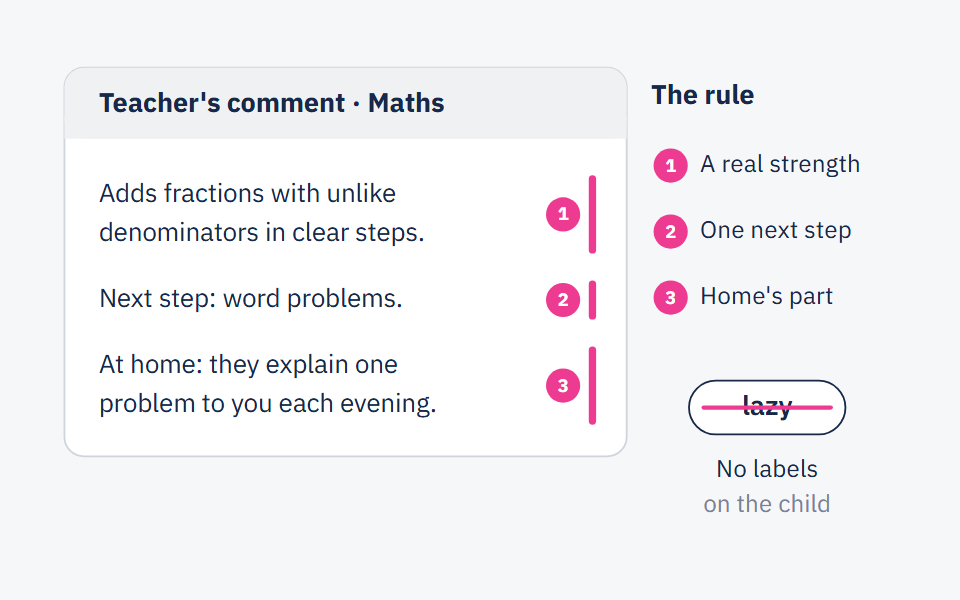
Feedback that moves a student has three parts: what is right, specifically; one next step; and a task to do now, in the book. Here are 30 sentence stems grouped by what the work looks like, and a way to get through 35 books in one sitting with codes and whole-class feedback.
Short feedback phrases — a printable card
A free printable PDF, no sign-up.
- Definition
- Feedback: What a teacher says or writes to a student about their work, telling them where they stand against the lesson's goal and what step will bring them closer to it.
The pattern: what's right, one step, a task now
“Excellent” and “Watch your mistakes” are written in books every day, and neither asks the student to do anything. In “Classroom Assessment: Minute by Minute, Day by Day” (ASCD, November 2005), Dylan Wiliam writes that to be effective, feedback needs to cause thinking — and grades do not do that. In “Seven Keys to Effective Feedback” (ASCD, September 2012), Grant Wiggins goes further: “Good job”, “You did that wrong” and a letter grade are not feedback at all. Effective feedback, for him, is concrete, specific and useful — something you can act on.
The pattern that fixes this is three parts in two or three lines:
- What's right, specifically: name the thing that is right, by question number or line. The Education Endowment Foundation's guidance report “Teacher Feedback to Improve Pupil Learning” (UK, 2021) suggests that praise, if given, works better aimed at a specific achievement in the task than as a general comment such as “great work”.
- One next step: one, not five. The same report says the most useful feedback focuses on the task, the subject, or the student's self-regulation — how they plan and check their work — while feedback on a learner's personal characteristics, or a general, vague remark, is less likely to help.
- A task to do now: one line the student does in the book before moving on. The report asks teachers to give students opportunities to use feedback, and says only then is the feedback loop closed. Wiliam gives an example of a comment that demands work: telling a student that five of their 20 answers are wrong, and asking them to find and fix those five.
| Subject | Instead of | Write |
|---|---|---|
| Maths | “Good, watch your mistakes.” | “Question 4 is right, every step. In question 5 you added the denominators — make them the same before you add. Redo question 5, then solve underneath.” |
| Writing | “Nice writing.” | “Your first sentence pulls the reader in with a question. The second paragraph repeats the first one's idea. Cut two sentences from it and put one example in their place.” |
| Science | “Incomplete.” | “You drew the whole circuit with the right symbols. You didn't say what happens to the bulb when the switch is opened. Write that in one line under the drawing.” |
30 sentence stems, by what the work looks like
These are stems you finish from the student's own work; the brackets are replaced by a question number, a line or a word. Each situation has two stems for what's right, two for the next step, and one for the task now. Pick one from each part, never all five.
1. Everything is right
- What's right: all your answers are right, and your steps in [question] are clear enough for someone else to follow.
- What's right: you used [method] in [question] without being asked to.
- Next step: try a problem where you don't know the method in advance.
- Next step: explain why your method works, not only how you carried it out.
- Now: write a problem that would catch anyone who forgets [step], then solve it.
2. A mistake in understanding or method
- What's right: you started [question] with the right step: [step].
- What's right: you understood what the question asks and put it in your own words on the first line.
- Next step: your understanding stops at [step]. Compare your working with the worked example, line by line.
- Next step: the same mistake appears in [questions], so it's a rule to revisit, not a slip.
- Now: redo [question] under your first attempt, and next to the line that changed, write what you changed.
3. A calculation slip
- What's right: your method is right in every question.
- What's right: you wrote out every step, which makes the mistake easy to find.
- Next step: [number] of these have a calculation error, not a method error. I'm not telling you which.
- Next step: check each answer a second way before moving to the next question.
- Now: find the questions with an error and correct them in a different pen.
4. Unfinished work
- What's right: questions [1 to 3] are right and well set out.
- What's right: you started [part] the right way.
- Next step: you stopped at [question]. Write down what you do know about it, even if you can't solve it yet.
- Next step: break [task] into steps and write only the first one.
- Now: finish [question], then mark the hardest line in it.
5. Right answer, weak explanation
- What's right: the answer is right, which shows you know the method.
- What's right: you used the right term: [term].
- Next step: your sentence says what you did; I want to know why.
- Next step: add one example that supports what you wrote.
- Now: rewrite the sentence starting with the word “because”.
6. Progress after a struggle
- What's right: compare today's [question] with last week's: the mistake in [step] has gone.
- What's right: you corrected [question] on your own after yesterday's comment.
- Next step: you have [skill] secure; the next step is [next skill].
- Next step: try [question] without looking back at the example.
- Now: write one line on what helped you fix it, so you can come back to it next time you're stuck.
35 books in one sitting: codes and whole-class feedback
An individual written comment in every book takes time that a teacher of five classes does not have. The EEF report acknowledges this: some forms of written feedback carry a significant opportunity cost because of their impact on teacher workload. It also says the method of delivery — written or verbal — matters less than following the principles of good feedback. It admits that evidence on specific methods is thin, so its suggestions draw on its expert panel and practitioners' experience. Among the approaches it discusses are codes in the margin and whole-class feedback.
Decide what you are looking for before you open the first book
The lesson's goal, not everything on the page. Handwriting, layout and spelling matter, but they are not today's feedback.
Read five books without writing anything
Note the mistakes you see on a side sheet. If a mistake shows up in two or more of the five, it is probably the class's mistake.
Give each common mistake a code
A letter or a number: A for a wrong common denominator, B for an answer not simplified, C for missing steps. The EEF report gives an example of letter codes a teacher writes in the margin, each standing for a question about one part of good work.
Mark the rest of the books with codes
A tick where it is right, the code in the margin where it is wrong, and a personal line only where no code fits: an advanced student who needs a challenge, or one who stumbled on something nobody else did. On your side sheet, note who needs a word from you in the lesson.
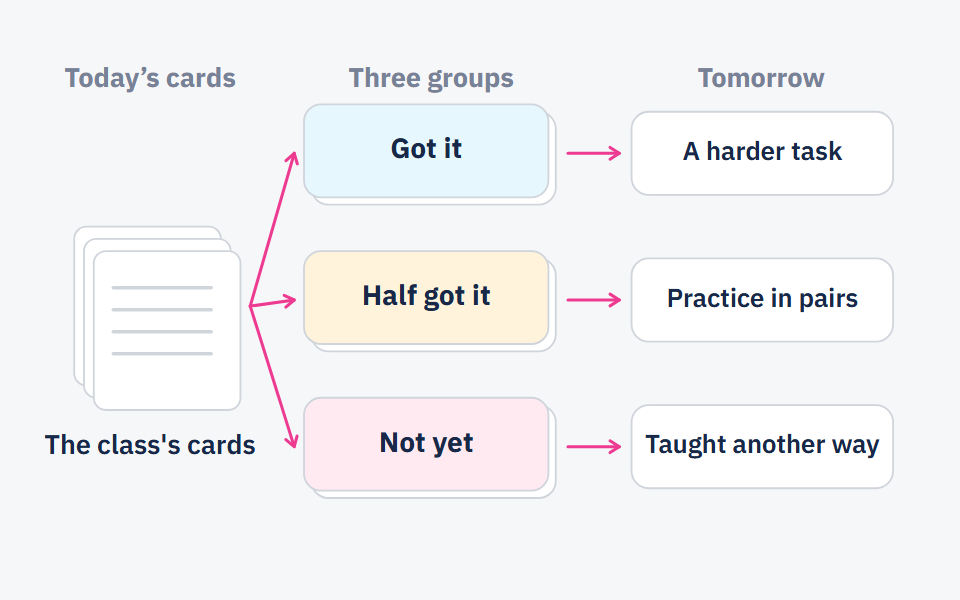
Start the next lesson with whole-class feedback
On the board: what the class got right, the three mistakes with their codes and no names, one correct example, and a task for each code. Each student finds their code in their book and does the task in the first minutes, in place of the usual board task.
Next round, look first: did the student do the task?
Feedback the student does not act on cost you time and taught nothing. Make the first thing you look for in the next book the trace of today's comment.
What the class got right: finding the common denominator when one denominator divides the other.
| Code | The mistake | Your task now |
|---|---|---|
| A | Added the numerators together and the denominators together, as in | Shade and on two fraction strips, then redo the problem with a common denominator. |
| B | A right answer not written in simplest form | Simplify the answers marked with this code, and write the number you divided by. |
| C | An answer with no steps | Rewrite one problem with every step, as in the worked example. |
A correct example from the class, no name: .
How the phrases stay in your voice
- Quote the student's work: a question number, or a word they wrote. A ready-made stem becomes a personal comment when it points at something in this book only.
- Don't write the same sentence in 35 books: if one sentence fits twenty students, it belongs on the board, not in the books — that is what codes and whole-class feedback are for.
- Write the way you talk in class: short sentences, plain language, speaking straight to the student.
- Give the mark after the comment, not with it: in the same article, Wiliam cites a study by Butler (1988) showing that students who receive a grade and a comment ignore the comment. If your school requires a mark, give it after the student has done the task.
String has a tool that writes feedback on a student's writing against your own criteria, which you read and rework in your own voice before it reaches the student.
When feedback is not enough
If more than half the class went wrong at the same step, the problem is in the lesson, not in the books, and the fix is to reteach that step with a new example, not to write thirty comments. The EEF report starts from the same place: high-quality instruction in the first place reduces the work feedback has to do. You will know before you open the books from the exit ticket at the end of the lesson, and from the explain item on a good worksheet.
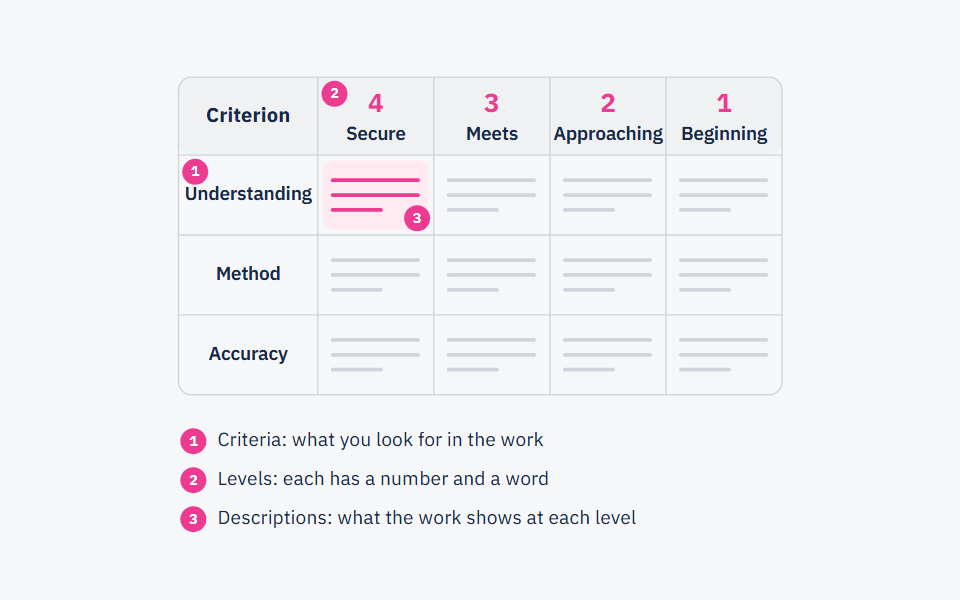
And feedback in the book is not the same as report card comments at the end of term: the first asks the student for work tomorrow; the second describes a whole term to a parent, and has its own post. If you want to agree with your students in advance on what “good work” means, start from a rubric, then write your comments in the language of its levels.
Frequently asked questions
- What are good feedback comments for students?
- Short sentences written on a student's work that name what is right, give one next step, and ask for something to do now. This page has 30 stems grouped by what the work looks like, and a printable card.
- Should I write “Excellent” in a student's book?
- Write it if you like, but don't stop there. “Excellent” on its own tells the student neither what to repeat nor what to do next; add what exactly was excellent, and a next step.
- What is the difference between marking and feedback?
- Marking judges the answer: right or wrong. Feedback tells the student what to do after that judgement. That is why the shortest comment can be the most useful: “Three of these are wrong — find them and fix them.”
- How do I give feedback to a class of 40?
- With codes and whole-class feedback: read five books, name the common mistakes with codes, mark the rest with codes, then start the next lesson with a task for each code. Keep personal lines for the students no code fits.
Sources
Every fact in this post that we did not produce ourselves comes from one of these sources.
- Classroom Assessment: Minute by Minute, Day by Day (Dylan Wiliam), Educational Leadership vol. 63, no. 3 — ASCD, 2005-11-01
- Seven Keys to Effective Feedback (Grant Wiggins), Educational Leadership vol. 70, no. 1 — ASCD, 2012-09-01
- Teacher Feedback to Improve Pupil Learning: Guidance Report — Education Endowment Foundation (EEF), 2021 (PDF undated in print; file metadata June 2021)
Written with String's editorial team: we use AI for research and first drafts, and a person checks every fact and every source before anything is published. How we write
Founder and CEO, String
“I grew up in a house of teachers.” I spent a year designing the STEM program for one of the largest school groups in Saudi Arabia, have written curriculum by hand, trained robotics coaches and sold software into schools, then left that job to build String in Amman.