The diagnostic test before a unit: build it in twenty minutes and read it
A good diagnostic test is short: one question per misconception you expect, and you know in advance what the wrong answer to it looks like. Eight questions are enough before a fractions unit and take twenty minutes to write; then one grid turns the class's answers into four groups for the first week.
Diagnostic test before the fractions unit, with the reading grid
A free printable PDF, no sign-up.
- Definition
- Diagnostic test: A few questions students answer before a unit starts, not counted toward the grade, each written to reveal one specific misconception, so the teacher knows where to begin with each group. Also called a pre-assessment or pre-test.
What separates it from any short quiz is that each question is written from a mistake, not from a lesson. The fractions practice guide from the Institute of Education Sciences (IES), published in September 2010, says teachers should know the mistakes students most often make with fractions and the misconceptions that cause them, and should know “how to design problems that diagnose the source of errors.” That is what the eight questions below do.
The eight questions: each catches one misconception
The questions were written for this post, for the start of a unit on adding and subtracting fractions with unlike denominators; none is copied from a textbook. They suit Grade 6 in Jordan, the GCC and Egypt, and Grade 5 or 6 elsewhere. The last column describes the wrong answer you are looking for, not the right one, so solve the questions yourself before you print them.
| Question | The misconception it catches | What the wrong answer looks like |
|---|---|---|
| 1. Which is larger, or ? Explain in a sentence. | A larger denominator means a larger fraction | Chooses “because 8 is bigger than 3” |
| 2. Which is larger, or ? Explain in a sentence. | Compares the fractions by numerator alone | Chooses “because 3 is bigger than 2” |
| 3. Mark on a number line from 0 to 4. | Reads numerator and denominator as two separate whole numbers | Puts it between 3 and 4 |
| 4. Complete: | Changes the denominator but not the numerator | Writes |
| 5. | Adds the numerators together and the denominators together | Writes |
| 6. | Takes the larger denominator without converting the other fraction | Writes |
| 7. | Gives the whole number the denominator of the fraction beside it | Writes , having read 3 as |
| 8. What is of 18? | Does not know what numerator and denominator do in “a fraction of a quantity” | Writes 6 (found one third and stopped) or 27 (divided by the numerator, multiplied by the denominator) |
The first four questions are about what the unit stands on: the meaning and size of a fraction, and equivalence. The last four come from the unit itself. Asking about something you have not taught yet can seem odd, but these are the questions that tell you who learned it already. Dylan Wiliam calls this kind “range-finding items” (Educational Leadership, November 2005) and says they help a teacher judge where to begin instruction.
The steps: from a skills list to the sheet in twenty minutes
Write what the unit stands on, in four lines (5 minutes)
Open the unit's first lesson and ask: what must a student know before this? For adding and subtracting fractions: the meaning and size of a fraction, comparing, equivalence, and common multiples. Write no more than four skills; a diagnostic test is not a review of the whole year.
Name one misconception per question (5 minutes)
Do not start from the question; start from the mistake. The IES guide lists common fraction errors, among them: adding numerators and denominators separately, putting the larger denominator in the answer without converting, changing a denominator without the numerator, placing between 3 and 4 on a number line, and believing is larger than . Choose the ones you see in your class.
Write the question so its wrong answer is unmistakable (7 minutes)
A good question here is one whose wrong answer you can predict before you ask it. In question 6, a student who takes the larger denominator without converting gives one answer you already know: . If you cannot fill in the third column, the question does not diagnose anything yet.
Add “explain in a sentence” where one wrong answer has two causes (2 minutes)
In question 2, a student may choose because they compare numerators, or because they think a larger denominator means a larger fraction. Only the sentence tells you which idea they hold.
Time it for the student, and say it is not graded (1 minute)
Eight short questions take about a quarter of an hour. Tell students their answers will not count and that you want to see how they think: a student afraid of the grade may leave a question blank, and a blank tells you nothing.
Why the mistake and not the lesson? Because these mistakes are not random. Barak Rosenshine writes in “Principles of Instruction” (American Educator, Spring 2012) that such errors are attempts by students to be logical in an area where their background knowledge is weak. A student who writes is applying whole-number addition as they learned it, which is exactly what makes the mistake predictable.
Reading the results: one grid that turns answers into four groups
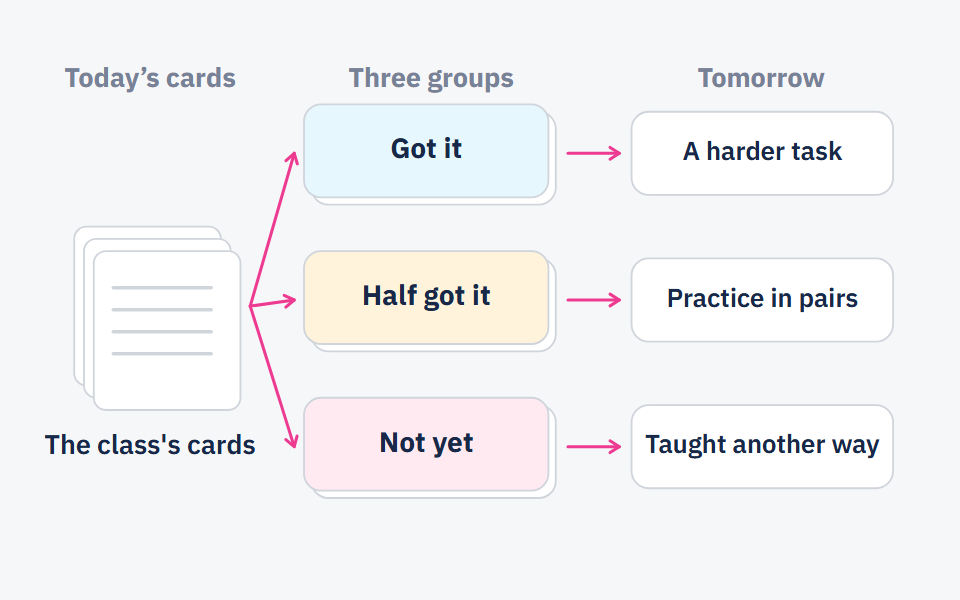
Do not mark the papers out of ten. Draw a grid: a row for each student, a column for each question, and a tick or a cross in each cell. Then read each row from the start: the first block of questions with a mistake decides the student's group. A student who is wrong about what a fraction means will not gain from a lesson on adding yet, whatever their answers to the last questions.
| Group | Who goes in it | What you do in week one |
|---|---|---|
| A — Meaning | Wrong on at least one of questions 1 to 3 | Ten minutes a day with you on fraction strips and the number line, before any rule |
| B — Equivalence | Questions 1 to 3 right, question 4 wrong | Short practice on equivalent fractions with strips, then by multiplying numerator and denominator together |
| C — Ready | Questions 1 to 4 right, a mistake in 5 to 8 | Starts the unit as you planned it; their mistakes on the last questions are what you will teach |
| D — Ahead | All eight right | Deeper tasks on the same topic instead of repeating what they know |
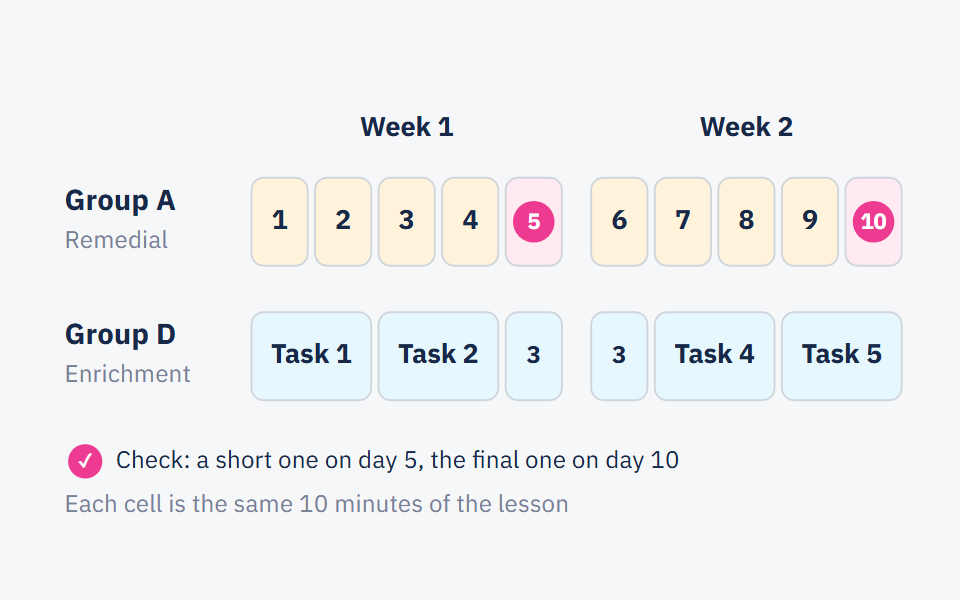
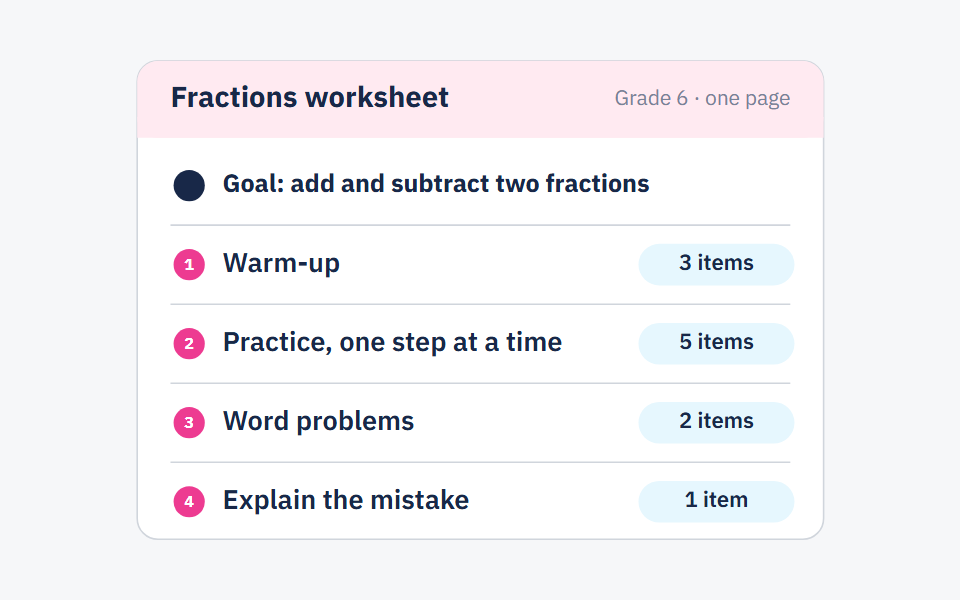
Groups A and B are where the remedial plan comes in: one page per group, with two weeks of ten-minute activities, and an enrichment track for group D on the same page. Group C works on the fractions worksheet with the rest of the class once you reach adding and subtracting.
After week one: how you know a group has changed
A group describes what a student knows today; it is not a name for the student. At the end of the week, give each group one question like the one it got wrong, with new numbers: “Which is larger, or ?” for group A, say, and “Complete: ” for group B. Whoever gets it right moves up a group. The same sorting, with one question at the end of a lesson, is explained in the exit-ticket guide.
When a diagnostic test does not help
- When it is marked out of ten: you learn that a student scored 5, not why. The grid tells you which mistake; the score does not.
- When it runs long: twenty questions tire a student before they reach what you want to know. One question per misconception is enough.
- When nothing changes afterwards: if the unit starts with the same explanation for everyone, the test cost a quarter of a lesson for nothing. Decide what you will do with each group before you give it.
- When multiple-choice options are random: if the wrong options are arbitrary numbers, a student's choice reveals no particular idea. Make every wrong option the result of a misconception you know.
Frequently asked questions
- What is the difference between a diagnostic test and a pre-test?
- The names are often used for the same thing: questions before a unit. A pre-test may only measure what students know; a diagnostic test is written to reveal why they get things wrong, so every question has a misconception it is looking for.
- Where can I find a Grade 6 maths diagnostic test example?
- At the top of this page: the eight questions and the blank grid on one printable page, no sign-up. For another unit, make one in String for free.
- Should a diagnostic test be graded?
- No. A grade can make students guess or leave questions blank, and you need their mistake as it is. Record the kind of mistake in the grid, not a score.
- How many questions does a diagnostic test need?
- One for each misconception you want to find, with “explain in a sentence” when a mistake can come from two ideas. Eight questions are enough before a fractions unit, and students answer them in about a quarter of an hour.
Sources
Every fact in this post that we did not produce ourselves comes from one of these sources.
- Developing Effective Fractions Instruction for Kindergarten Through 8th Grade (Siegler et al.), IES Practice Guide NCEE 2010-4039 — Institute of Education Sciences, U.S. Department of Education (via ERIC), 2010-09
- Classroom Assessment: Minute by Minute, Day by Day (Dylan Wiliam), Educational Leadership vol. 63, no. 3 — ASCD, 2005-11-01
- Principles of Instruction: Research-Based Strategies That All Teachers Should Know (Barak Rosenshine) — American Educator, 2012 (Spring issue)
Written with String's editorial team: we use AI for research and first drafts, and a person checks every fact and every source before anything is published. How we write
Grade 6 mathematics · Jordan
Teaches Grade 6 mathematics in Jordan and writes here about teaching maths from inside the classroom.