Remedial and enrichment plans built from diagnostic results
A remedial plan that gets used is one page per group, not per student: one misconception the diagnostic test revealed, a goal, ten short activities over two weeks, and a check at the end that decides who leaves it. The same page holds an enrichment track for students who are ahead, and a full Grade 6 fractions example comes with it.
Remedial and enrichment plan — template for one group
A free printable PDF, no sign-up.
- Definition
- Remedial plan: A short plan a teacher writes for a group of students who share one gap, saying what they will learn, how, over how many lessons, and which question will show they have closed the gap. Also called an intervention plan; its counterpart is the enrichment plan for students already past the goal.
The template: one page per group
The plan starts from the grid of the diagnostic test before the unit: each group in the grid has one misconception, so it gets one page. The example below was written for this post, for group A in the diagnostic for a Grade 6 fractions unit: the students who went wrong on what a fraction means and how big it is. None of its problems is copied from a textbook.
Students: four (sample data), each wrong on at least one of questions 1 to 3 in the diagnostic.
Misconception: reads numerator and denominator as two separate whole numbers, so thinks is larger than , or puts between 3 and 4 on a number line.
Goal: compares two fractions, places a fraction on a number line, and explains the answer in a sentence.
Time: ten minutes at the start of each lesson, for ten lessons, while the rest of the class works on an independent task.
| Day | Activity — 10 minutes |
|---|---|
| 1 | Students fold equal paper strips into halves, thirds, quarters and eighths, and write the name of each part on it. |
| 2 | They lay the eighths strip under the thirds strip, compare and , then finish the sentence: “The more parts there are…” |
| 3 | A number line from 0 to 1: how many marks do they draw to split it into four equal parts? Then they label the quarters. |
| 4 | A line from 0 to 4: they mark 3 and 4, then mark , and explain why it does not sit between 3 and 4. |
| 5 | Short check: two questions like questions 1 and 3 of the diagnostic, with new numbers. Anyone who gets one wrong repeats day 2 or day 4. |
| 6 | Two fractions with the same numerator, and , then two with the same denominator, and . Strips first, then a sentence. |
| 7 | More than one half, less, or equal? , and . They place each fraction on a line from 0 to 1 before answering. |
| 8 | They compare each of and with one half, without a common denominator, then say which fraction is larger and why. |
| 9 | They order four fractions on one number line from 0 to 1: , , and . |
| 10 | Final check: five questions (below). |
Final check: Which is larger, or ? Which is larger, or ? Which is larger, or ? Mark on a number line from 0 to 3. Mark on a number line from 0 to 2. Each comparison asks for a sentence explaining the answer.
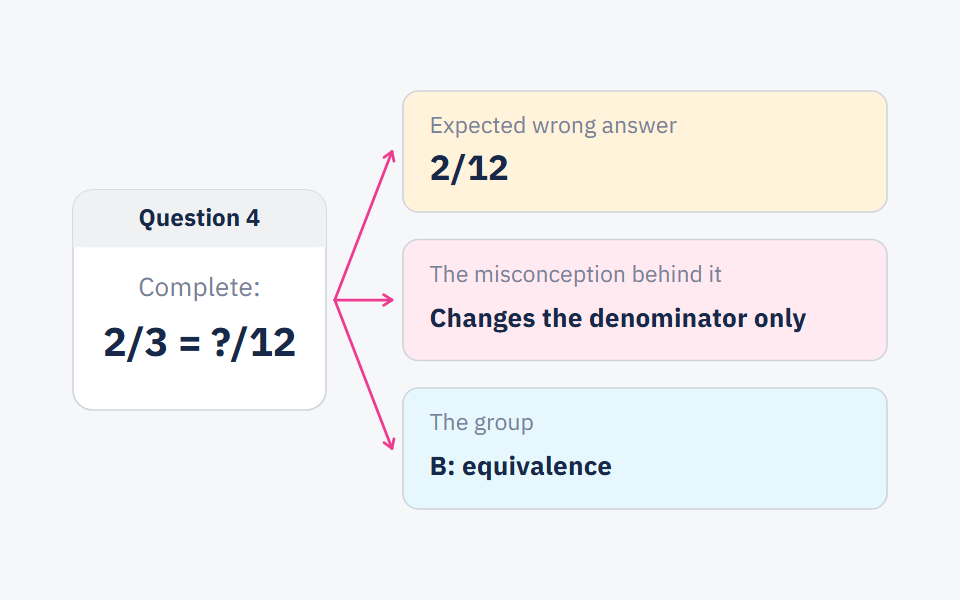
Exit rule: four correct answers out of five, with the explanation. Students who reach it answer the equivalence question ; if they get it right they join group C, otherwise group B's plan. Students who do not reach it repeat one week, with only the activities they got wrong.
How to fill in each field
The group: from the grid, not from an impression
Write the names the grid placed in this group, not the students you think of as “weak” in general. A student who went wrong only on equivalence does not need two weeks on what a fraction means.
The misconception: one, in the words the student thinks in
The fractions practice guide from the Institute of Education Sciences (IES), published in September 2010, describes a common mistake as students applying what they know about whole numbers to fractions, seeing numerator and denominator as separate whole numbers. Written that way, the misconception tells you what the activities have to change.
The activities: start with what can be seen, then move to the number line
The same guide recommends number lines as a central tool for representing fractions, and having students compare fractions and place them on it. For a student who puts between 3 and 4, it suggests locating 3 and 4 on a 0-to-4 line first, then placing between 0 and 1, and discussing why each number goes where it does. That is day 4.
Ten minutes a student succeeds in
Barak Rosenshine writes in “Principles of Instruction” (American Educator, Spring 2012) that the optimal success rate in practice appears to be about 80 percent. If a student gets most of the ten minutes wrong, the activity is too hard and the student is practising the mistake. Make each activity one small step after the one before it.
The check: the question they got wrong, with new numbers
Do not test anything the plan did not work on. Take the diagnostic questions that put the student in the group, change only the numbers, and set the exit rule before you begin.
After the plan: where each student goes
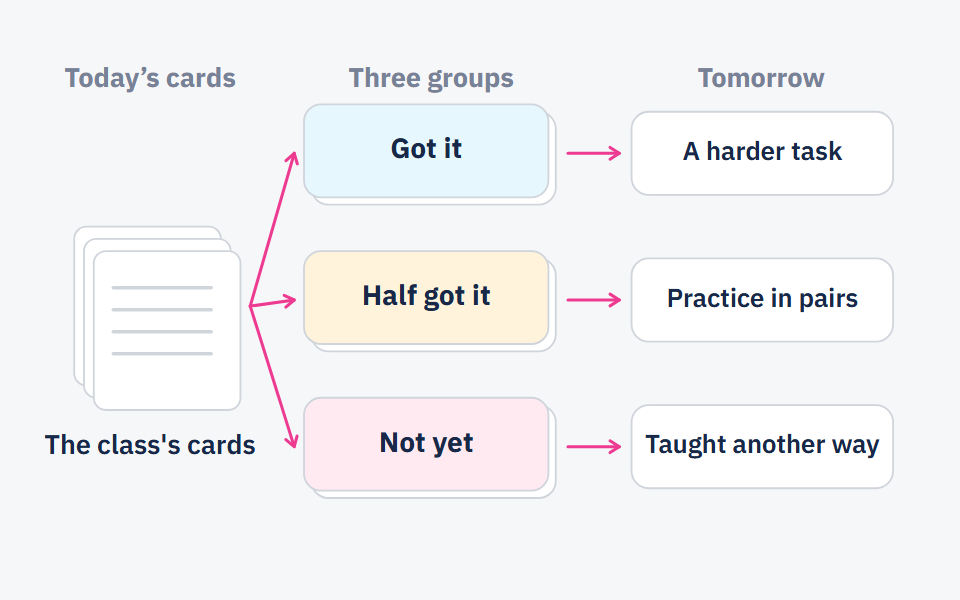
Rosenshine describes “mastery learning”: students master one set of lessons before moving to the next, with help from the teacher or other students until they do. So the plan ends with the check, not with a date, and says in advance what happens to those who pass and those who do not.
The enrichment track, on the same page
In the same ten minutes, group D, the students who got all eight diagnostic questions right, works on deeper tasks on the same topic, not on more problems of the same kind. Each task takes two days, and at the end of the two weeks each student presents one task to the class. The questions are open, so there is no key for them on this page.
| Days | Task |
|---|---|
| 1 and 2 | Write three fractions between and , and explain how you know they lie between them. |
| 3 and 4 | Write as the sum of two fractions with numerator 1 and different denominators. Is there a second way? Explain. |
| 5 and 6 | Which is closer to 1, or ? Explain without finding a common denominator. |
| 7 and 8 | Write a question that catches students who add the numerators together and the denominators together, and the wrong answer you expect. |
| 9 and 10 | Write a word problem with two fractions with different denominators, swap it with a classmate, then check their working. |
In “Classroom Assessment: Minute by Minute, Day by Day” (ASCD, November 2005), Dylan Wiliam suggests sometimes pairing students who understand a concept with those who do not, for peer tutoring. If you want to, make a student from group D a partner in the strip-folding on day 1, then send them back to their own track.
Three mistakes that make a remedial plan paperwork
- A plan for every student: as many pages as there are students, nobody reads them, and no lesson has time for them. One page per group is enough: the diagnostic grid gives you four groups, and only two of them need a remedial plan.
- The same explanation, more slowly: a student who did not understand the rule the first time is unlikely to understand it when you repeat it. Start from a representation they have not seen yet: the strip, then the number line.
- A plan with no end: without a check and an exit rule, a student can stay in “the remedial group” all term. The two weeks and the check are what keep the group temporary.
If your school asks for an official form
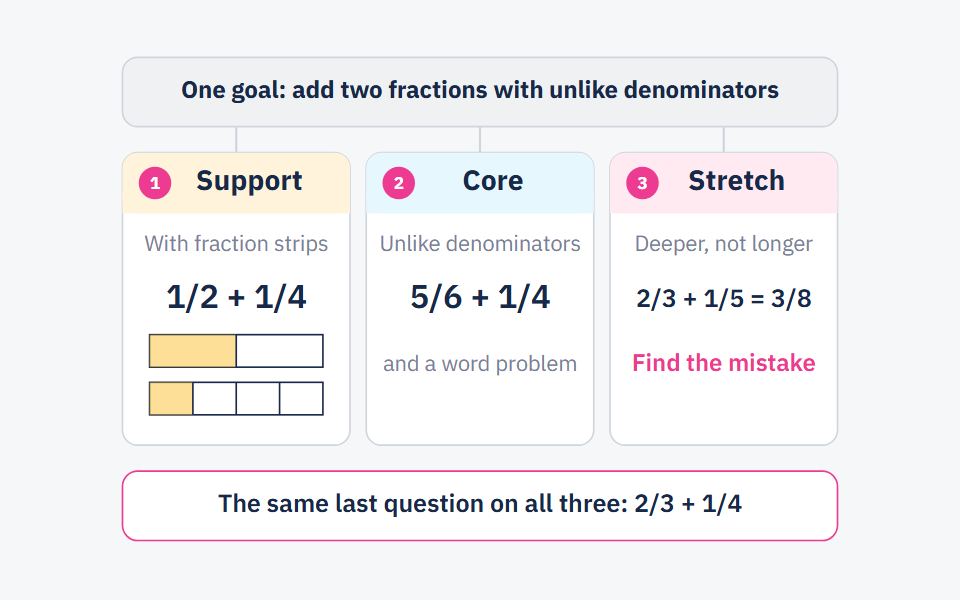
Your school or supervisor may require a specific remedial or enrichment plan form, with fields that differ from country to country. This template does not replace it, and we do not reproduce any official form here. But if the form you are given has a field such as “areas of weakness”, that is the misconception; “learning outcomes” are the goal, “procedures” are the activities, and the “assessment tool” is the check. Write your plan this way first, then copy it into the form you are asked for. For group C, which needs no plan, a worksheet at three levels is enough inside the lesson.
Frequently asked questions
- What is the difference between a remedial plan and an enrichment plan?
- A remedial plan is for students who have not yet reached what the goal stands on; an enrichment plan is for those already past it. Both are built from the same results, and they can share one page because they happen in the same minutes.
- Is a remedial plan only for low-achieving students?
- It is for students who missed one specific step, not for students labelled weak. A student can be good at calculating and still be wrong about what a fraction means. Do not write “weak” on the plan or say it in front of the student.
- Where can I get a free math intervention plan template?
- At the top of this page: the blank template on one printable page, no sign-up, and the full example above for a fractions group. For another misconception, write one in String for free.
- When does a remedial plan end?
- When the student reaches the exit rule you set before starting, not when the two weeks are over. Students who do not reach it repeat only the activities they got wrong, for one more week.
Sources
Every fact in this post that we did not produce ourselves comes from one of these sources.
- Principles of Instruction: Research-Based Strategies That All Teachers Should Know (Barak Rosenshine) — American Educator, 2012 (Spring issue)
- Developing Effective Fractions Instruction for Kindergarten Through 8th Grade (Siegler et al.), IES Practice Guide NCEE 2010-4039 — Institute of Education Sciences, U.S. Department of Education (via ERIC), 2010-09
- Classroom Assessment: Minute by Minute, Day by Day (Dylan Wiliam), Educational Leadership vol. 63, no. 3 — ASCD, 2005-11-01
Written with String's editorial team: we use AI for research and first drafts, and a person checks every fact and every source before anything is published. How we write
Grade 6 mathematics · Jordan
Teaches Grade 6 mathematics in Jordan and writes here about teaching maths from inside the classroom.