Stories
A story a child gets to the end of
Pick a lesson and it comes back as a story: large-print pages, written in Arabic and English at once, read on screen and printed the way a book opens.
By the numbers
16
pages, the longest a book gets
9
paper stocks a book can be set on
8
beats every story's arc walks
A4
landscape sheet per facing spread
How a book gets made
Four steps, and not one of them starts you on a blank page.
- 1
Pick the lesson
From the curriculum tree, or with one line you type about the topic. That alone is how the book learns what it is about.
- 2
Ask for pages in a sentence
«Write four pages», «make it simpler for younger readers», «open with a scene-setting page», «close the story with a final page». And it walks a story's arc — a child, then a want and an obstacle, then the turn, then the close — rather than a lesson plan wearing a story's clothes.
- 3
Keep the ones you like
Every page arrives as a proposal and joins the book only when you say so. After that, one page can be rewritten on its own, dragged somewhere else, duplicated or deleted.
- 4
Read it, or print it
Open the book exactly as your student opens it — the same screen, not a preview of it — or print it: two facing pages on every landscape A4 sheet.
What gets a child to the last page
Two lines in large print, not a paragraph
A children's-book page is two or three lines and no more. A young reader turns the page because they finished it, not because they gave up on it — and that is the whole difference between a book that gets finished and one that gets abandoned halfway.
Every page written in both languages
Every page carries its Arabic and its English, written together rather than one translated out of the other afterwards. One book reads in two classrooms.
A book that opens the right way
Pages turn right to left in Arabic and left to right in English, and the arrow keys follow the reading direction rather than the screen. A book that turns backwards in one of its two languages is not a book in that language.
It prints the way it opens
One landscape A4 sheet per facing spread, printed in the book's own paper colour rather than white. A single page on a portrait sheet is not the same object: the picture and its words stop facing each other, and that facing is the whole grammar of the form.
What arrives written, and what is not drawn yet
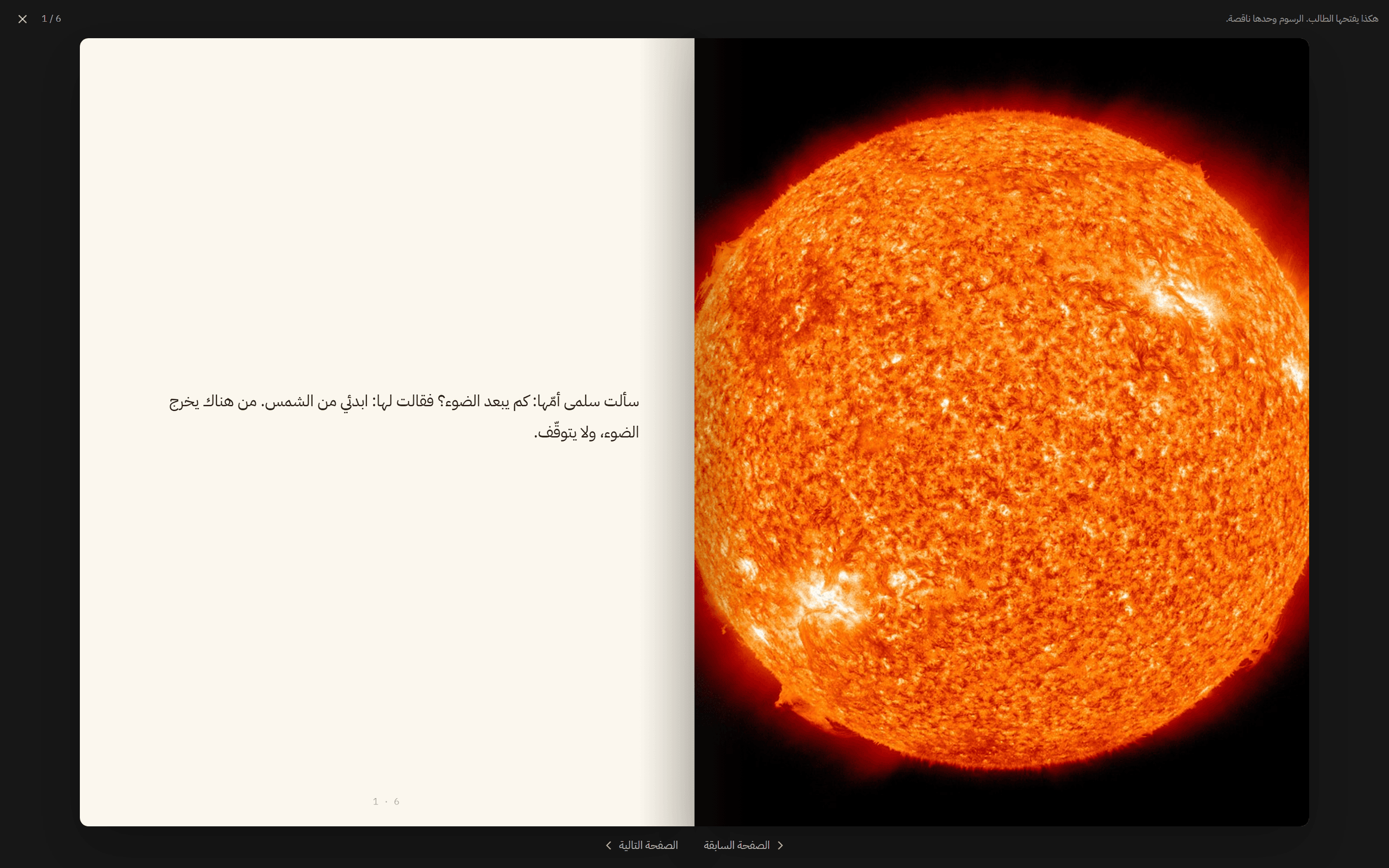
The words arrive fully written in Arabic and English, and every page carries a description of the picture it wants. Drawing that picture is not something String generates today: the book above was built on real photographs, and a new book reaches you with its pages described rather than drawn. The product says so on its own screen, as you read at the top of this page, and we repeat it here rather than let you find it at the first print.
What is in the story editor
No rails and no panels: a book, a conversation about it, and three ways to hand it over.
What you do to a single page
- Rewrite it in clearer words
- Make its words shorter
- Change its picture description
- Add a new page after it
- Drag it somewhere else in the book
- Duplicate it, or delete it
- Add a blank page, and ask for what goes on it
The book's paper and ink — nine of them
- Classic — warm stock, black ink
- Bedtime — deep night, pale ink
- Crayon — bright white and plain colour, for the youngest
- Watercolour — quiet washes and soft edges
- Kraft — rough brown board, like a handmade notebook
- Folk — warm ochre and deep red, for old tales
- Mono — hard contrast, no colour, for a reader who is easily distracted
- Meadow — quiet green and daylight, for nature and science
- Sand — desert warmth and brown ink, for stories close to home
How the book gets there
- Read it on screen the way your student reads it
- Share it with your classes; they open it whenever they like, in class or at home
- Share it by a link that works for anyone, with no account
- Print it two pages to a landscape A4 sheet
- Or save it as a file from that same print window
Common questions
Read next
String — Interactive Lessons
You describe the lesson. Your student plays it
Not a sheet to print and not a video to watch. It is an activity your student walks through one screen at a time, and every answer is marked the moment it is given.
Presentations
You never start from a blank slide again
Write the topic in one line and a deck comes back ordered end to end: an opening, then the idea and its examples, then a recap at the close.
Make one for your class
Pick the lesson, ask for four pages, and read what comes back.