The hinge question: one mid-lesson question that decides what comes next
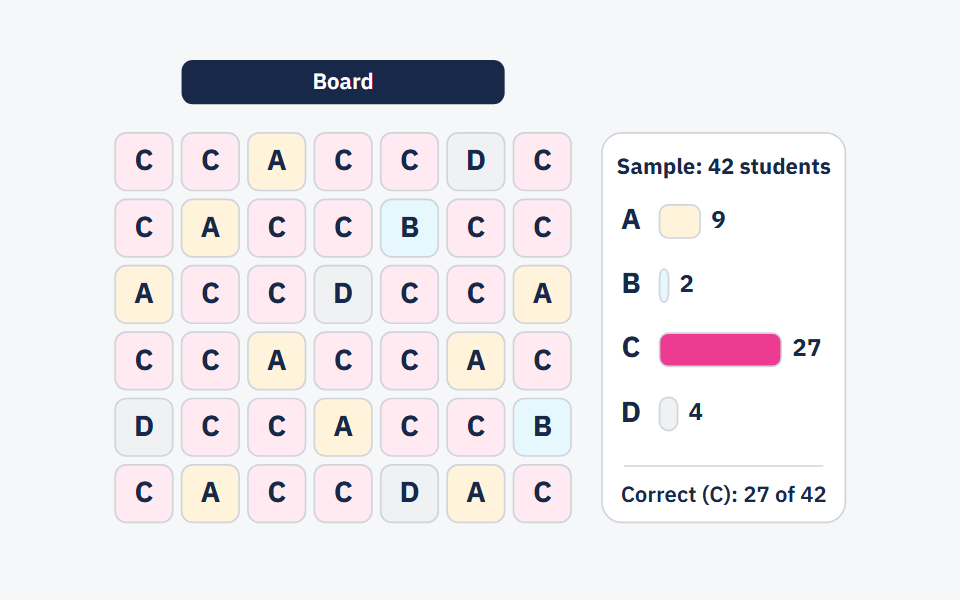
A hinge question is one question you ask before moving to the next part of the lesson; every student answers at the same moment, and each wrong option stands for a misconception you know in advance. Within two minutes the answers tell you whether to move on, re-teach or open a discussion.
Hinge question planner
A free printable PDF, no sign-up.
- Definition
- Hinge question: A multiple-choice question a teacher asks at the point in a lesson that the rest depends on. Every student answers at the same moment, each wrong option points to a specific misconception, and the answers decide what the teacher does next.
Why “hinge”: the lesson can turn more than one way
The name comes from Dylan Wiliam. In “Classroom Assessment: Minute by Minute, Day by Day” (ASCD, November 2005) he writes that teachers can use questions to check on student understanding before continuing the lesson, and calls this a “hinge point” because the lesson can go in different directions depending on student responses.
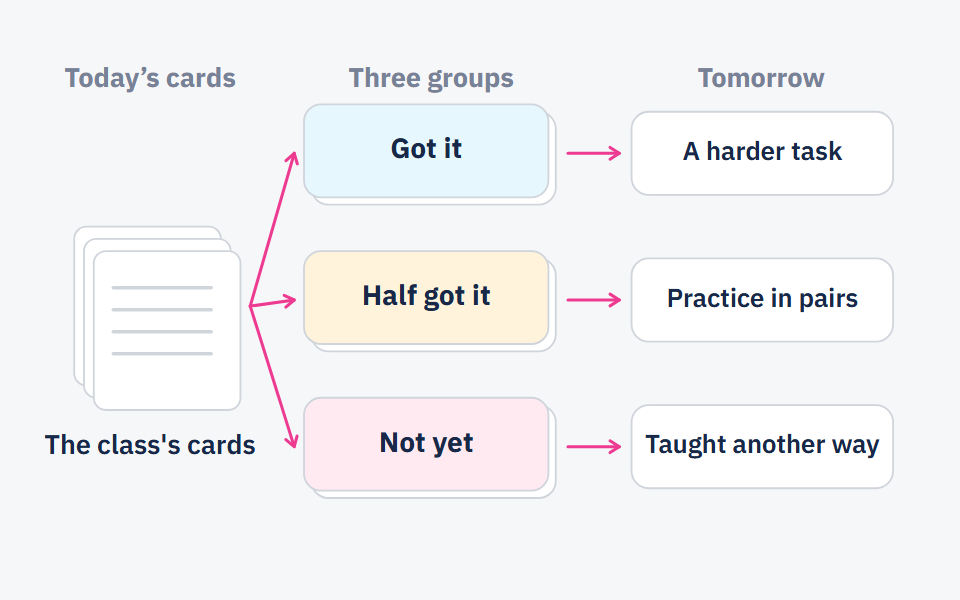
Wiliam suggests giving each student a set of four cards labelled A, B, C and D and asking the question in multiple-choice format. He then names three decisions: if all students answer correctly, the teacher can move on; if no one does, the teacher might reteach the concept; if they split, the teacher can use that to engineer a whole-class discussion or to match students up for peer teaching.
He also writes that teachers carefully craft hinge-point questions to create moments in which the direction of instruction depends on student responses. The word that matters is “carefully”: a hinge question is not improvised in class, because its whole value lies in its wrong options.
A full example: one question, four answers, four messages
In a lesson on adding fractions with unlike denominators, after the worked example and before practice, the teacher writes one question on the board and asks every student to show a letter:
What is $1/4 + 1/6$?
| Option | What it means when a student picks it |
|---|---|
| A) | Added the numerators together and the denominators together. The meaning of a fraction has not settled yet: top and bottom are treated as two separate numbers. |
| B) | Correct: and , so the sum is . |
| C) | Found the common denominator but left the numerators unchanged. Knows the first step, not why the numerator changes with the denominator. |
| D) | Multiplied instead of adding: . The mix-up is between operations, not in the arithmetic. |
The decision, written into the plan before the lesson: if many show A, go back to fraction strips before any rule. If many show C, work one more example aloud, saying why the numerator is multiplied by the same number as the denominator. If many show D, put an addition and a multiplication side by side. If almost everyone is right, start practice.
How to write options that diagnose: six steps
Start from the misconceptions, not the right answer
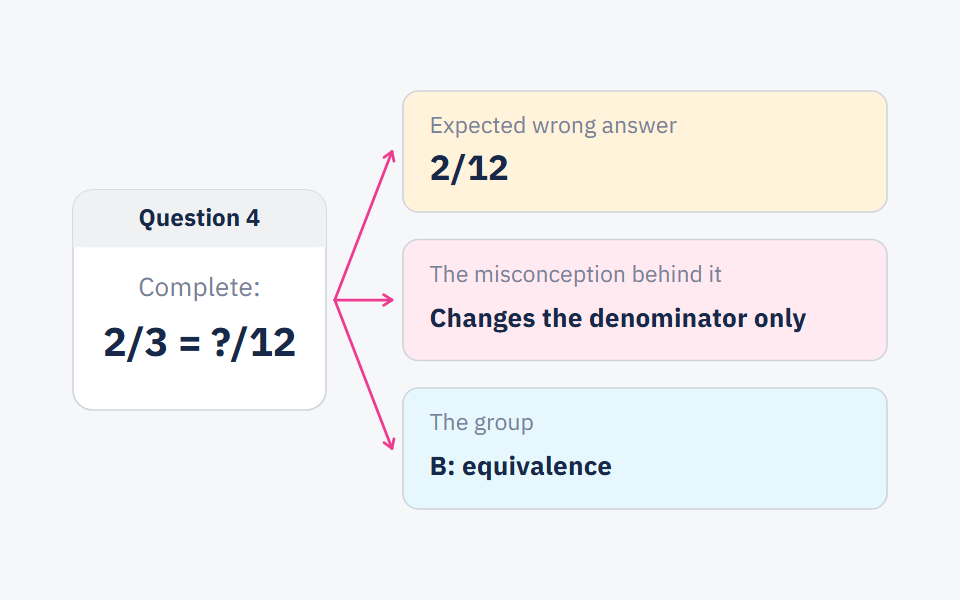
Before writing the question, list the mistakes you expect on this particular idea. They come from three places: past exit tickets, the diagnostic test before the unit, and your own years of teaching it.
Work out each wrong option from its misconception
is not a random number; it is exactly what a student who adds tops and bottoms writes. Run each misconception on the question the way the student would, and make the result an option.
Cut the free option
The University of Illinois guide “Improving Your Test Questions” advises making all alternatives plausible and attractive to the less knowledgeable or skillful student. An option nobody picks tells you nothing and raises the odds of a lucky guess. Three honest options beat four with a filler.
Give it one right answer nobody can argue with
The same guide asks for only one correct or best response, and for using “none of the above” and “all of the above” sparingly. In a hinge question you want each card held up to tell you what its owner thinks, and “all of the above” cannot.
Keep it answerable in under a minute
One step of thinking, and a short text you read aloud twice. If students need paper to work it out, it is a practice question, not a hinge question.
Write your decision for each option before the lesson
One line per option: what you will do if many choose it. A question whose result changes nothing in the lesson cost two minutes for nothing.
12 examples in four subjects, and what each option reveals
These questions were written for this post, not taken from a textbook. The correct answer is given because the point is to teach the method; change the numbers and texts to fit your own lesson. Some questions have only three options, because a fourth would have been filler.
| Subject | Question and options | Correct | What each wrong option reveals |
|---|---|---|---|
| Maths | A) B) C) D) | A | B: subtracts the smaller from the larger and ignores both signs. C: dropped the sign of the first number and worked out . D: carried “two negatives make a positive” over from multiplication to subtraction. |
| Maths | A rectangle is 6 cm long and 4 cm wide. What is its area? A) 20 cm B) 24 cm² C) 10 cm² D) 24 cm | B | A: found the perimeter instead of the area. C: added the sides instead of multiplying. D: the arithmetic is right, but area units and length units are not yet told apart. |
| Maths | In , what is the value of the digit 4? A) 4 B) 40 C) D) | C | A: confuses a digit with its value. B: carries whole-number places to the right of the point, so tenths become tens. D: mixes up the tenths and hundredths places. |
| Science | A cart is pushed along level ground and let go, and soon it stops. Why? A) the push it was given ran out B) friction acts against its motion C) objects stop by themselves when no force pushes them D) gravity pulls it back | B | A: thinks a push is stored in the object and gets used up. C: thinks rest is an object's natural state and motion needs a constant force. D: knows some force stopped it, so picks the force whose name they know. |
| Science | Where does most of the mass of the dry wood a tree builds as it grows come from? A) the soil B) water C) sunlight D) carbon dioxide in the air | D | A: thinks plants feed on soil the way we feed on food. B: knows water is essential, so takes it for the building material itself. C: confuses energy with matter: light supplies energy, not mass. |
| Science | Why do we see a full moon one night and a crescent another? A) Earth's shadow covers part of it B) it moves further from Earth and closer again C) from Earth we see different parts of its sunlit half as it orbits us D) it spins and shows us its dark side | C | A: confuses the phases with a lunar eclipse. B: explains a change of shape with a change of distance. D: believes the Moon has a permanently dark side and that its spin changes its shape. |
| Arabic | In «كافأَ المعلّمَ الطلابُ» (“the students rewarded the teacher”, object placed first), which word is the subject (الفاعل)? A) المعلّمَ B) الطلابُ C) a hidden pronoun, «هو» | B | A: finds the subject by its position after the verb rather than by its case ending. C: knows «المعلّمَ» is accusative so cannot be the subject, but does not recognise the delayed subject and looks for it in a hidden pronoun. |
| Arabic | How is «المجتهدين» parsed in «كافأَ المديرُ الطلابَ المجتهدين»? A) a second object, accusative B) an adjective, genitive because it ends in ي C) the second term of an iḍāfa, genitive D) an adjective, accusative, marked by ي | D | A: thinks every accusative noun after the object is another object. B: judges case by the final letter, reading ي as always genitive. C: confuses an adjective with iḍāfa because the two nouns sit side by side. |
| Arabic | Which sentence is correct? A) كانَ الجوُّ جميلٌ B) كانَ الجوَّ جميلاً C) كانَ الجوُّ جميلاً D) كانَ الجوَّ جميلٌ | C | A: does not apply كان to the predicate, treating the sentence as if كان were not there. B: thinks كان makes both nouns accusative. D: swaps the effect of كان with that of إنّ. |
| English | Which sentence is correct? A) She don't like tea. B) She doesn't likes tea. C) She not like tea. D) She doesn't like tea. | D | A: uses don't with every subject. B: marks the third person twice, in doesn't and in likes. C: negates the way Arabic does («هي لا تحبّ»), without an auxiliary. |
| English | Yesterday I ___ to the market. A) go B) went C) goed D) was go | B | A: does not mark the past. C: applies -ed to an irregular verb. D: thinks was on its own makes the sentence past. |
| English | I saw two ___ in the street. A) cars red B) reds cars C) red car D) red cars | D | A: puts the adjective after the noun, as in Arabic. B: makes the adjective plural to agree with the noun, as in Arabic. C: forgot the plural noun after a number. |
After the cards go up: a decision rule
Wiliam's three decisions need thresholds when there are forty students in front of you. These thresholds are our suggestion, not a research finding; adjust them for your class and for how much the rest of the lesson depends on the idea:
| What you see | Decision | What you say |
|---|---|---|
| 9 in 10 or more right | Move on, and note who was wrong so you can visit them during independent practice | “Good, let's go on. I'll come round to some of you shortly.” |
| Between half and 9 in 10 right | Pair discussion that puts right with wrong, then a second, similar question you prepared in advance | “If you showed B, explain to a neighbour who showed another letter why you chose it. One minute, then another question.” |
| Fewer than half right | Re-teach another way, not the same way louder: a drawing, a concrete example or a new worked example | “It looks like my explanation wasn't clear. Let me try another way.” |
| One wrong option chosen by many | You know the misconception by name, so deal with it alone | “Lots of you chose A, and there's an understandable reason. Let's see what it is.” |
The second question matters after a discussion or a re-teach: you only know either worked if you ask again. So write two hinge questions into the plan, not one.
And remember that a student guessing among four options is right one time in four on average. Don't judge one student from one card; what you are reading is a picture of the class. For running cards in a large class, from handing them out to counting down before students show, see the crowded-class guide.
What a hinge question is not
- Not an exit ticket: the exit ticket comes at the end of the lesson and its decision is for tomorrow. A hinge question comes in the middle, and its decision is for the next few minutes. The exit ticket has its own guide.
- Not a quiz: nothing is marked or recorded. Once it carries a mark, students may show what they think you want rather than what they think.
- Not a question for one student: Wiliam notes that with traditional questioning the teacher hears only one student's thinking, and needs responses from all students in real time to gauge the whole class.
- Not “Does everyone understand?”: students don't always know they haven't understood; the wrong option they pick tells you.
- And where it doesn't fit: if the skill can't be captured in options — writing a paragraph, designing an experiment — ask for one step on a mini whiteboard instead of cards.
Frequently asked questions
- What is a hinge question, in short?
- A multiple-choice question in the middle of a lesson that the whole class answers at once, where each wrong option stands for a known misconception, so the answers tell you to move on, re-teach or open a discussion.
- Is a hinge question formative assessment?
- Yes. Formative assessment (commonly called both التقويم التكويني and التقويم البنائي in Arabic) happens during learning, and its purpose, in Wiliam's words, is adjusting teaching as needed while the learning is still taking place, not giving a mark. A hinge question is one of its shortest tools.
- How many options should a hinge question have?
- Four if every wrong option is a real misconception, three if not. An option nobody picks tells you nothing.
- Do hinge questions work outside maths?
- Yes: the table above has examples in science, Arabic and English. They work wherever a common misconception can be written as an option.
- Where can I find ready formative assessment questions?
- This post has 12 hinge questions, and the exit-ticket guide has 15 end-of-lesson questions. The printable at the top of the page is a planner for writing your own.
Sources
Every fact in this post that we did not produce ourselves comes from one of these sources.
- Classroom Assessment: Minute by Minute, Day by Day (Dylan Wiliam), Educational Leadership vol. 63, no. 3 — ASCD, 2005-11-01
- Improving Your Test Questions — Center for Innovation in Teaching & Learning, University of Illinois Urbana-Champaign, undated (read 2026-10-22)
Written with String's editorial team: we use AI for research and first drafts, and a person checks every fact and every source before anything is published. How we write
Founder and CEO, String
“I grew up in a house of teachers.” I spent a year designing the STEM program for one of the largest school groups in Saudi Arabia, have written curriculum by hand, trained robotics coaches and sold software into schools, then left that job to build String in Amman.