A crowded class: checking what every student understood in five minutes
In a class of forty, “Does everyone understand?” tells you nothing. Here are four ways to get an answer from every student at the same moment, none taking more than five minutes of the lesson: A/B/C/D cards, mini whiteboards, a hinge question and an exit ticket, each with the words to say and the trap to avoid.
A/B/C/D answer cards — four sets per page
A free printable PDF, no sign-up.
Why “Does everyone understand?” fails with forty students
Ask “Does everyone understand?” and most of the class says nothing, a few say yes, and the lesson moves on. In “Principles of Instruction” (American Educator, Spring 2012), Barak Rosenshine describes exactly this in the less effective teachers: they simply asked “Are there any questions?” and, if there were none, assumed the students had learned the material and handed out worksheets.
Asking one student does not fix it. In “Classroom Assessment: Minute by Minute, Day by Day” (ASCD, November 2005), Dylan Wiliam points out that with traditional questioning the teacher hears only one student's thinking, and that a hands-up rule lets students disengage by keeping their hands down. To gauge the whole class, the teacher needs responses from every student in real time. The four techniques below do that, and none needs a device.
The four techniques in one table
Pick the technique by what you want to know. The minutes are our estimate for a class of 40 once students are used to the routine; the first few times, each takes about twice as long.
| Technique | What it tells you | Minutes in the lesson | Materials and prep | Best moment |
|---|---|---|---|---|
| A/B/C/D cards | Which option each student chose, so you know how many hold each misconception | One to two per question | Four cards per student, printed once: ten A4 sheets for forty students, plus a multiple-choice question written before the lesson | After the explanation, before the next step |
| Mini whiteboards | The answer itself in the student's hand — a number, a word, a step — so you see mistakes you did not predict | Two to three | A board, pen and cloth per student, or a white sheet in a clear plastic sleeve | During guided practice, problem by problem |
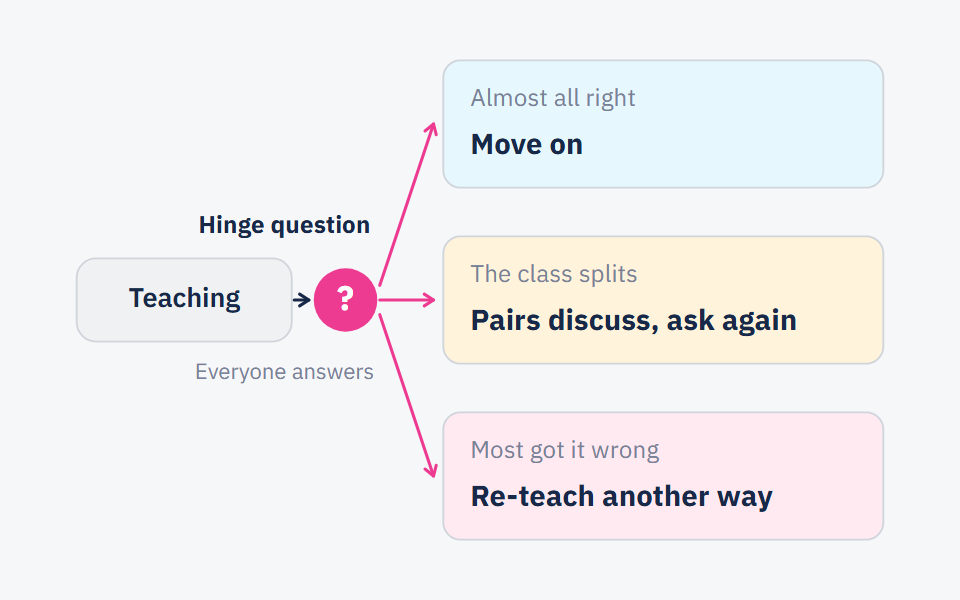
| Hinge question | Whether to move on, re-teach or open a discussion: it is a decision, not a tool | Two, or five if you need a discussion | One question written into the plan with your decision for each result, answered on cards or boards | At the point the rest of the lesson depends on |
| Exit ticket | Each student's named answer on paper that stays with you after the bell | 5 at the end of the lesson, then about 20 to read 40 tickets | A quarter of an A4 sheet per student: ten sheets for forty | The end of the lesson, to plan tomorrow |
You do not need all four every lesson. Two are usually enough: one in the middle of the lesson and the exit ticket at the end.
A/B/C/D cards: the whole class answers at once
Wiliam describes it like this: give each student a set of four cards labelled A, B, C and D, and ask the question in multiple-choice format; if the question is well designed, the teacher can quickly judge the different levels of understanding in the class. In Arabic-medium classes the options are أ، ب، ج، د, so the printable at the top of this page carries both alphabets, four sets to a sheet.
The steps, in order, with the words to say:
- Before the question: “I'll read the question twice. Think on your own, and nobody shows a card until I ask.”
- After the question, wait: at least three seconds before you ask for answers. Cambridge's “Getting started with Assessment for Learning” notes that on average teachers wait only 0.9 seconds after a question before taking an answer, and that Mary Rowe suggests increasing wait time to three seconds improves the quality of answers.
- On the signal: “Choose your card and hold it face down against your chest. Three, two, one: show me.” When everyone shows at once, a slow student has no time to look at a neighbour's card. Rosenshine notes that choral responses only worked when all students started together on a signal, otherwise only the faster students answered; we think the same holds for cards.
- While you read the room: scan row by row and count the minority letters, not the majority. Then say what you see, without names: “I can see a lot of C, some A, and a few D.”
- After reading: “Cards down.” Then decide, as Wiliam suggests: if all students answer correctly, move on; if no one does, you might re-teach the idea; if they split, run a whole-class discussion, or pair students who got it right with students who did not.
The trap: an option nobody chooses. It is a free option that raises the chance of guessing right and tells you nothing. Write each wrong option to stand for a misconception some of your students really hold; the hinge question shows how to write them, with twelve examples in four subjects.
Mini whiteboards: when you want to see the answer, not pick it
Wiliam describes a second way: every student writes the answer on an individual dry-erase board and holds it up at the teacher's request, and the teacher scans the responses for new ways of solving the problem as well as misconceptions. Its edge over the cards is that students write their own answers, so you see mistakes you never put among the options.
If you have no boards: the same Cambridge page says learners can write the answer to a closed question on a piece of paper, a mini whiteboard or a tablet and hold it up. The cheapest substitute for a board we know is a white sheet inside a clear plastic sleeve, written on with a whiteboard pen and wiped with a tissue. Without sleeves, a page from the back of the exercise book and a thick pen will do for a question or two.
- Before the question: “Write the answer only, big enough to read from the back.”
- When a student finishes: “Turn your board face down and wait.” You see who is done; the neighbour does not see the answer.
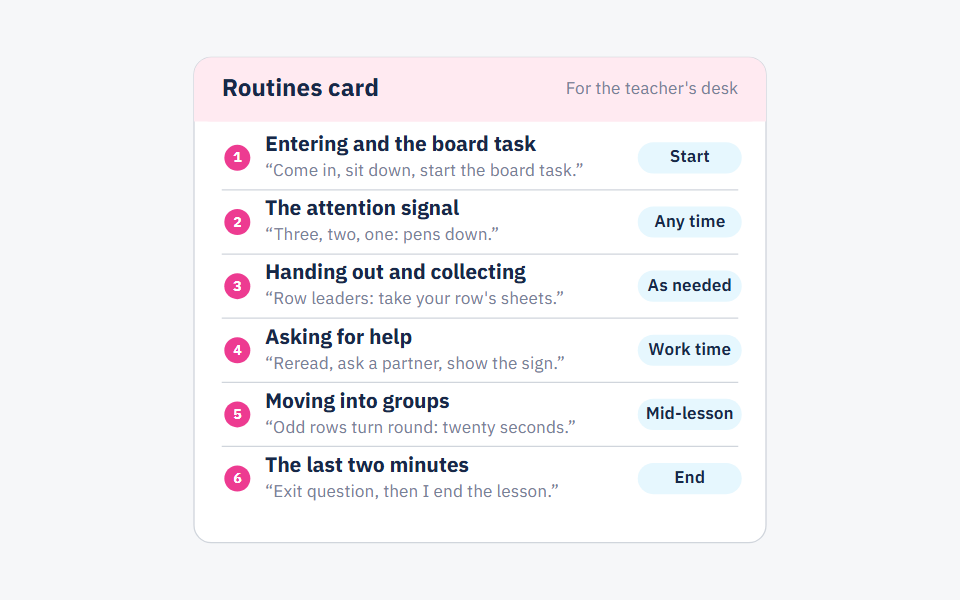
- On the signal: “Boards up… down… wipe.” Three words, repeated until they are a routine; six classroom routines shows how to build one like it in a week.
- The trap: asking for a long answer. Forty boards of full sentences cannot be read from the front. Ask for a number, a word, one step or a small sketch.
The hinge question: one question that decides the rest of the lesson
A hinge question is not a third tool but a moment you choose and a question you write for it in advance. Wiliam calls the point where a teacher checks understanding before continuing the lesson a “hinge point”, because the lesson can go in different directions depending on student responses. You ask it on cards or boards; the difference is that before the lesson you write down what you will do with each result.
Tell the class: “Before we go on, one question that decides what we do for the next few minutes.” Then follow the card steps above.
The trap: asking it at the end of the lesson. A hinge question helps only while there is time left to change what follows; the last question of the lesson belongs on the exit ticket.
The exit ticket: the only one that stays with you after the bell
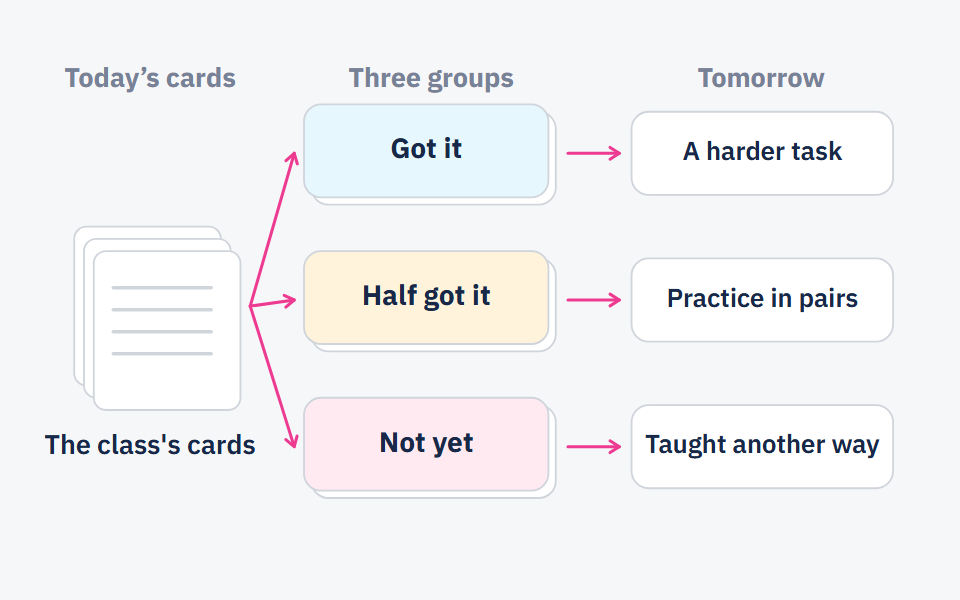
The first three techniques show you the class in the moment, then vanish. The exit ticket, as Wiliam describes it, works differently: students are given index cards and hand in their answers to a question the teacher poses before they can leave the classroom, and sometimes the question helps the teacher judge where to begin the next day's instruction. The exit-ticket guide has tickets to print, 15 ready questions and a way to sort them into three piles.
With forty students the time goes on reading, not writing: at half a minute a ticket, forty take about 20 minutes. To cut that down:
- Ask for an answer you can sort at a glance: a number, a letter or a word, with one line for the reason.
- Sort as you read: put each ticket straight onto one of three piles — got it, half got it, not yet. No corrections, no marks.
- Make collecting a routine: “Name first, then the answer. Each row's monitor collects the tickets and puts them on my desk.”
A full example: a science lesson for a class of 42
This example was written for this post, and its numbers are an illustrative sample, not results from a real class.
| Minute | Technique | What the teacher says | What the teacher does with the result |
|---|---|---|---|
| 15 | Mini whiteboards | “Write one example of a physical change, in two or three words.” | Reads the boards and copies the wrong examples onto the board, without names, to come back to after the hinge question. |
| 25 | Hinge question on cards | “Which of these is a chemical change? A) sugar dissolving in water B) water freezing C) an iron nail rusting D) tearing a sheet of paper” | In the sample: C 27, A 9, D 4, B 2. The class is split, so everyone who showed A or D explains their choice to a neighbour who showed C, for one minute; then the teacher asks a second, similar question prepared in advance. |
| 40 | Exit ticket | “Write one chemical change that happens in your kitchen at home, and the evidence that a new substance formed.” | Sorts the tickets after the lesson. Anyone still holding “a change you can't undo is chemical” starts tomorrow's lesson with the teacher. |
What each wrong option in the hinge question reveals: a student who picks A thinks the sugar becomes a different substance because it can no longer be seen. B means a change of state is taken for a chemical change. D means any change that cannot be undone is taken for a chemical one — but torn paper is still paper.
The time: checking understanding took about 12 of the 45 minutes, spread over three moments: three for the whiteboards, four for the hinge question with its discussion and second question, and five for the exit ticket.
When these techniques don't help
- When the task is longer than a short answer: cards and boards measure a number, a letter or a step. A paragraph, a project or an experiment needs more time and a rubric.
- When students are afraid of being wrong in front of others: never name the student who showed a wrong option, and never mark any answer. The Cambridge page suggests turning a wrong answer into a positive event with something like: “I'm glad you said that, as I'm sure lots of other students have the same misunderstanding.”
- When you read the result and change nothing: if the lesson will go on the same whatever the class shows, the question cost two minutes for nothing. Write your decision for each result before you ask.
- When checking happens every five minutes: three moments in a lesson are usually enough; more breaks up the teaching and tires the class.
Frequently asked questions
- How do I check understanding in a crowded classroom without marking forty notebooks?
- Have students answer together on cards or boards during the lesson, so you read the room in under a minute, and keep paper for the exit ticket at the end. None of it is marked, and there are no notebooks to correct.
- What if I don't have mini whiteboards?
- A white sheet in a clear plastic sleeve does the same job. Without sleeves, the printed A/B/C/D cards work for any multiple-choice question and are printed once for the whole term.
- Won't students copy each other's cards?
- Copying drops when everyone shows on a count and holds the card at the chest, not above the head. Even so, read the cards as a picture of the class rather than a verdict on each student, and check individuals on the exit ticket, which each student writes alone.
- What about red and green traffic-light cards?
- Wiliam describes them: students flash green to show they understand and red to show they don't. In our view they tell you what students think they understand, not what they do; use them to know when the class wants you to stop, and a question to know what it understood.
- How many sheets of cards do I print for forty students?
- Ten A4 sheets from the printable, four sets on each. Print on card if you can, or glue them onto cardboard, so they last the whole term.
Sources
Every fact in this post that we did not produce ourselves comes from one of these sources.
- Classroom Assessment: Minute by Minute, Day by Day (Dylan Wiliam), Educational Leadership vol. 63, no. 3 — ASCD, 2005-11-01
- Principles of Instruction: Research-Based Strategies That All Teachers Should Know (Barak Rosenshine) — American Educator, 2012 (Spring issue)
- Getting started with Assessment for Learning — Cambridge Assessment International Education, undated (read 2026-10-22)
Written with String's editorial team: we use AI for research and first drafts, and a person checks every fact and every source before anything is published. How we write
Founder and CEO, String
“I grew up in a house of teachers.” I spent a year designing the STEM program for one of the largest school groups in Saudi Arabia, have written curriculum by hand, trained robotics coaches and sold software into schools, then left that job to build String in Amman.