Measurable learning objectives: how to write them, with verbs for each level
A measurable objective is a sentence with one verb you can see on the student's page, a condition that says what they are given, and a criterion that says when it counts as met. Here is a verb table for each level of Bloom's taxonomy, and 12 objectives rewritten from unmeasurable to measurable.
Measurable learning objectives — verb table to print
A free printable PDF, no sign-up.
- Definition
- Learning objective: A sentence describing what a student will be able to do by the end of a lesson or unit, with a verb that can be observed and measured. In Arabic, «نتاج تعلّم» (learning outcome) is the common term in Jordan and «ناتج تعلّم» in the Gulf and Egypt, and many planning forms say a learning or behavioural objective.
A measurable objective: condition, behaviour, criterion
This split is credited to Robert Mager, whose book, later titled Preparing Instructional Objectives, first appeared in the early 1960s. The University of Illinois Chicago guide to learning objectives sets out the three parts and cites Mager on the third: the behaviour, what the learner will be able to do; the condition, the tools, situations, settings or restrictions under which the behaviour will occur; and the standard, the criterion of an acceptable outcome, such as accuracy or time. Mager's Wikipedia page summarises the same three parts, calling the behaviour the performance.
| Part | The question it answers | Example |
|---|---|---|
| Condition | What is the student given, or not allowed? | Given six pairs of fractions with unlike denominators, without a calculator, |
| Behaviour | What does the student do, that you can see on the page? | the student adds each pair, writing the answer in simplest form, |
| Criterion | When do we say the objective is met? | getting at least five of the six pairs right. |
Of the three, the behaviour matters most. The University of Arkansas guide to writing objectives says each objective needs one measurable verb, and warns against verbs that cannot be quantified, such as understand, learn, appreciate or enjoy. It explains why one: if an objective has two verbs, say define and apply, what happens if a student can define but not apply?
As for the condition and the criterion, we suggest writing them when they change something: the condition when the task is different with it, such as a calculator or a blank map, and the criterion when success has a number you can count.
The verb table: six levels of the revised Bloom's taxonomy
Benjamin Bloom proposed his taxonomy in 1956, the University of Arkansas guide notes; in 2001 Anderson and Krathwohl revised its levels from nouns to verbs, as the University of Illinois Chicago guide notes. The six revised levels are remember, understand, apply, analyze, evaluate and create. The English verbs in the table come from the University of Arkansas guide's list, with their Arabic equivalents, and an example for each level from one lesson: the area of a rectangle.
| Level and what it means | Verbs | Arabic | Example from a lesson on the area of a rectangle |
|---|---|---|---|
| Remember: retrieving knowledge from memory | list, name, define, match, recall | يعدّد، يسمّي، يعرّف، يطابق، يستذكر | Students write the rule for the area of a rectangle. |
| Understand: constructing meaning from what is said, written or drawn | explain, describe, summarize, paraphrase, give original examples of | يشرح، يصف، يلخّص، يعيد الصياغة بكلماته، يعطي مثالاً من عنده | Students explain with a drawing why area is length times width. |
| Apply: carrying out a procedure in a given situation | calculate, solve, use, predict, apply | يحسب، يحلّ، يستعمل، يتنبّأ، يطبّق | Students calculate the area of a rectangular room from its length and width. |
| Analyze: breaking material into parts and seeing how they relate | classify, break down, categorize, diagram, simplify | يصنّف، يجزّئ، يرسم مخططاً، يبسّط | Students break an L-shaped figure into two rectangles to find its area. |
| Evaluate: making judgements against criteria | judge, choose, defend, compare, support | يحكم، يختار، يدافع عن، يقارن، يدعم رأيه بدليل | Students judge whether a classmate's answer to an area problem is correct, showing where any mistake is. |
| Create: putting elements together into a new whole | design, compose, build, invent, develop | يصمّم، يؤلّف، يبني، يبتكر، يطوّر | Students design a plan for a garden of no more than 60 m². |
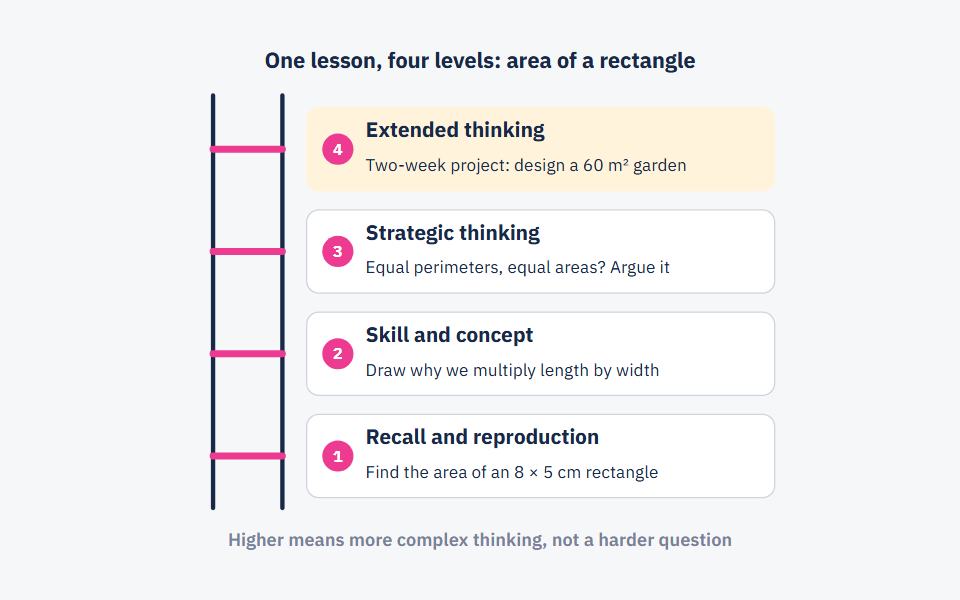
The University of Arkansas guide adds that the verb alone does not set the level: the skill, action or activity you teach with it does. “Explain”, to take our own example, is no more than recall if the student repeats an explanation memorised from the book. You will find the same warning in Depth of Knowledge, when you write the question that measures the objective.
12 objectives, from unmeasurable to measurable
These examples were written for this post, across six subjects. Each row has an objective that cannot be measured, then the same objective with one visible verb, and a criterion where success has a number.
| Subject | Before: unmeasurable | After: measurable | Level |
|---|---|---|---|
| Maths | Students will understand adding fractions. | Students add two fractions with unlike denominators, writing the answer in simplest form, getting 4 of 5 problems right. | Apply |
| Maths | Students will become familiar with types of triangles. | Students classify eight drawn triangles by their sides in a three-column table. | Analyze |
| Maths | Students will realise the importance of checking their work. | Students judge whether a written answer to an area problem is correct, pointing to the wrong step if there is one. | Evaluate |
| Science | Students will know the water cycle. | Students label the stages on a blank water-cycle diagram: evaporation, condensation, precipitation. | Remember |
| Science | Students will understand physical and chemical change. | Students explain in their own words the difference between a physical and a chemical change, with an example of each from their kitchen at home. | Understand |
| Science | Students will be creative in science experiments. | Students design an experiment to test how sunlight affects a plant's growth, stating what they change, what they measure and what they keep the same. | Create |
| Arabic | Students will master grammatical analysis (iʿrāb). | Students analyse the subject and the object in five verbal sentences, giving the case ending of each. | Apply |
| Arabic | Students will enjoy reading the story. | Students summarise the story in five sentences that keep the order of events. | Understand |
| English | Students will learn the past simple. | Students write five sentences about their holiday in the past simple, at least two of them with an irregular verb. | Apply |
| Social studies | Students will know why people settled near rivers. | Students explain two reasons early people settled near rivers, with an example of each. | Understand |
| Civics | Students will appreciate public services in their city. | Students choose the more important of two services the municipality provides in their area, supporting the choice with two reasons. | Evaluate |
| Computing | Students will become familiar with spreadsheets. | Students calculate the average of ten students' marks in a spreadsheet with the AVERAGE function. | Apply |
Notice what changed in each row: a verb nobody can see became a verb that leaves a mark on the page, and a broad topic became a specific task. This is what the University of Arkansas guide does in its before-and-after examples, where “Understand immigration policy” becomes “Describe the history of American immigration policy”, because understand is not a measurable verb.
Four mistakes that make an objective unmeasurable
- A verb you cannot see: understand, know, become familiar with, realise, appreciate, enjoy. Ask yourself: what will I see on the student's page when they understand? The answer is the verb to write.
- Two verbs in one objective: “Students define a fraction and add two fractions” is two objectives. Split them, or keep the higher one if it includes the other, as the University of Arkansas guide does when it drops “describe” from “Describe and create a marketing plan”.
- An objective about the teacher: “The teacher explains adding fractions” or “the teacher shows a video on the water cycle” describes your lesson, not the learning. Write what the student will do.
- An objective that is an activity: “Students complete the worksheet” says what students will do in the lesson, not what they will learn. For a similar example, the guide advises writing the purpose of the task with a measurable verb.
From the objective to the question that measures it
A well-written objective almost writes the last question of the lesson for you. The objective “students add two fractions with unlike denominators, writing the answer in simplest form” is measured by one exit-ticket question: “Add .” That is why the lesson plan template starts with the goal, then the exit-ticket question, before any activity. When the objective sits at evaluate or create, such as a project or a presentation, measure it with a rubric whose criteria come from the objective itself.
Lesson objectives serve the unit's objective. The University of Arkansas guide advises that lesson-level verbs be at or below the level of the course-level objective, never above it. The same rule works for a unit: if the unit objective is “solve word problems on adding fractions”, do not give one of its lessons an objective at the create level.
Frequently asked questions
- What do «نتاجات التعلّم» and «نواتج التعلّم» mean?
- Both are Arabic for learning outcomes, and there is no difference in meaning: «نتاجات التعلّم» is the common term in Jordan, «نواتج التعلّم» in the Gulf and Egypt. Both describe what a student will be able to do at the end of the learning.
- What is a behavioural objective?
- A name many planning forms use for the same kind of sentence: what the student will do. Whatever your school calls it, what matters is that the verb can be measured.
- Which verbs should I avoid in learning objectives?
- Verbs that leave nothing you can see: understand, know, learn, appreciate, enjoy, become familiar with, realise. Replace them with a verb from the table above.
- Does every objective need a condition and a criterion?
- Every objective needs the behaviour. We suggest adding the condition and the criterion when they change the task, or when success has a number you can count.
- How many objectives should one lesson have?
- We suggest one, two at most: each objective needs a question that measures it at the end of the lesson, and the last five minutes do not hold more than that.
Sources
Every fact in this post that we did not produce ourselves comes from one of these sources.
- Using Bloom's Taxonomy to Write Effective Learning Objectives — Teaching Innovation and Pedagogical Support, University of Arkansas, 2022-07-26
- Learning Objectives: Examples and Before & After — Teaching Innovation and Pedagogical Support, University of Arkansas, 2022-07-26
- Bloom's Taxonomy of Educational Objectives (Erin Stapleton-Corcoran) — Center for the Advancement of Teaching Excellence, University of Illinois Chicago, 2023-01-25
- Learning Objectives (Erin Stapleton-Corcoran) — Center for the Advancement of Teaching Excellence, University of Illinois Chicago, 2023-01-27
- Robert F. Mager — Wikipedia, undated (checked 2026-10-22)
Written with String's editorial team: we use AI for research and first drafts, and a person checks every fact and every source before anything is published. How we write
Founder and CEO, String
“I grew up in a house of teachers.” I spent a year designing the STEM program for one of the largest school groups in Saudi Arabia, have written curriculum by hand, trained robotics coaches and sold software into schools, then left that job to build String in Amman.