A Grade 6 maths short quiz for the first term, ready to print
A good short quiz takes ten minutes: eight questions, one objective each, and before you print it you know what a wrong answer to each one means. Here is the quiz ready to print, on fractions, decimals and ratio, and one table that turns its results into a decision for tomorrow's lesson.
Short quiz — Maths — Grade 6
A free printable PDF, no sign-up.
- Definition
- Short quiz: A few questions on what was taught in recent days or weeks, answered in minutes during the lesson, each written to measure one objective, so the teacher knows which objectives have held and which need another go.
A short quiz is not only for marks. The review by John Dunlosky and colleagues, as summarised in a release from the Association for Psychological Science (January 2013), rated practice testing as one of the two learning strategies with the highest overall utility among those it studied. And in “Principles of Instruction” (Spring 2012), Barak Rosenshine reports that even at secondary level, classes with weekly quizzes scored better on final exams than classes with only one or two quizzes in the term.
The quiz: eight questions in ten minutes
The questions were written for this post, not copied from a textbook. They cover three Grade 6 maths topics: fractions, decimals and ratio. We do not know the order of these topics in your class's book, so open the first-term contents page and swap any question on a topic your class has not reached yet. The answer key is not on this page: solve the questions yourself before you print, or ask for the key along with the quiz when you make it in String.
| Question | Topic |
|---|---|
| 1. Write in simplest form. | Fractions |
| 2. Put the right sign (>, < or =) between and , and write how you know. | Fractions |
| 3. Add: | Fractions |
| 4. Subtract: | Fractions |
| 5. Order from smallest to largest: , , | Decimals |
| 6. Multiply: | Decimals |
| 7. Write as a decimal. | Decimals |
| 8. A recipe for 4 people needs 6 eggs. How many eggs does it need for 10 people? Show your method. | Ratio |
One objective per question, and a meaning for every wrong answer
This table is for the teacher, not the student. The second column is the objective, or “learning outcome” as many curricula call it. The third column describes the wrong answer to look for, not the right one.
| Question | Objective | What a wrong answer tells you |
|---|---|---|
| 1 | Write a fraction in simplest form | or : knows to divide the numerator and denominator by the same number, but stopped before reaching simplest form. A little practice is enough. |
| 2 | Compare two fractions with unlike denominators | If they write that 5 is bigger than 2, or 8 bigger than 3, they are comparing numerators or denominators alone and not seeing the fraction as one number. That is a mistake of meaning, not of calculation. |
| 3 | Add two fractions with unlike denominators | : added the numerators and the denominators, so the meaning of a fraction has not settled. : made a common denominator but forgot to change the numerators. |
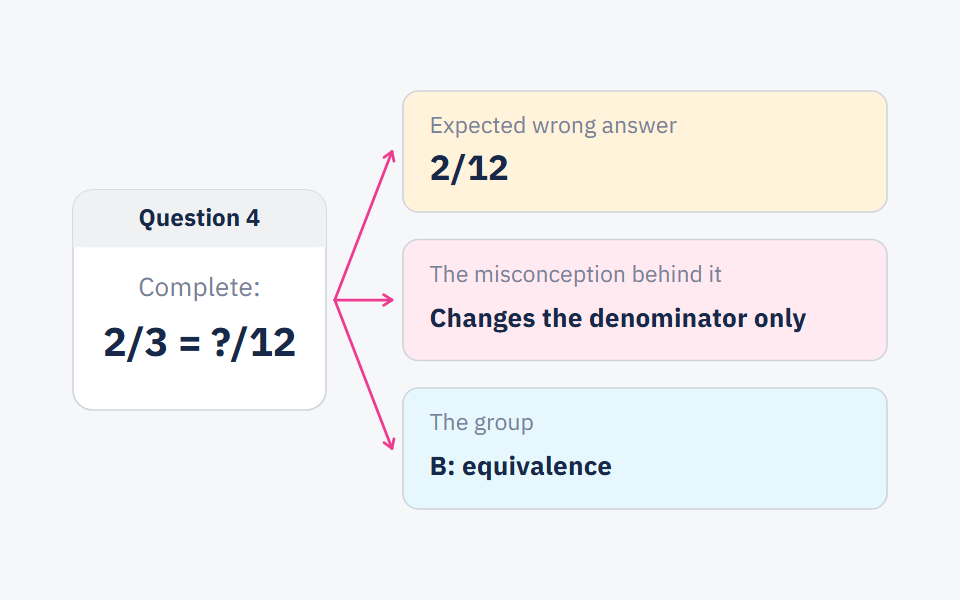
| 4 | Subtract mixed numbers | : subtracted the smaller from the larger in each part separately. Does not know what to do when the first number's fraction is smaller than the second's. |
| 5 | Compare and order decimals | Ordering by length — putting smallest or largest — means they think the number with more places is bigger. |
| 6 | Multiply two decimals | : put the decimal point in the wrong place, sometimes from believing multiplication always makes things bigger. : added instead of multiplying. |
| 7 | Write a fraction as a decimal | or : wrote the numerator and denominator side by side, without reading the fraction as a division. |
| 8 | Solve a proportion problem | 12: added 6 eggs because the difference between 4 people and 10 people is 6 — thinking additively where multiplication is needed. |
The mistake in question 8 is not our invention. The Education Endowment Foundation's guidance report “Improving Mathematics in Key Stages Two and Three” gives it as a common misconception in multiplicative reasoning: asked for the quantities in a recipe for 10 people instead of 4, many pupils add 6, because the difference in the number of people is 6, rather than multiplying.
How to run it in exactly ten minutes
Before the lesson: two versions with different numbers
Print one copy per student, and a second version for neighbouring seats that changes the numbers and keeps the ideas — instead of , say, and 12 people instead of 10. Solve both versions yourself before you print.
Instructions: one minute
“Ten minutes, eight questions. Write the answer, and at least one step under it. If you get stuck on a question, move to the next one and come back at the end.”
Answering: eight minutes
Walk around and do not help. Notice where students stop; that is part of the result. At minute seven, say: “One minute left.”
Collecting: one minute
Collect all the papers at the same moment, and let nobody finish after collection.
Marking after the lesson: one mark per question
Give one mark per question, and record a table with a row for each student and a column for each question, right or wrong. Thirty papers by eight questions fills it quickly, and it is what you read from in the next section.
Reading the results in one table: columns before rows
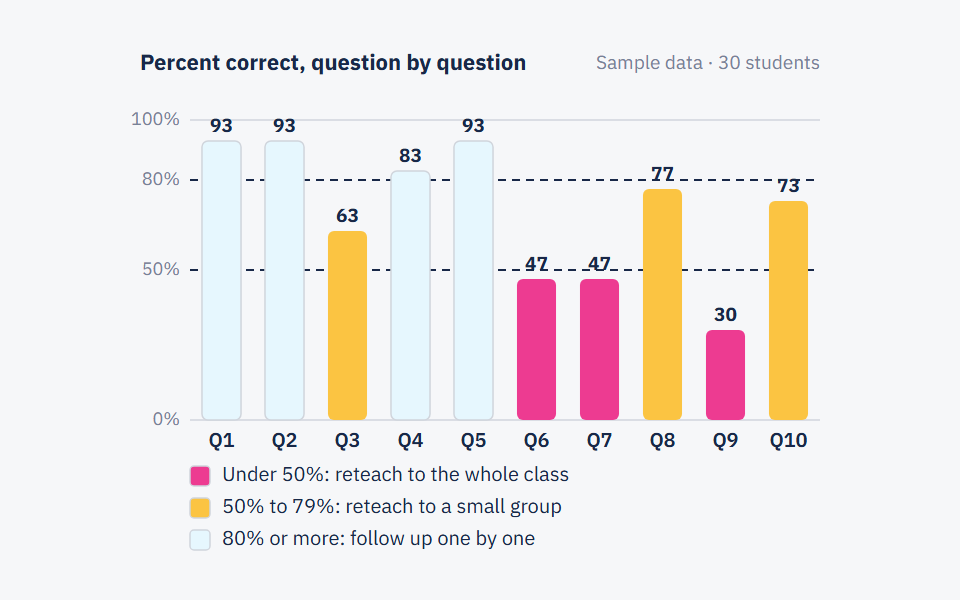
Do not start with each student's total. Start with the number of wrong answers to each question: every question is an objective, and every column gives you a decision. The two cut-offs in the table come from different places. The first, 6 or fewer wrong out of 30, is based on Rosenshine's statement in the same article that the optimal success rate appears to be about 80%; applying it to a single question in a short quiz is our own choice. The second, half the class, is a working rule we suggest, not taken from any source.
| Wrong answers to a question (class of 30) | What it means | What to do next lesson |
|---|---|---|
| 6 or fewer | About 8 in 10 got it right: the objective holds for most of the class | Do not reteach. Give whoever got it wrong one or two problems at the start of the lesson, and go over their paper with them |
| 7 to 14 | A clear group for whom the objective has not held | Ten minutes with you for that group, while the rest work on a harder task on the same objective |
| 15 or more | Half the class or more: the problem is most likely in the teaching, not the students | Reteach the objective to the whole class another way: a drawing, fraction strips, or an everyday example |
Then read the rows. A student who got three of the first four questions wrong does not need more practice; they need a remedial plan that starts from the meaning of a fraction. If you find that about half the class missed all the fraction questions, the problem lies before this unit, and the tool for it is the diagnostic test. For analysing a longer test — the difficulty of each question and the gaps in the class — see analysing test results with a simple table.
Three mistakes that turn a short quiz into a mark with no decision
- Recording only the total: two students who each scored 5 out of 8 can have entirely different gaps, one in fractions and one in decimals. The total tells you how much; the columns tell you where.
- Questions on what has not been taught: a question on a lesson the class has not reached measures nothing, and teaches students that the quiz has nothing to do with the lessons. Match the questions to what you actually taught.
- Eight questions instead of a whole unit: one question per objective is a signal, not a verdict. It tells you where to look; judging mastery of the unit is the job of the unit test.
Frequently asked questions
- Where can I get a printable Grade 6 math quiz?
- At the top of this page: the quiz itself, eight questions on one page as a PDF, no sign-up and no answer key. If you want the key and a second version with different numbers, ask for them with the quiz when you make it in String.
- Does this quiz match my class's first-term book?
- We did not build it on any particular book. Its three topics are Grade 6 maths topics; open your book's contents page and swap any question on a lesson your class has not reached for one on an objective you have taught.
- What is the difference between a short quiz and a monthly test?
- A monthly test is longer, covers a unit or more, and its mark is usually recorded. A short quiz is ten minutes on the objectives of the last week or two, and its first job is to decide what you do in the next lesson.
- How often should I give a short quiz?
- Once a week is enough, on its last day, as in the weekly plan. Between quizzes, the exit ticket tells you what happened in each lesson.
Sources
Every fact in this post that we did not produce ourselves comes from one of these sources.
- Principles of Instruction: Research-Based Strategies That All Teachers Should Know (Barak Rosenshine) — American Educator, 2012 (Spring issue)
- Which Study Strategies Make the Grade? (on Dunlosky et al., Psychological Science in the Public Interest) — Association for Psychological Science, 2013-01-10
- Improving Mathematics in Key Stages Two and Three: Guidance Report (Henderson, Hodgen, Foster, Kuchemann) — Education Endowment Foundation, 2017 (PDF undated; file named 2017)
Written with String's editorial team: we use AI for research and first drafts, and a person checks every fact and every source before anything is published. How we write
Grade 6 mathematics · Jordan
Teaches Grade 6 mathematics in Jordan and writes here about teaching maths from inside the classroom.