Before you print the exam: twelve checks
Check the exam paper in twelve points before it goes to the copier, in four groups: content, clarity, fairness, and layout and marking. You need the test blueprint, a printed copy you solve yourself, and a colleague who marks two questions with your scheme.
Before you print the exam — twelve checks
A free printable PDF, no sign-up.
An annotated exam page: where each check sits
The figure shows the first page of a short Grade 6 test on ratio and proportion, written for this post to explain the checks — it is not a full test. The numbers are the twelve checks: eight you can see on the paper itself, and four behind it, in the blueprint and the marking scheme. Students never see those four, but they decide whether a student's mark says anything about what was learned.
The twelve checks, each with its reason in one line
Print one copy, pick up a pen, and tick each check the paper passes. Whatever fails can usually be fixed before the paper reaches the copier.
Content
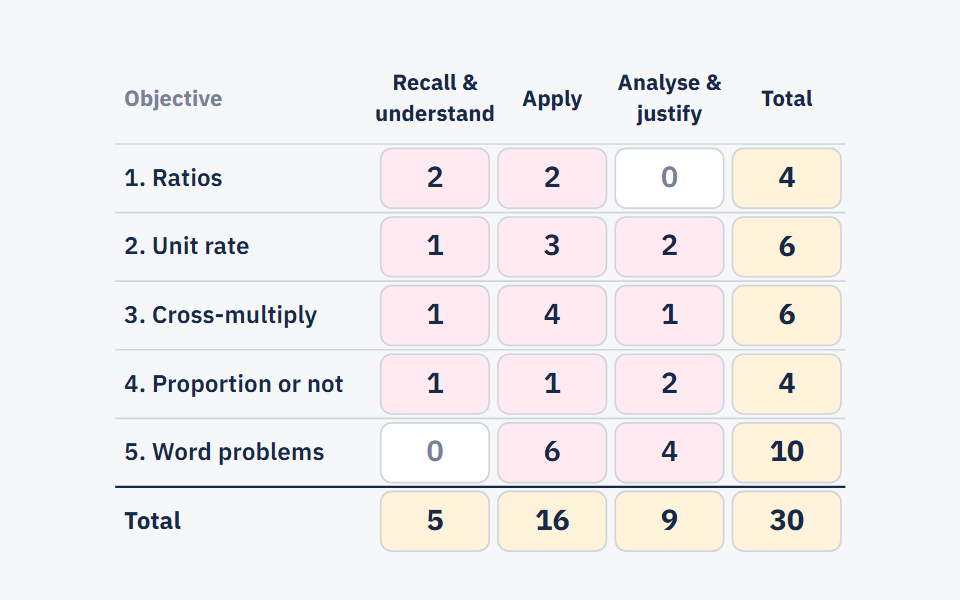
- 1. It matches the blueprint. Add up the marks for each objective and compare them with the table. Why: an objective that took a quarter of the unit's time gets about a quarter of the marks, not double that.
- 2. Every objective has a question. Write the objective number beside each question on your copy. Why: you will learn nothing from the results about an objective nobody was asked about.
- 3. Levels as they were taught. The paper has as much application and justification as students practised. Why: a paper that is all recall cannot tell you whether a student can use what they remember.
Clarity
- 4. One task per question. If a question says “calculate, then explain”, split it into (a) and (b) with marks for each. Why: when a student gets a two-part question wrong, you cannot tell which part they have not mastered.
- 5. Marks beside every question, and beside every part. Why: students know where to spend their time, and nobody writes a page for a one-mark question.
- 6. Instructions at the top: the time, the total marks, the number of pages, where to write, and whether to show working. Why: every question you are asked during the exam breaks the whole room's concentration.
Fairness
- 7. No trick wording. No double negatives; a negative that has to stay is underlined; no hard word that has nothing to do with what you are testing. Why: a student who misses because they did not see “NOT” has not made a maths mistake.
- 8. Black-and-white safe. No information carried by colour alone, no drawing that disappears on the copier. Why: a paper copied on a black-and-white machine loses every colour it had.
- 9. Time to finish and check. Solve the paper yourself and time it. Why: if students cannot finish, the last questions measure speed, not learning.
Layout and marking
- 10. Page numbers. “Page 1 of 2” on every page, “continued” at the bottom, and no question split across two pages. Why: a student who misses the back page loses its marks for a reason that has nothing to do with learning.
- 11. Room to answer. Under each question, a box big enough for the working you expect, not just the answer. Why: a narrow space tells the student “answer only”, then costs them the method marks.
- 12. A scheme a second marker can follow. Give a colleague the scheme and one student's answers to two questions. Why: if they reach a different mark, the scheme does not yet say what is in your head.
What each check protects
Content: the test measures only what you taught
Helenrose Fives and Nicole DiDonato-Barnes open “Classroom Test Construction: The Power of a Table of Specifications” (Practical Assessment, Research & Evaluation, February 2013) with students complaining about a test that asked about something covered for “like 2 seconds” in class. They write that what was discussed longer or in more detail should appear in greater proportion on the test: an objective that took 10% of instructional time should count for 10% of the assessment. They also write that the thinking level of the items needs to match the thinking level of instruction if teachers are to make valid judgments about their students' understanding. The unit test blueprint has a completed table for a 30-mark unit to run the first three checks against.
Clarity: students know the task before they start
The guide “Improving Your Test Questions”, from the Center for Innovation in Teaching & Learning at the University of Illinois, says to express a single idea in each item, to phrase each item so the student's task is clearly indicated, and to give each essay item a point value and an estimated time limit. For problem-solving items it asks that the directions state whether students must show their work for full or partial credit, and that the parts of an item be clearly separated with their point values.
Fairness: students get it wrong on the subject, not on the paper
The same guide says to use negatively stated stems sparingly and, when you do, to underline or capitalise the negative word. It says to avoid unfamiliar vocabulary, and to avoid sweeping words such as “always” and “never” in true-false items, because they let a test-wise but unprepared student answer correctly.
On colour, the W3C accessibility guidelines, WCAG 2.2, say colour should not be the only visual means of conveying information, and note that people using limited-colour or monochrome displays cannot get information carried by colour alone. A paper run through a black-and-white copier is in the same position — which is why Question 3 above tells boys from girls with fill and hatching, not colour.
On time, Fives and DiDonato-Barnes describe the ideal test as one students can complete in the time allotted, with enough time to brainstorm any writing and to check their answers before handing in. Our advice: solve the paper yourself, time it, and multiply your time by about three to estimate a student's.
Layout and marking: the same mark whoever marks it
The Illinois guide notes that different readers can give the same essay answer different marks, and that the same reader can judge the same paper differently over time. It describes analytical scoring — each answer compared with an ideal answer, and points given for the necessary elements — and recommends, when possible, asking another instructor to read and grade your students' answers, and working through each problem yourself before the test is given.
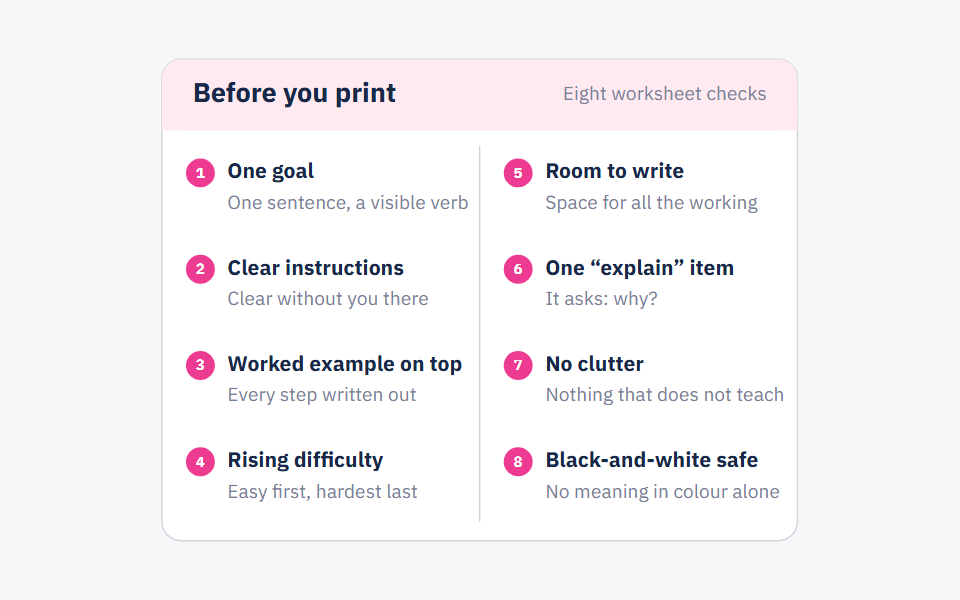
Page numbers and answer space are our advice, not a source's: an unnumbered back page can come back blank, and a cramped space hides the working you want to give marks for. The good worksheet: eight checks before you print draws the same space rule on a sheet before and after review.
In what order: from the blueprint to the copier
Start with the blueprint, not the paper
Checks 1, 2 and 3. On your copy, write each question's objective and level beside it, then total the marks per objective and per level and compare with the table. No table? Write the unit's objectives on a sheet and start from there.
Solve the whole paper in pen, in its own boxes
Checks 9 and 11. Time yourself. If the boxes cannot hold your working, they will not hold a student's.
Read every question as a slow reader would
Checks 4, 5, 6 and 7. Is the task clear from the words alone? Does the question ask for one thing? Can you see the negative? Are the marks there?
Copy one page in black and white
Checks 8 and 10. Did a drawing, a shade or a word disappear? Are the page number and “continued” in place?
Give a colleague two questions and their scheme
Check 12. Pick the two longest questions and give them one student's answers, or an answer you write with a deliberate mistake. If their mark differs from yours, add to the scheme the line that was in your head.
What this checklist will not catch
The checklist examines the paper, not the quality of each question. A question can pass every check and still be easier than you meant, or have wrong options so far off that nobody picks them. Write wrong options from mistakes your students actually make, as in hinge questions, and raise a question's level the way depth-of-knowledge questions describe. If your school requires an official header or exam form, use it: these checks are run inside it, not instead of it.
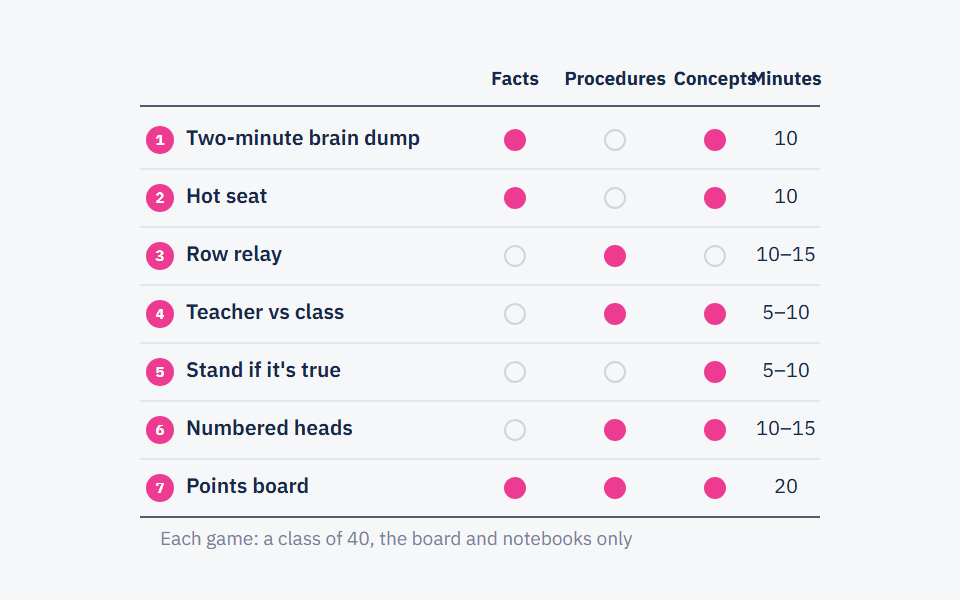
Once the paper is printed, there is still review week. Seven exam review games gives you ways for every student in a class of 40 to recall what they learned, with no equipment.
Frequently asked questions
- What makes a good exam paper?
- It matches the blueprint, has instructions at the top and marks beside every question, asks for one thing per question, reads in black and white, can be finished and checked in the time allowed, and has a marking scheme another teacher can follow to the same mark.
- How many questions should a 45-minute test have?
- There is no single number for every subject; the blueprint and the question types decide it. Solve the paper yourself, time it, and leave students time to check their answers. If time is tight, cut from the objective that has more marks than its share.
- Should I show the marks for each question on a final exam?
- Yes, and for each part of a question. The University of Illinois guide recommends it, and students use it to decide where to spend their time.
- Where can I find a ready-made exam template?
- Many sites and teacher groups share ready-made exams. Run any of them through the twelve checks before printing, starting with the first: does it match what you taught? If you want a paper for your own unit, make it in String for free, then run the same checks.
Sources
Every fact in this post that we did not produce ourselves comes from one of these sources.
- Classroom Test Construction: The Power of a Table of Specifications (Helenrose Fives, Nicole DiDonato-Barnes), Practical Assessment, Research & Evaluation vol. 18, no. 3 — Practical Assessment, Research & Evaluation (full text via ERIC, EJ1005136), 2013-02
- Improving Your Test Questions — Center for Innovation in Teaching & Learning, University of Illinois Urbana-Champaign, undated (read 2026-10-22)
- Understanding Success Criterion 1.4.1: Use of Color (WCAG 2.2) — W3C Web Accessibility Initiative, 2025-09-16 (updated)
Written with String's editorial team: we use AI for research and first drafts, and a person checks every fact and every source before anything is published. How we write
Founder and CEO, String
“I grew up in a house of teachers.” I spent a year designing the STEM program for one of the largest school groups in Saudi Arabia, have written curriculum by hand, trained robotics coaches and sold software into schools, then left that job to build String in Amman.