Reports
See who understood and who slipped, before the next lesson
One paper is enough: a map of the class skill by skill, the wrong idea your students share, and a written report for every one of them.
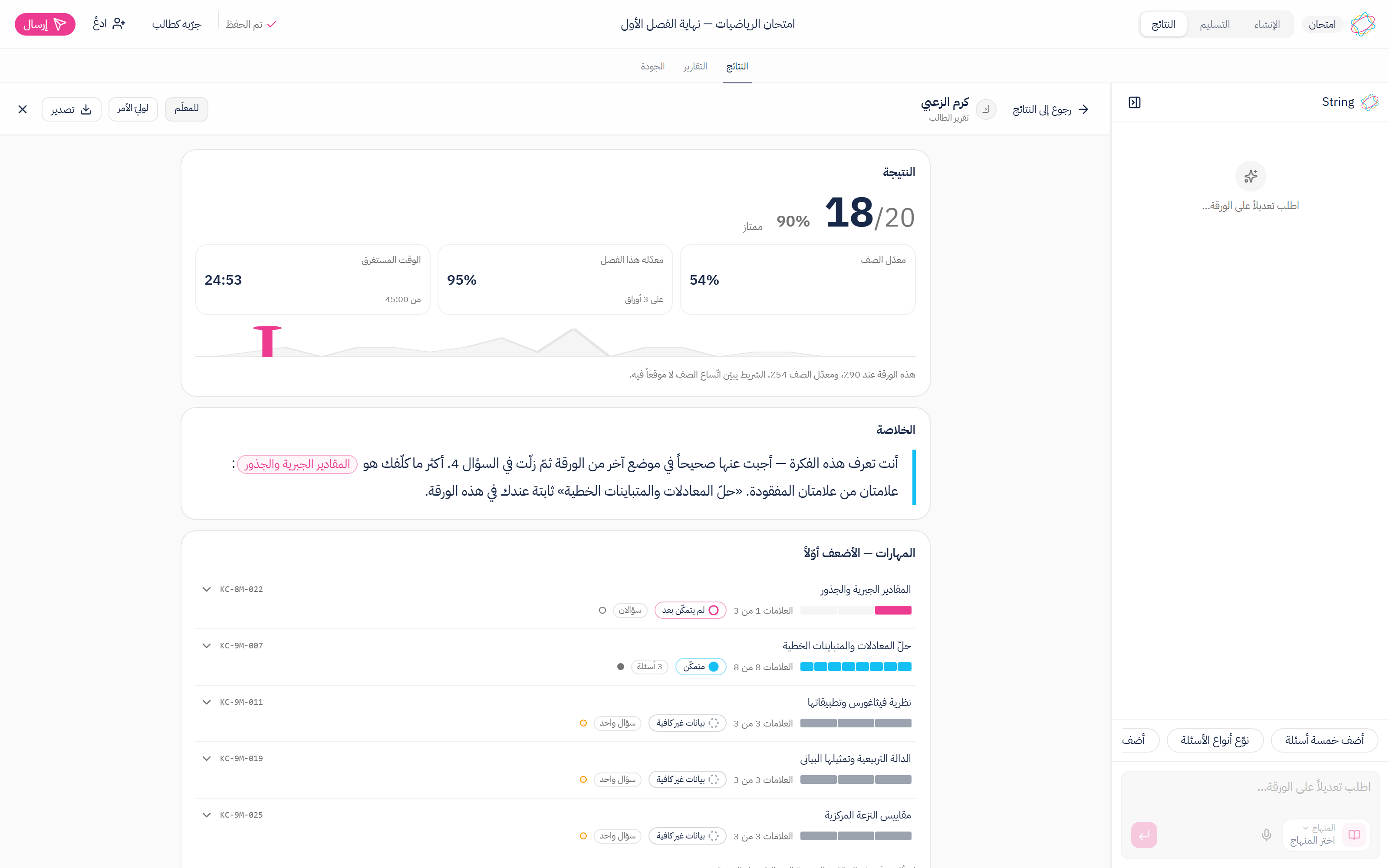 Sample data
By the numbers
12
sections in one student's report
13
sections in the class report
5
reasons a lost mark is filed under
9
places it says less rather than guess
What you know before you walk into the next lesson
Four things a column of marks will not tell you, however long you stare at it.
The whole class, one skill at a time
A row per student, a column per skill, and four states in every cell: mastered, partly there, not yet, or not enough evidence. Each state has a shape and a name and not only a colour, because this gets printed in black and white.
The wrong answer they agreed on
Students are grouped by the wrong option they picked, not by what they scored. Then it states the idea rather than the statistic — «15 students are reading the hollow circle as a filled one», never «15 picked option B», because nobody can teach an option letter.
The question that runs against your paper
Every question carries a difficulty and a discrimination figure. When the students who did best on the rest of the paper do worst on one question, it is handed to you to look at: it might be the key, it might be the wording, it might be something taught sideways. You know which. The report does not.
A written report for every student
Twelve sections opening on the result and the short version, then the skills sorted weakest first: each carries its curriculum code, its marks out of the marks available, its state, and the number of questions that state rests on — and where the evidence is a single question it says «not enough evidence» even when the mark is full. Then where the marks went, the biggest blocker, question by question, and what happens next. It has a second version written for a parent, one switch away.
From the paper to Sunday's decision
Four steps, and not one of them is typing marks into a spreadsheet.
- 1
The class sits the paper
The exam you wrote, in the form you set it in.
- 2
Closed questions mark themselves
The ones that need a human are marked as waiting; you open the student's paper and set the mark yourself. Your mark always beats the automatic one.
- 3
Both reports build from the papers themselves
One for the class and one for each student, built from the answers rather than from a summary of them — which is why the report moves when you change a question or a mark.
- 4
You decide what to reteach, and to whom
Every section ends in something to do: a working group, a period spent whole on one skill, or a question to rewrite before the next paper.
About the class in the screenshot, and about your students' work
The engine above is built and running; the class inside it was generated for the picture, because a real class's marks do not belong on a page anyone can open. And your students' work does not train our models, is not sold, never reaches a data broker, and carries no advertising. Those are practices, written down here plainly — String holds no compliance certification of any kind, and will not display a badge it does not have.
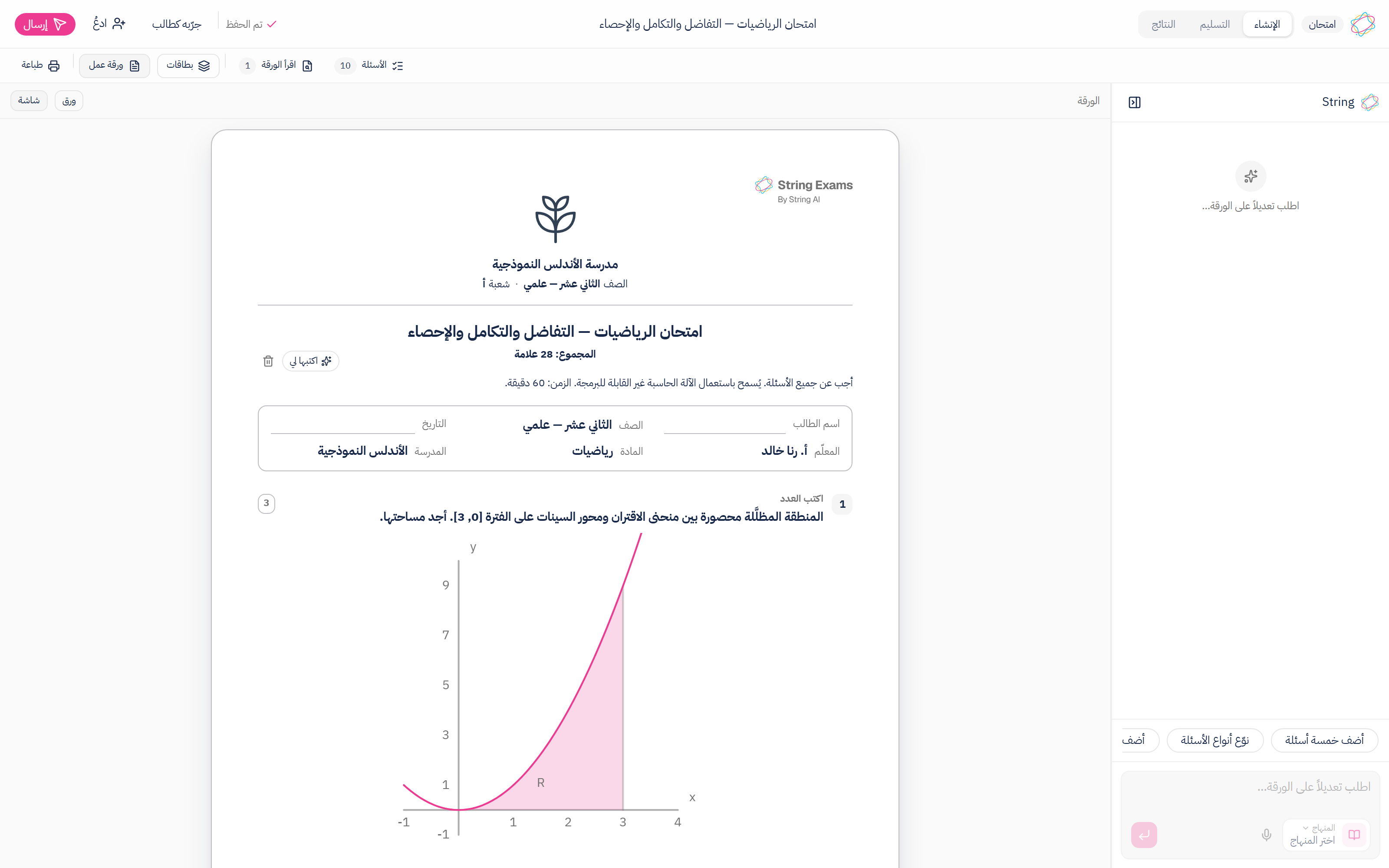
The report reads the paper you wrote
There is no second test, no parallel question bank, and no ready-made template your class has to be poured into. The exam you set is the source of every figure in both reports.
- 23 question types in the system, and three of them — long writing, comparison and drawing — are never machine-marked at all; they wait for you to read them.
- Difficulty, discrimination and the paper's reliability coefficient are computed over the machine-marked questions alone, so the reliability figure does not shift every time you mark a drawing.
- And what the paper did not measure is named: a whole section lists the skills this exam never reached.
What the two reports say, and what they refuse to say
The third group is not a list of gaps. Those are decisions, taken deliberately, and they stay.
One student's report — 12 sections
- The result
- The short version
- Skills, weakest first
- Where the marks went
- The full analysis
- The real blocker
- Question by question
- How the paper was worked
- Against the class
- What changed
- What happens next
- About this report
The class report — 13 sections
- The exam in one line
- The short version
- The skill map
- What to reteach first
- What the class has wrong
- Where to work in groups
- Worth a look
- The paper itself
- What the paper covered
- The exam against the platform
- How the class has moved
- Your actions
- About this report
Things this report will not do
- It never gives a student a rank in the class or a percentile among their peers, and the distribution strip under the result shows how widely the class spread rather than where the student sits in it.
- It never names another student in anything a student or a parent reads.
- It never asserts cheating. A fast right answer is a question for you, not a verdict from it.
- No group is named for an ability. Groups are named for what they need, and there is no «top group» in it.
- It does not correct your answer key. It shows you the question and leaves the judgement to you.
- It will not build a class report on fewer than 5 papers, and will not print a reliability figure for a paper under 8 questions. It says why in both cases.
- And when the exam disagrees with what the platform recorded, the reading that embarrasses String — that our own bar is too loose — is put before the one that blames the class.
Common questions
Read next
Exams
A paper in the real national-exam format, ready to print
Questions, figures, header and marks — on A4 exactly as your student will see them.
String — Interactive Lessons
You describe the lesson. Your student plays it
Not a sheet to print and not a video to watch. It is an activity your student walks through one screen at a time, and every answer is marked the moment it is given.
Run your first report
One paper your class sits is enough to give you a map of it.