Rubrics students can read: how to write one, with four ready to use
A good rubric is a short table: a few criteria, and for each level a number and a description students can recognise their own work in before they hand it in. Here are four ready rubrics that combine both, and how to write your own.
Rubric — blank printable template
A free printable PDF, no sign-up.
- Definition
- Rubric: A table that names what to look for in a student's work — the criteria — and describes in words what the work looks like at each level of quality, so students know before they start what is expected.
Three parts: criteria, levels, a description in every cell
In her review “Appropriate Criteria: Key to Effective Rubrics” (Frontiers in Education, April 2018), Susan Brookhart defines a rubric by two parts: criteria that express what to look for in the work, and descriptions of the levels of performance for each criterion. The Eberly Center's guide at Carnegie Mellon University splits it into three, the three drawn at the top of this page:
- Criteria: what you look for in the work. We suggest three or four for most tasks; each extra one is more cells a student reads and does not remember.
- Levels: four in the rubrics below, each with a number (4, 3, 2, 1) and a word (secure, meets, approaching, beginning).
- Descriptions: one sentence in each cell saying what the work shows at that level — not a judgement of it.
Numbers and descriptions: why you need both
Two names circulate among teachers, a “numeric” rating scale and a “descriptive” one, as if they were two separate tools. The numeric one puts scores from 1 to 4 against each criterion; the descriptive one says in words what each level means. Brookhart calls the first a rating scale, because it asks for a decision on a scale that does not describe the performance: a student given a 2 for “organisation” does not know what is missing to reach a 3.
So the four rubrics below combine the two: the number at the top of the column, to add up and record; the description in the cell, for the student to understand. Each one totals 16, because it has four criteria and the top level is 4. If your school needs a mark out of 20, multiply by 20 and divide by 16: a student who scored gets out of 20. But record the four numbers, not only the total; a total of 12 does not say which criterion is the weak one.
Four ready-to-use rubrics
These rubrics were written for this post. Each has four criteria and four levels, in language a student in grades 5 to 9 can read. Change the wording to fit your task and class, and drop any criterion you do not need.
1. Problem solving in maths
| Criterion | 4 · Secure | 3 · Meets | 2 · Approaching | 1 · Beginning |
|---|---|---|---|---|
| Understanding the problem | Writes what is given and what is asked in their own words, leaving out what is not needed | Writes what is given and what is asked | Writes some of what is given, or forgets what is asked | Copies the numbers without saying what is asked |
| Choosing a method | Chooses a suitable method and says why | Chooses a suitable method | Chooses a method that works for part of the problem | Tries operations with no plan |
| Accuracy | Every step is correct and written in order | One arithmetic slip that does not change the method | More than one slip, or a missing step | The steps do not reach an answer |
| Checking and answering | Checks the result another way, and writes the answer as a sentence with a unit | Writes the answer as a sentence with a unit | Writes a bare number with no sentence or unit | No clear answer |
2. Oral presentation
| Criterion | 4 · Secure | 3 · Meets | 2 · Approaching | 1 · Beginning |
|---|---|---|---|---|
| Content | Accurate information, with an example or evidence for every idea | Accurate information, with examples for most ideas | A little accurate information, no examples | Inaccurate or off-topic information |
| Organisation | An opening that names the topic, ideas in order, an ending that pulls them together | An opening and an ending; the order slips once | Ideas with no clear order | No opening and no ending |
| Voice and eye contact | Heard at the back of the room; looks at the audience most of the time | Can be heard; looks at the audience sometimes | Quiet voice; reads from the paper most of the time | Reads from the paper throughout |
| Answering questions | Answers accurately and adds an example | Answers accurately | Gives a partial answer | Does not answer, or repeats what was said |
3. Project
| Criterion | 4 · Secure | 3 · Meets | 2 · Approaching | 1 · Beginning |
|---|---|---|---|---|
| Understanding the topic | Explains the project's idea and links it to two or more lessons in the unit | Explains the project's idea and links it to one lesson in the unit | Describes what was made without explaining the idea | Cannot say what the project is about |
| Sources | Named, credible sources support every idea; information in their own words | Credible sources support most ideas; most information in their own words | Sources do not support the ideas, or information copied as it was | No sources |
| The product | Answers the project's question clearly; a reader from outside the class could follow it | Answers the project's question | Answers part of the question | Does not answer the project's question |
| Working with the team | Finishes their share on time and helps teammates who fall behind | Finishes their share on time | Finishes their share late or after a reminder | Does not finish their share |
4. Writing a paragraph
| Criterion | 4 · Secure | 3 · Meets | 2 · Approaching | 1 · Beginning |
|---|---|---|---|---|
| Main idea | A first sentence states the idea, and the ending comes back to it | A first sentence states the idea | The idea can be inferred but is not written | No single idea holds the sentences together |
| Details and examples | Three details or examples, all supporting the idea | Two details that support the idea | One detail, or details off the idea | No details |
| Linking | Varied linking words where they belong: because, then, so, even so | Linking words in most places | One linking word repeated, such as “and” | Separate sentences with no links |
| Spelling and punctuation | No spelling or punctuation mistakes | One or two that do not get in the way | Three to five mistakes | More than five, some of which block the meaning |
How to write a rubric students can read
Start from what the task teaches, not its rules
Brookhart warns against criteria about following the directions rather than describing learning — for example “has three sources” instead of “uses a variety of relevant, credible sources”. Ask yourself what the student will learn from this task. That is the criterion.
Describe, do not judge
“Excellent” and “poor” give your opinion, not what is in the work; that is why Brookhart recommends descriptive language over evaluative language. Write “writes the answer as a sentence with a unit”, not “good answer”.
Write the top and bottom levels first
Describe the work you want at level 4 and the work furthest from it at level 1, then fill in between. The ASCD article in step five advises that it should be obvious at a glance that a 4 is what everyone should aim for and a 1 is something to avoid.
Change one thing from one level to the next
If both the number of examples and the clarity of voice change between levels 3 and 2, the student cannot tell which one decided the score. Make the difference in each cell one thing you can see in the work.
Read it with students over two pieces of work
“Using Rubrics to Promote Thinking and Learning” (ASCD, February 2000) suggests showing students a good and a weak example of a similar task and asking what makes the good one good and the other weak. What they say is your criteria, in their words.
Let students assess their draft with it
The same article reports a study of 40 seventh graders: half were given a rubric and asked to assess their own work with it from time to time, and on the test after the task they had learned more. It is a small study, but the point is plain: a rubric a student reads before handing in teaches; one read after the score only explains the score.
Rubric or checklist?
Brookhart notes that rubrics, checklists and rating scales all start from criteria; what sets them apart is the scale. A checklist asks yes or no for each criterion, a rating scale asks for a number that does not describe the performance, and a rubric describes each level.
| Tool | What it asks of each criterion | Use it when |
|---|---|---|
| Checklist | Is it there? Yes or no | It is enough for the thing to be present: a title, a unit, the steps of an experiment in order |
| Numeric rating scale | How many points out of 4? | You need a quick record of a skill whose levels students already know |
| Rubric with numbered, described levels | What does the work show, and what number is that? | The skill has degrees of quality and you want students to know their next step: writing, presenting, problem solving, projects |
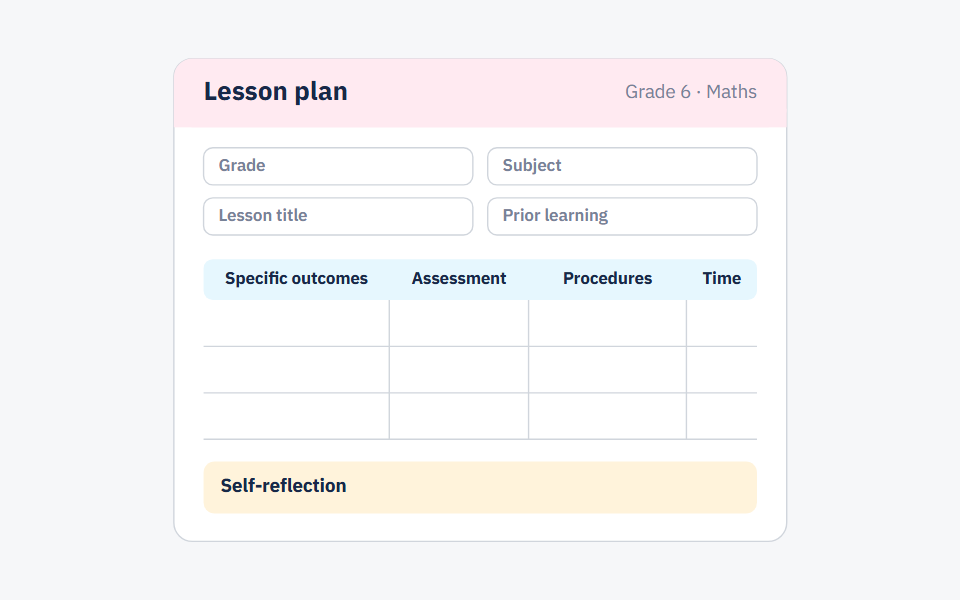
The honest limit of a rubric is that it takes time to write, and a short task with a right-or-wrong answer does not earn it. For the last question of a lesson an exit ticket is enough, and for planning the whole lesson there is the lesson plan template.
Frequently asked questions
- What is the difference between a numeric and a descriptive rubric?
- A numeric scale gives each criterion a score from 1 to 4 with no description; a descriptive one says in words what each level means. The most useful rubric does both, as the four above do.
- What is a rubric in Arabic?
- سلّم التقدير, or سلّم التقدير اللفظي for the descriptive kind; some say معيار التقييم. It is a table of criteria and levels, with a description for each level.
- How many levels should a rubric have?
- Usually four: an even number leaves no middle for an unsure marker to retreat to, and it is enough to separate “there” from “nearly there”. Three are enough in the early grades.
- Should students see the rubric before the task?
- Yes — that is most of its value. They read it before they start and check their draft against it before they hand in. A rubric a student first sees next to the score explains the score but does not improve the work.
Sources
Every fact in this post that we did not produce ourselves comes from one of these sources.
- Appropriate Criteria: Key to Effective Rubrics (Susan M. Brookhart) — Frontiers in Education, 2018-04-10
- Using Rubrics to Promote Thinking and Learning — ASCD, 2000-02-01
- Grading and Performance Rubrics — Eberly Center, Carnegie Mellon University, undated (page © 2025)
Written with String's editorial team: we use AI for research and first drafts, and a person checks every fact and every source before anything is published. How we write
Founder and CEO, String
“I grew up in a house of teachers.” I spent a year designing the STEM program for one of the largest school groups in Saudi Arabia, have written curriculum by hand, trained robotics coaches and sold software into schools, then left that job to build String in Amman.