Depth of Knowledge: questions at every level from one lesson
The four Depth of Knowledge levels describe the thinking a question demands, not how hard it is: recall, then skill and concept, then strategic thinking, then extended thinking that takes days. Here are 16 questions from one lesson, the area of a rectangle, four per level, with the reason for each.
Depth of Knowledge — question stems for each level
A free printable PDF, no sign-up.
- Definition
- Depth of Knowledge (DOK): A framework developed by Norman Webb that sorts standards, questions and tasks into four levels by the complexity of the thinking the answer requires, not by its difficulty: recall and reproduction, skill and concept, strategic thinking, and extended thinking.
The four levels: what thinking a question demands
Norman Webb first built the framework to evaluate the relationship between the complexity of academic standards and the complexity of the test items meant to measure them, as WebbAlign's DOK primer explains. WebbAlign is a program of the non-profit Wisconsin Center for Education Products and Services (WCEPS). The framework has since spread, and the same primer lists teachers using it to inform lesson plans, unit designs and classroom assessments. The table below summarises the four levels as the mathematics definitions describe them, as last revised by Webb and Sara Christopherson in 2026, with the sign that tells you which level a question is at.
| Level | What it demands | How you spot it in a question |
|---|---|---|
| 1. Recall and reproduction | Recalling a fact, definition or rule, or carrying out a procedure exactly as it was taught | The student either knows the answer or does not; nothing needs to be figured out |
| 2. Skill and concept | Some mental processing beyond a habitual response, and a decision about how to approach the problem | The student chooses the method, explains with concepts, or moves the idea from one representation to another |
| 3. Strategic thinking | Reasoning and analysis in a situation that is non-routine and more abstract | It is not clear from the first reading what solving it needs, and there may be more than one way to solve it |
| 4. Extended thinking | At least the complexity of level 3, in work that takes days or weeks | Planning, research and revision; it cannot be finished in one sitting |
16 questions from one lesson: the area of a rectangle
We picked a lesson every maths teacher knows and wrote four questions at each level. The questions were written for this post, not taken from a textbook, and classified against WebbAlign's mathematics definitions; the second column says why each one sits where it does. Change the numbers to suit your class.
Level 1: recall and reproduction
| Question | Why this level |
|---|---|
| 1. Write in words the rule for the area of a rectangle. | Recalling a memorised rule. |
| 2. Find the area of a rectangle 8 cm long and 5 cm wide. | Applying a known formula, which the mathematics definitions place at level 1 explicitly. |
| 3. If a rectangle's length and width are in metres, what unit is its area in? | A fact the student knows or does not. |
| 4. A rectangle on squared paper is 6 squares long and 3 squares wide. How many squares does it cover? | Reading directly from a diagram. |
Level 2: skill and concept
| Question | Why this level |
|---|---|
| 5. A rectangular room has an area of 12 m² and is 4 m long. How wide is it? | The student works out the operation from the words, then reports the answer with its unit in context. |
| 6. Find the perimeter of a rectangle 5 cm long and 3 cm wide, then its area, and explain why the two answers have different units. | Distinguishing between two mathematical ideas: perimeter and area. |
| 7. Use squared paper to show why we multiply length by width to find the area. | Explaining the reason for a procedure in the student's own words, with a representation other than the formula. |
| 8. A rectangle is 10 m long and 4 m wide. What happens to its area if we double the length and keep the width? | Describing the effect of changing one quantity, in one given case. |
Level 3: strategic thinking
| Question | Why this level |
|---|---|
| 9. A student says: “If two rectangles have the same perimeter, they have the same area.” Do you agree? Support your answer with two examples. | Critiquing a claim and building an argument; the route to the answer is not visible on first reading. |
| 10. A farmer has 20 metres of fencing to put around a rectangular garden. Which length and width give the largest area, if the sides are whole metres? Justify your choice. | Modelling a situation with a constraint, and comparing possible answers before choosing one. |
| 11. The school wants to tile a rectangular yard 12 m long and 8 m wide with square tiles 40 cm on a side. How many tiles does it need? Write your plan before you calculate, then say what could make the number the school buys larger than your answer. | Modelling a real situation with its constraints, not applying one formula. |
| 12. Conjecture: if we double both the length and the width of a rectangle, how many times larger is its area? Test your conjecture on three rectangles, then explain why it holds for every rectangle. | A conjecture, then a test, then a general argument. |
Level 4: extended thinking
| Task | Why this level |
|---|---|
| 13. Two-week project: design a plan for a school garden of no more than 60 m², with rectangular planting beds and paths at least one metre wide. Draw two designs, work out the area of every part, then choose one and defend your choice to the class. | Designing and weighing alternatives over several days. |
| 14. Over a week: measure your classroom's walls, windows and door, work out the area that needs paint, find the coverage printed on a real paint tin, then write a report on how many tins are needed and how you got there. | Measuring, researching and reporting, where each decision depends on the one before. |
| 15. Over two weeks: measure the floor of your classroom and of two others in the school, work out each student's share of the area, then write the school a recommendation backed by the numbers. | Collecting data, then a conclusion and a recommendation built on it — not data collection alone. |
| 16. Design a board game that teaches a younger class the area of a rectangle: write the rules, try it with classmates, revise it twice from what you saw, then write what you changed and why. | Original work through repeated revision, which asks students to watch their own thinking. |
Compare questions 8 and 12. The idea is the same: how changing the sides changes the area. But question 8 asks students to describe what happens in one given case, and question 12 asks for a general conjecture and an argument that holds for every rectangle. What changed is the kind of thinking, not the topic or the numbers.
The common mistake: confusing depth with difficulty
The general guidelines in the mathematics definitions say it plainly: consider the complexity of the cognitive demands, not the difficulty for students. The science definitions add that level 1 expectations can be difficult and may take time and effort to learn, although they are not complex. Finding the area of a rectangle is a hard question, but it is a routine procedure at level 1. “Show with a drawing why a rectangle has an area of 6” is easier, but it asks for an explanation that uses the concept, so it is level 2.
WebbAlign's definitions warn against four more mistakes:
- Judging by the verb alone: “identify” can sit at level 1 or higher. Identifying the attributes of a triangle is a definitional task; identifying the most appropriate mathematical model for a situation takes analysis. The same goes for “describe”: listing the steps of a worked answer is level 1, while describing it with a mathematical argument is more complex. Hence the guideline: do not rely on verbs; consider the kind of thinking a correct answer requires.
- Treating the levels as a teaching sequence: WebbAlign's primer says DOK does not suggest any hierarchy of teaching or learning progression, and that no level is “better” than another. The science definitions add that students do not need to master level 1 before working on more complex tasks.
- Assuming a long task is level 4: the definitions give the example of a student who records a river's water temperature every day for a month, then organises and graphs the data. It is long, but it is level 2, because it is repetitive and does not demand higher-order thinking.
- Mistaking a confusing question for a deep one: a question that is hard to understand because of an error or its wording is not more complex; it simply needs editing, as the general guidelines put it.
How to use the levels in your next test
Label the questions on the last test you wrote
Write the level next to each question. If every one is level 1, you now know what your test is missing and where to start.
Tie the level to the objective, not to a fixed ratio
The primer notes that the levels are used to tell content developers the target level for each item and the expected spread of levels on a test, but the definitions give no fixed ratio; what you are measuring decides the spread. If the lesson's objective is “students explain why…”, a level 1 question cannot measure it. Measurable learning objectives shows how to write the objective itself.
Raise one question by one level
Take a level 1 question and add a decision, an explanation, or a claim for students to judge — as in the move from question 2 to question 8, then to question 12 above. We suggest making your exit ticket a level 2 question: two lines of explanation tell you what a student understood, not only what they memorised.
Keep level 4 for projects
The science definitions say that on-demand tests are not the right tool for judging the full scope of level 4 work, and that it is best suited to classroom assessment. Assess the project with a rubric that describes its stages, not with a question on the test paper.
Read the results through the levels
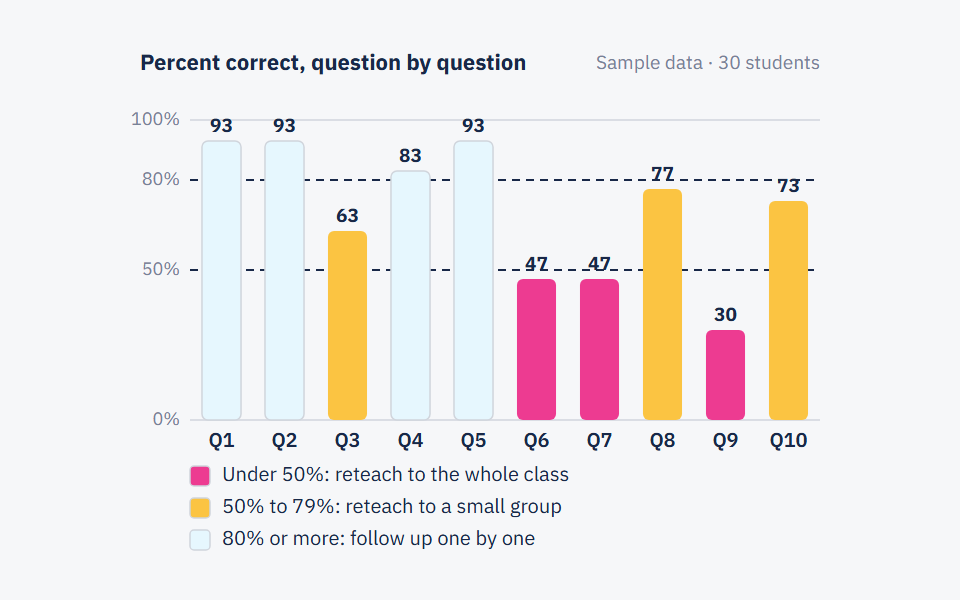
When half the class misses a question, ask: is it deeper than anything they practised, or only harder? Analysing test results shows how to work out the percent correct on each question.
The levels are not only for maths. WebbAlign also publishes definitions for science, reading and social studies, and one of the level 1 examples in the science definitions is labelling a diagram of the water cycle with the correct terms. Here are four questions from a lesson on the water cycle, one per level:
| Level | Question |
|---|---|
| 1 | Label the stages on a diagram of the water cycle. |
| 2 | Drops of water appear on the outside of a glass of cold water. Explain why, using the words condensation and water vapour. |
| 3 | Design a short experiment to test how temperature affects how fast water evaporates: what will you change, what will you measure, and what will you keep the same? |
| 4 | Over three weeks: plan and run an experiment comparing evaporation from two containers, one in the shade and one in the sun, then write a report that explains the results and proposes a way to cut evaporation from a rooftop water tank. |
Frequently asked questions
- What are the four Depth of Knowledge levels?
- Recall and reproduction, skill and concept, strategic thinking, and extended thinking. All four describe the complexity of the thinking an answer requires, not how hard the question is.
- What is the difference between DOK and Bloom's taxonomy?
- Bloom's taxonomy classifies learning objectives into six levels and usually comes with lists of verbs for each, as in the University of Arkansas guide. DOK describes the complexity of what the task itself demands, and its definitions warn against relying on the verb. We suggest Bloom's when you write the objective, and DOK when you write the question that measures it.
- Do Webb's levels work for every subject?
- WebbAlign publishes separate definitions for mathematics, science, reading and social studies. This post applies the levels to one maths lesson and one science lesson.
- How many questions from each level should a test have?
- Webb's definitions give no fixed ratio. Our advice: measure each objective with a question at its level, put at least one level 2 or level 3 question in every quiz, and keep level 4 for projects.
Sources
Every fact in this post that we did not produce ourselves comes from one of these sources.
- DOK Definitions for Mathematics (Norman Webb, Sara Christopherson) — WebbAlign, Wisconsin Center for Education Products and Services, 2026 revision (first published by Webb, 2002)
- DOK: Categories of Cognitive Engagement for Science (Norman Webb, Sara Christopherson) — WebbAlign, Wisconsin Center for Education Products and Services, 2019 revision
- What is Depth of Knowledge (DOK)? — DOK Primer — WebbAlign, Wisconsin Center for Education Products and Services, 2025
- Using Bloom's Taxonomy to Write Effective Learning Objectives — Teaching Innovation and Pedagogical Support, University of Arkansas, 2022-07-26
Written with String's editorial team: we use AI for research and first drafts, and a person checks every fact and every source before anything is published. How we write
Founder and CEO, String
“I grew up in a house of teachers.” I spent a year designing the STEM program for one of the largest school groups in Saudi Arabia, have written curriculum by hand, trained robotics coaches and sold software into schools, then left that job to build String in Amman.