A Grade 6 fractions worksheet ready to print, and how it is built from one goal
A good worksheet starts from one goal and orders its problems for it: three warm-up items everyone can do, five that climb one step at a time, two word problems, and one mistake for the student to explain. This Grade 6 sheet on adding and subtracting fractions is ready to print, with the reason for every item and how to adapt it to your class.
Worksheet: adding and subtracting fractions with unlike denominators — Grade 6
A free printable PDF, no sign-up.
- Definition
- Worksheet: A page on which a student works alone through problems ordered for one goal of the lesson, so their work shows you how far they have got.
The whole sheet: eleven problems for one goal
Goal: students add and subtract two fractions with different denominators and write the answer in simplest form. The problems were written for this post, not copied from a textbook. They suit Grade 6 in Jordan, the GCC and Egypt, and Grade 5 or 6 elsewhere. The answer key is not on this page; ask for one in String when you make the sheet there. Solve the problems yourself anyway before you hand them out.
| Section | Problem | Why it is there |
|---|---|---|
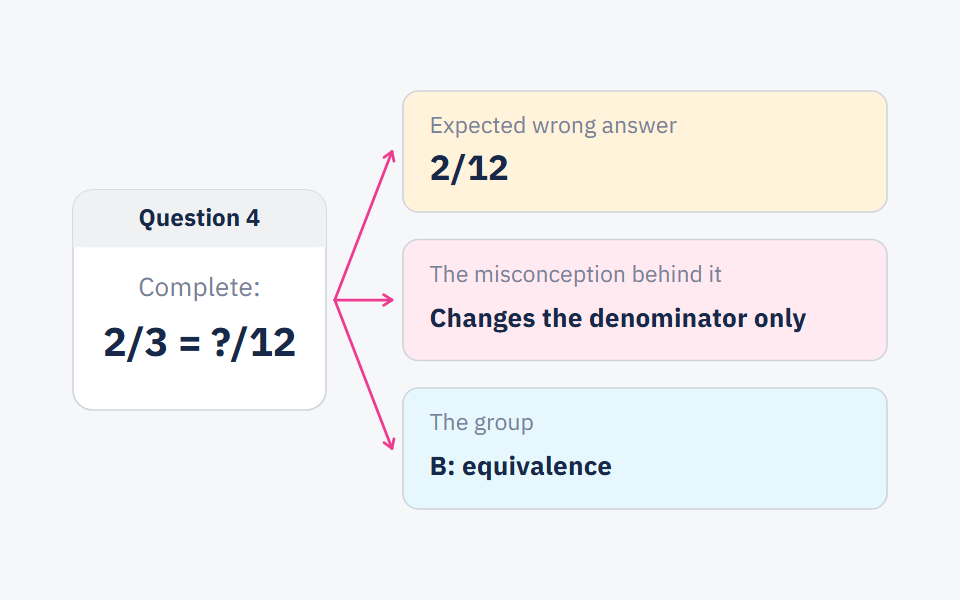
| Warm-up | 1. Complete: | Equivalent fractions: the step everything after it stands on |
| Warm-up | 2. What is the least common multiple of 6 and 8? | The least common denominator is this very number |
| Warm-up | 3. , in simplest form | Subtracting with a shared denominator, and simplifying |
| Practice | 4. | One denominator divides the other, so only one fraction changes |
| Practice | 5. | The same relationship in subtraction, and the answer simplifies |
| Practice | 6. | Denominators with no common factor, so both fractions change |
| Practice | 7. | The denominators share a factor, so the least common denominator is smaller than their product |
| Practice | 8. , as a mixed number | The answer is greater than one |
| Word problem | 9. A jug holds litre of juice. litre is poured into a glass. How much is left in the jug? | Subtraction in a real situation with sensible numbers |
| Word problem | 10. A student read of a story on Monday and of the whole story on Tuesday. Has the student read more than half of the story? Explain. | Two steps: add, then compare the result with one half |
| Explain the mistake | 11. A student wrote: . Explain the mistake in a sentence, then correct the work. | Sees a common mistake from the outside |
Why four sections, in this order
Warm-up: three problems almost everyone gets right
Barak Rosenshine writes in “Principles of Instruction” (American Educator, Spring 2012) that the optimal success rate in practice appears to be about 80 percent, and that practice with a low success rate risks students practising errors. So the first three problems review what the goal needs: equivalence, common multiples, and subtracting with a shared denominator.
Practice: five steps, each adding one new difficulty
The problems climb not by bigger numbers but by the relationship between the denominators: one divides the other, then they share no factor, then they share a factor that makes their product larger than needed, then the answer exceeds one. If a student stumbles only on problem 7, you know what is missing is the least common denominator, not adding itself.
Two word problems: sensible numbers in a real situation
The fractions practice guide from the Institute of Education Sciences (IES), published in September 2010, recommends presenting fraction computation in real-world contexts with plausible numbers. Problem 10 asks for a second step after adding, comparing with one half, so calculation alone is not enough.
Explain the mistake: one problem where the student sees the error from outside
The same guide names adding or subtracting the numerators and the denominators separately as a common fraction mistake, and suggests presenting meaningful problems that make students think about why that approach is wrong. Problem 11 does that: its answer is 1, which is more than the the student started from, and that is impossible when you subtract.
Three mistakes that turn a worksheet into busywork
- Twenty problems of the same kind: after the fifth you learn nothing new about the student. Five problems that climb tell you exactly where they stumble.
- Two goals on one sheet: adding and multiplying together, or common and decimal fractions together. When a student goes wrong, you cannot tell which goal they missed.
- A word problem with unreal numbers: a jug holding 37 litres of juice is nothing a student has seen, so they cannot judge their answer. Choose sensible numbers, so students can check their answer by common sense.
How to adapt it to your class
- Change the numbers, keep the relationship between denominators: if you replace , choose two denominators that also share a factor, such as 6 and 9 or 8 and 12; that problem is there to test the least common denominator.
- Match your class's book: if you teach in Jordan, the Grade 6 maths student book and workbook for each semester are published on the National Center for Curriculum Development's site. Take numbers and situations from the lesson you are teaching, without copying the book's exercises.
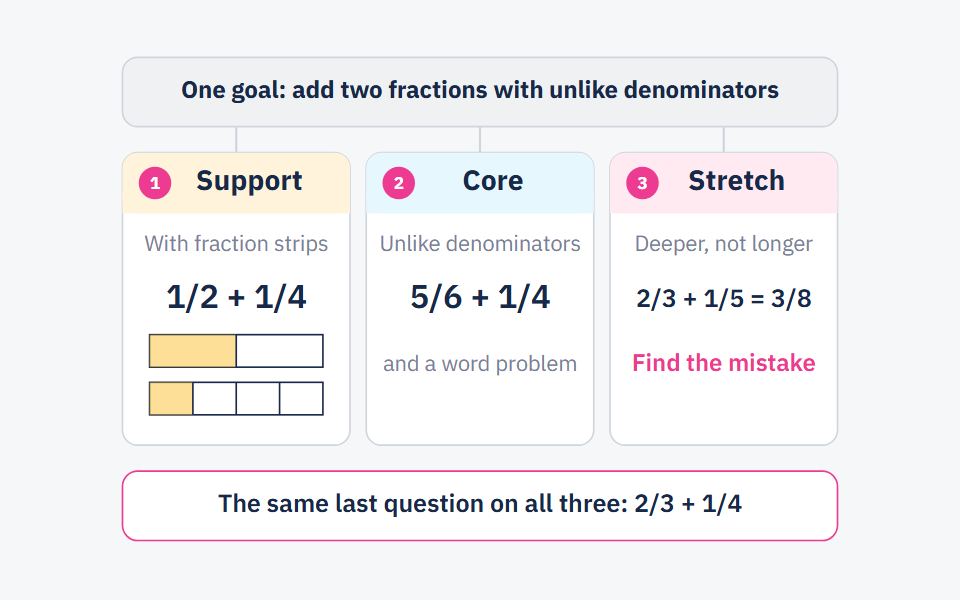
- For a class with wide gaps: use this sheet as the core and derive a support and a stretch version, as in one worksheet at three levels.
- For students who are a step short of the goal: if a student gets all the warm-up problems wrong, this sheet is not their place today. Start from what the diagnostic test before the unit shows.
- For decimals: the same skeleton works for a decimals worksheet: a warm-up on place value, then adding numbers with different numbers of decimal places, then a word problem, then a mistake to explain.
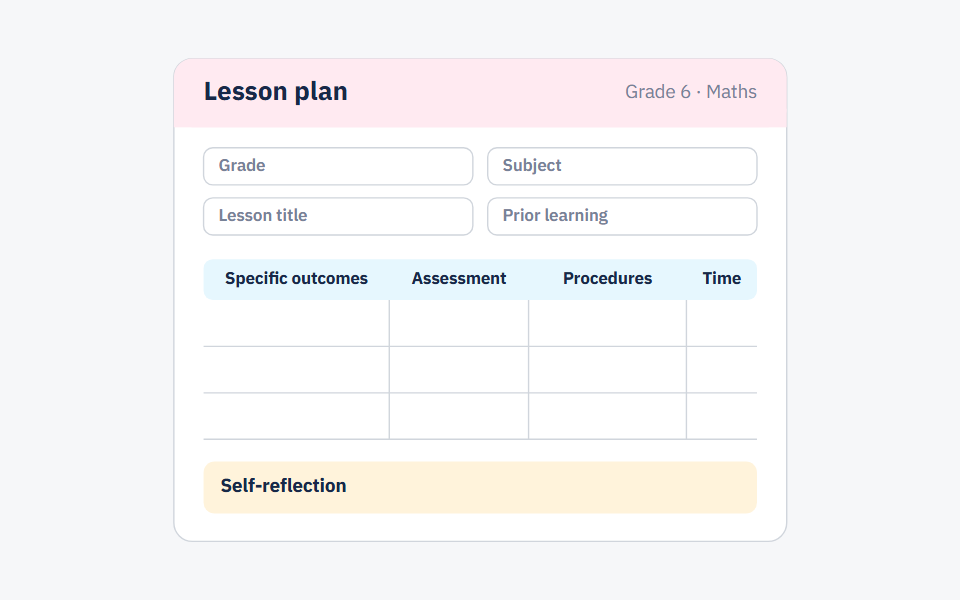
The honest limit: this sheet is for independent practice after the explanation, not for teaching addition from scratch. If the lesson has not been taught yet, start with a worked example as in the lesson plan, then hand out the sheet.
Frequently asked questions
- Where can I get a Grade 6 fractions worksheet PDF?
- At the top of this page: the whole sheet on one printable A4 page, no sign-up. For another lesson, make one in String for free.
- How long does the sheet take?
- It is designed for the independent-practice part of a lesson, about 15 minutes in a 45-minute lesson plan. Early finishers go back to problem 10 and write a clearer explanation.
- Does it work for Grade 5 or Grade 7?
- It works for any class where students add and subtract fractions with unlike denominators. For a younger class, soften problems 7 and 8; for an older one, add a third fraction or a mixed number.
- What is the difference between a worksheet and a quiz?
- A worksheet is practice: students work through it to learn, and can make mistakes without penalty. A quiz measures what they have learned. A good worksheet also tells you what students need, because its problems are ordered.
Sources
Every fact in this post that we did not produce ourselves comes from one of these sources.
- Developing Effective Fractions Instruction for Kindergarten Through 8th Grade (Siegler et al.), IES Practice Guide NCEE 2010-4039 — Institute of Education Sciences, U.S. Department of Education (via ERIC), 2010-09
- Principles of Instruction: Research-Based Strategies That All Teachers Should Know (Barak Rosenshine) — American Educator, 2012 (Spring issue)
- الكتب المدرسية — الصف السادس (كتاب الطالب وكتاب التمارين في الرياضيات) — المركز الوطني لتطوير المناهج، الأردن, 2026-2027 (page read 2026-10-22)
Written with String's editorial team: we use AI for research and first drafts, and a person checks every fact and every source before anything is published. How we write
Grade 6 mathematics · Jordan
Teaches Grade 6 mathematics in Jordan and writes here about teaching maths from inside the classroom.