The weekly plan: a one-page template that gives you your weekend back
A weekly plan is one page per class: five lessons, each with a goal, the question that checks it at the end, homework and materials. You write it in 40 minutes on the last school day of the week, before you leave school, so the only plan you take home is the next lesson's.
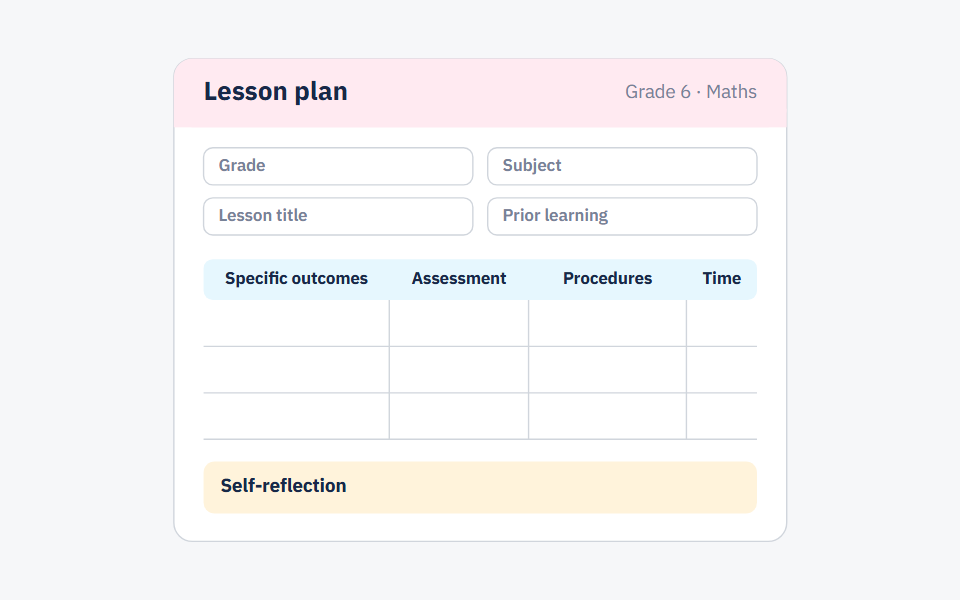
Weekly plan — printable template
A free printable PDF, no sign-up.
- Definition
- Weekly plan: A page a teacher writes for each class before the week starts, setting the goal of each lesson, the question that checks that goal at the end of it, the homework, and the materials that must be ready.
The template: five days, four lines each
A weekly plan is not five lesson plans squeezed onto one page. It is the decision that comes before them: what has to happen in each lesson, and how you will know it did. In “How to Write a Lesson Plan” (Cult of Pedagogy, September 2026), Jennifer Gonzalez describes this step: a rough outline of the unit noting “the main thing that has to happen on each day”, without the specifics of each lesson yet. The template below is that outline, set out as a table.
| Line | What you write | Why |
|---|---|---|
| Week goal | One sentence: what students can do on Thursday that they could not do on Sunday | It is the yardstick for all five lessons: a lesson that does not serve it belongs to another week |
| Goal (each day) | A verb you can see on paper: write, add, subtract, compare | If you cannot check it at the end of the lesson, it is a topic, not a goal |
| Check (each day) | The last question of the lesson, written as you will ask it | It tells you what to do in tomorrow's lesson before you start it |
| Homework (each day) | How many problems and what kind, or “no homework” | A short task on today's skill beats a full page copied in the morning |
| Materials (each day) | What must be printed or prepared, and how many copies | It shows you in one place everything the week needs printed |
| Follow-up | Names of students who need another go, and what moves to next week | Next week starts from here |
A full example: a week of adding and subtracting fractions, Grade 6
This example was written for this post, not copied from a textbook or an official form. It assumes five maths lessons a week, Sunday to Thursday. If your school week starts on another day, change the day names and nothing else.
Week goal: students add and subtract two fractions, with like or unlike denominators, write the answer in simplest form, and judge in a word problem whether their answer is sensible.
| Day | Goal | Check at the end of the lesson | Homework | Materials |
|---|---|---|---|---|
| Sunday | Write a fraction equivalent to a given one with a set denominator, and simplify a fraction. (The lesson opens with five minutes of review on multiples and factors) | “Write with denominator 20, then write in simplest form.” | Six problems: three on equivalence, three on simplifying | Fraction strips: one sheet per pair |
| Monday | Add and subtract two fractions when one denominator is a multiple of the other | “” | Five problems, and one “explain the mistake”: a student wrote | Nothing new |
| Tuesday | Add two fractions with unlike denominators by finding the least common denominator | “, and write the first step you took.” | Four addition problems, one of them a word problem | Independent practice sheet at two levels: one per student |
| Wednesday | Subtract two fractions with unlike denominators and write the answer in simplest form | “” | The fractions worksheet: parts one and two | The worksheet: one per student |
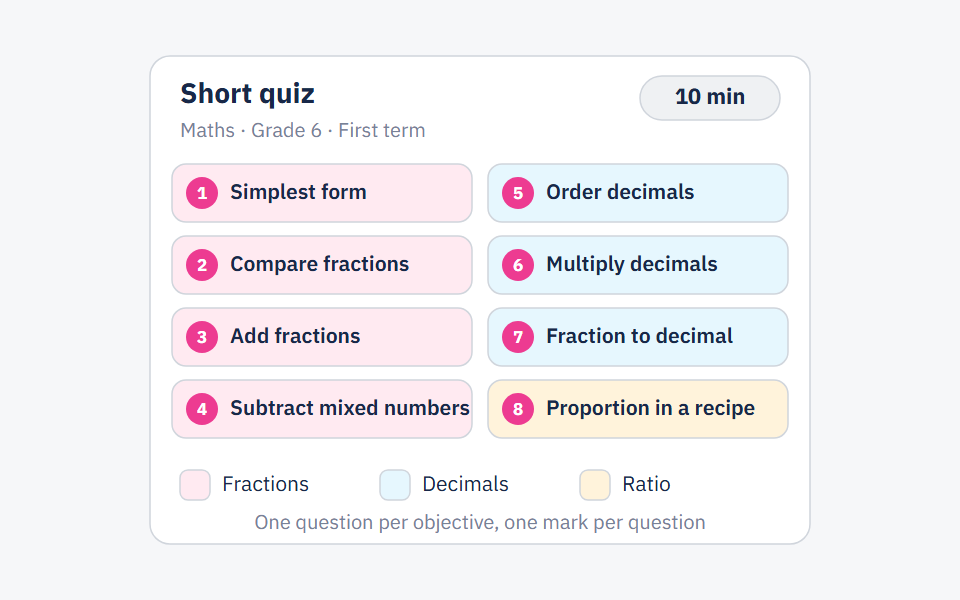
| Thursday | Solve a word problem with adding or subtracting fractions, and judge whether the answer is sensible | A short quiz: five questions on the whole week in 10 minutes | No new homework | The quiz, printed, and four word problems on cards for group work |
Follow-up: this line is written during the week, not at its start. Students who got Sunday's check wrong start Monday's lesson with two equivalence problems with you. Students who added the numerators and the denominators on Tuesday's check go back to fraction strips on Wednesday. Moves to next week: mixed numbers, and any question more than a third of the class got wrong in Thursday's quiz.
Notice three things about this week. The first lesson opens with a review and the last one ends with a short quiz, which is what Barak Rosenshine describes in “Principles of Instruction” (American Educator, Spring 2012): many successful programmes, especially in the elementary grades, built in extensive review, and one way to do it is to review the previous week's work every Monday and the previous month's work every fourth Monday (for you, the first day of your school week, whichever it is). The same article reports that even at secondary level, classes with weekly quizzes scored better on final exams than classes with only one or two quizzes in the term. The third thing: each lesson builds on the one before it, so if a lesson runs late, the table shows you what slips with it.
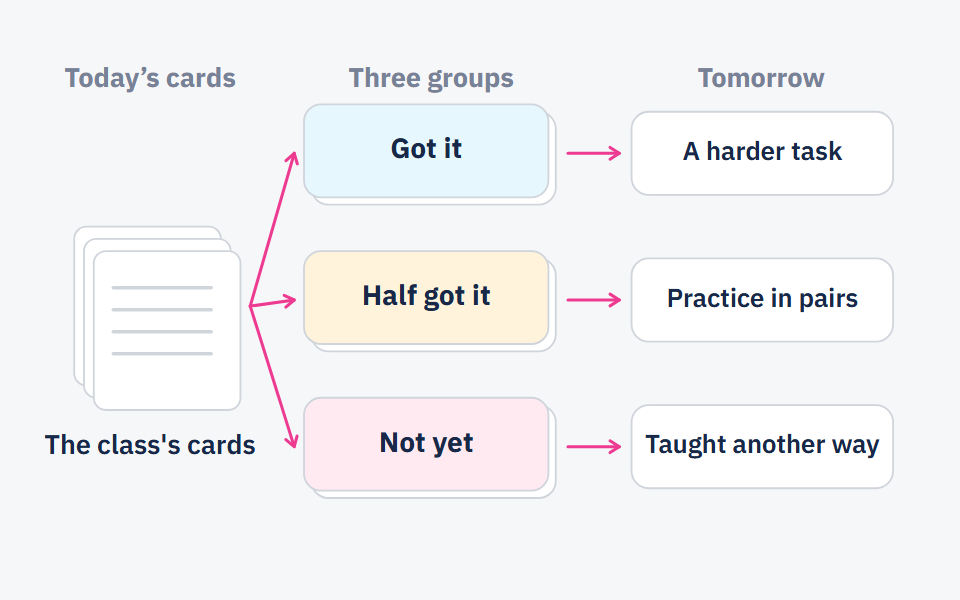
Tuesday's lesson is planned in full, all forty-five minutes of it, in the lesson plan template. And the check at the end of each lesson is an exit ticket: you sort its answers into three piles, then write what you decide in the follow-up line.
The 40-minute routine: in this order, on the last school day
Write the plan on the last school day of the week, at school, with the exit tickets and the week's quiz in front of you. In a Pew Research Center survey of 2,531 US public school teachers, run in October and November 2023, 84% said there is not enough time in their regular work hours for tasks like grading, lesson planning and paperwork. We have no comparable figure for Arab teachers, but what is not done at school gets done at home. The order below makes the plan a forty-minute job instead of an evening.
Read last week (5 minutes)
Sort the exit tickets and Thursday's quiz: who needs another go, and which question many students missed. Write the names in the follow-up line, then write three review questions to open the first lesson.
Fix the week's goal (5 minutes)
Open your pacing guide and find where you are: which lessons this week, and how many periods each. Then write the week's goal in one sentence. If it needs two sentences, your week holds two topics, and one of them belongs to next week.
Write five goals and five checks (10 minutes)
A goal for each day, then its question straight after, before any activity. This is backward design: the goal first, then how you will measure it, then the activities. Do not write the activities here; they belong in the lesson plan, the day before the lesson.
Decide homework and materials (10 minutes)
A short task on each day's skill, or “no homework” when tomorrow holds a quiz or a review. Then the materials: what gets printed, cut out or shown. Write the number of copies next to each.
Gather what to print and prepare (5 minutes)
Copy the materials line from all five days into one list, and send it all to print at once. A sheet printed on Sunday for Wednesday's lesson is not forgotten on Wednesday morning.
Check the plan before you close it (5 minutes)
Three questions: does each check measure its day's goal? Is there a review at the start of the week and a quiz at the end? Is there room for a lesson that runs late? In the example above, Thursday is that room: if a lesson slips, the word problems get shorter and the quiz stays.
Three mistakes that turn a weekly plan into a form you fill and never use
- Copying lesson titles from the pacing guide: “Monday: adding fractions” is a title, not a plan. The plan says what students will do and how you will know they did it.
- Five full lesson plans in one evening: the fourth lesson changes after the third lesson's exit tickets. Plan the week at the level of goals and checks, and write each lesson's detail the day before it.
- A week with no room for a late lesson: a plan that assumes every lesson will go as written falls apart by the second one. Make the last day of the week a review and a short quiz, so a delay can borrow from it.
If you teach more than one class, or your school wants an official form
- Two sections of the same grade: one page is enough; add two follow-up columns, one per section. The goal and the question are the same; the delays are not.
- Different grades: one page per class. Start with the class that has a quiz or the end of a unit this week, since it is the one that cannot slip.
- An official form: your school or supervisor may require a weekly planning form, with fields that differ from country to country, and we do not reproduce any official form here. But goals — “learning outcomes” in many forms — assessment questions and homework appear in most of them. Write the page this way first, then copy it across.
- Subjects other than maths: the four lines work for any subject. In a language class, the check might be “Write the main idea of the text in one sentence.”
Frequently asked questions
- What is the difference between a weekly plan and a lesson plan?
- The weekly plan decides each lesson's goal and the question that checks it. The lesson plan decides how the minutes of one lesson get there, and is written the day before.
- What is the difference between a weekly plan and a pacing guide?
- A pacing guide spreads the term's lessons across its weeks and is written once. A weekly plan takes one week of that guide, gives each lesson a goal, a check and homework, and changes with what happened the week before.
- Where can I get a free weekly lesson plan template to print?
- At the top of this page: a blank one-page template as a PDF, no sign-up. If you want a version to edit on screen, make it in String for free.
- How long does a weekly plan take to write?
- About forty minutes in the order above, with the exit tickets and quiz results in front of you. It takes longer in the first week of a unit, because the week's goal needs a read of the whole unit.
Sources
Every fact in this post that we did not produce ourselves comes from one of these sources.
- Principles of Instruction: Research-Based Strategies That All Teachers Should Know (Barak Rosenshine) — American Educator, 2012 (Spring issue)
- How to Write a Lesson Plan (Jennifer Gonzalez) — Cult of Pedagogy, 2026-09-01
- What's It Like To Be a Teacher in America Today? — Pew Research Center, 2024-04-04
Written with String's editorial team: we use AI for research and first drafts, and a person checks every fact and every source before anything is published. How we write
Grade 6 mathematics · Jordan
Teaches Grade 6 mathematics in Jordan and writes here about teaching maths from inside the classroom.