Lesson plan template on the official plan-book fields, with examples
A one-page lesson plan template laid out on the fields of the official lesson-planning book, so you can copy it straight into yours. It comes with filled-in lessons from maths, science and Arabic.
Lesson plan
A free printable PDF, no sign-up.
- Definition
- Lesson plan: A lesson plan is the page you write before you teach. It says what students should be able to do by the end, how you'll spend the period, and how you'll know they got there. Teachers keep it in the official lesson-planning book their ministry issues, which many of them simply call the preparation book.
In Jordan you can draft here and copy straight into your book without renaming a thing, since we kept the book's fields in the book's order. US teachers will know most of them by other names (objectives, prior knowledge, materials, procedures, assessment, reflection). Two may be new: links to earlier and later grades, and links to other lessons and subjects in the same grade.
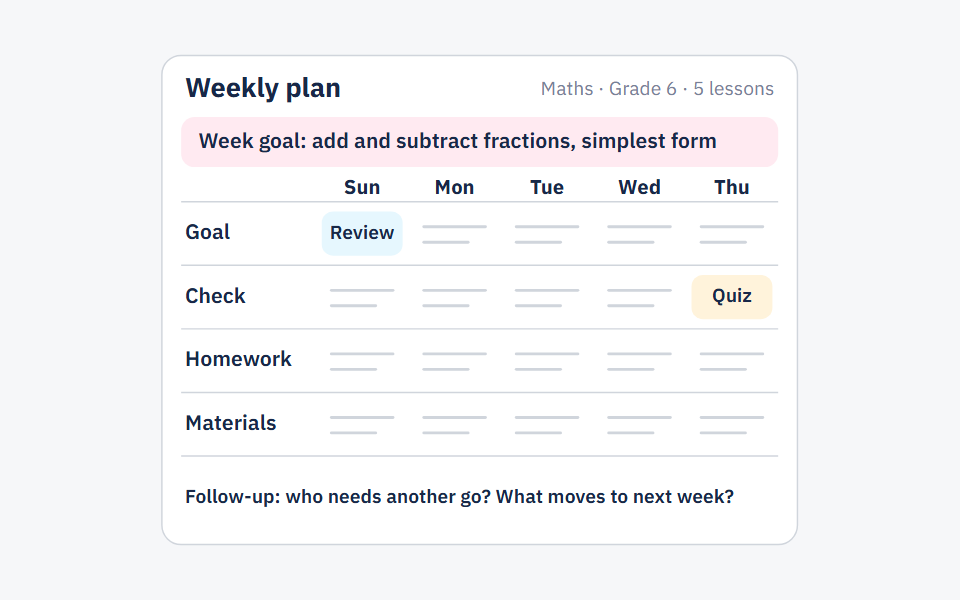
The fields, and how to fill in each one
The field names and their order follow the ministry's planning book, as printed in a 2014 copy of the form. Check them against the book your school gave you, and go with the book where they differ. The Arabic column copies the form exactly.
| Field | In the ministry book | What you write |
|---|---|---|
| Grade | الصف | Grades 1 to 10 of basic education. Secondary uses a level (المستوى) instead. |
| Subject | المبحث | Mathematics, science, Arabic, and so on. |
| Unit title | عنوان الوحدة | As it appears in the textbook. |
| Lesson title | عنوان الدرس | As it appears in the textbook. |
| Number of periods | عدد الحصص | How many class periods the lesson will take. |
| Dates, from and to | التاريخ من ... إلى | The day you expect to start the lesson and the day you expect to finish it. |
| Prior learning | التعلم القبلي | What students need before the new lesson can work: concepts, skills, facts and rules. Most US teachers would say prior knowledge. |
| Vertical links | التكامل الرأسي | Where the lesson connects to the same subject in earlier or later grades, with the topic, book and unit. |
| Horizontal links | التكامل الأفقي | Where it connects to other lessons in the same subject, or to other subjects in the same grade, with the subject, book and unit. |
| No. | الرقم | The outcome's number: 1, 2 and so on. |
| Specific outcomes | النتاجات الخاصة | The knowledge, skills and attitudes students should reach by the end of the lesson, each with a verb you can see. In US terms, the lesson's learning objectives. |
| Materials, tools and equipment (learning resources) | المواد والأدوات والتجهيزات (مصادر التعلم) | Everything you need: teaching aids, technology, books, models, samples, films. |
| Teaching strategies | استراتيجيات التدريس | Its number from your book's list, or 6 and its name |
| Assessment strategy | التقويم: الإستراتيجية | How you'll gather evidence of learning, by its number |
| Assessment tool | التقويم: الأداة | What you'll record that evidence with, by its number |
| Procedures | التنفيذ: الإجراءات | How the lesson's activities will run, in order. |
| Time | التنفيذ: الزمن | The minutes you expect each procedure to take, one by one. |
| Self-reflection | التأمل الذاتي: أشعر بالرضا عن · تحديات واجهتني · اقتراحات للتحسين | What you're pleased with, the challenges you met and suggestions for improvement, filled in during and after the lesson. |
The Time column has to add up to the period (or periods, if the lesson runs longer). Our example leaves out the strategy and tool numbers, so take those from your own book's list.
Before you fill it in (the ministry's own list)
- Read the lesson carefully and work out what it contains.
- Go back to the teacher's guide for the lesson.
- Check that the materials, tools and equipment you need are available.
We skipped the book's cover page and daily follow-up table (جدول المتابعة اليومي), which belong to the whole book, and added an optional homework line for forms like Oman's that put homework in the plan.
Where the research fits inside the fields
The ministry's fields tell you what to write down. They don't say how to run the lesson. Most of what we put in them comes from Barak Rosenshine's Principles of Instruction (American Educator, spring 2012), plus two ideas from Wiliam and Gonzalez.
| Practice | Field it goes in | What you write there |
|---|---|---|
| Begin with a short review of previous learning (Rosenshine, principle 1) | Prior learning, plus the first procedure and its time | What the lesson needs, three or four review questions, and the minutes |
| Present new material in small steps, with practice after each step (2) | Procedures and time | The new content cut into steps, each followed by a short task, with time for each step |
| Provide models (4), including thinking aloud | Procedures (the presentation) and teaching strategies | The worked example, its steps in order, and what you'll say aloud while you solve it |
| Guide student practice (5) | Procedures, and materials | The problems, and the question you'll ask as you go round the room |
| Ask a large number of questions and check every student's response (3); check for understanding (6) | Assessment strategy and tool | How you'll see every answer (a card held up, a word with a neighbour, a written summary, hands) and what you'll record |
| Obtain a high success rate, about 80 percent (7) | Assessment, and procedures | The decision point after guided practice |
| Require and monitor independent practice, on the same material as guided practice (9) | Procedures | The task, with the number of the outcome it serves |
| Exit pass (Dylan Wiliam) | Assessment (the closing assessment), and suggestions for improvement | The question, and what each kind of answer means for tomorrow |
| Backward design (Jennifer Gonzalez, after Wiggins and McTighe) | The order you fill the sheet in, not a field | Outcomes first, then assessment, then procedures |
In one maths study Rosenshine reports, the most effective teachers spent about 23 minutes of a 40-minute period on lecture, demonstration, questioning and working examples. The least effective spent only 11 minutes presenting new material. He never sets a lesson order or a minute-by-minute split, though, and nor does the ministry's form. The 5, 10, 10, 15 and 5 in our example are our own call. Move them around.
The decision point comes from his principle on success rates, where he puts the best rate at about 80 percent. If fewer than about 8 in 10 guided-practice answers are right, reteach before students work alone.
We took the exit card from Dylan Wiliam's Classroom Assessment: Minute by Minute, Day by Day in Educational Leadership (November 2005). Students answer your question on an index card and hand it in as they leave. He calls it an exit pass (most US teachers say exit ticket). It can be what he calls range-finding, a question that helps you judge where to start tomorrow.
Our fill order is from Jennifer Gonzalez's How to Write a Lesson Plan on Cult of Pedagogy, which credits Wiggins and McTighe's Understanding by Design. Measurable objectives first, then the assessment that measures them, and only then the lessons. She's describing a whole unit, so using it for one lesson is our adaptation. On our sheet that's outcomes, then assessment, then prior learning, procedures and materials.
Filled-in examples from maths, science and Arabic
The first example is a Grade 6 maths lesson on adding fractions with unlike denominators, with every field filled in. Two shorter ones follow, from science and Arabic, showing the fields that change from lesson to lesson. The titles are ours, so copy the real unit and lesson titles from your textbook. We've assumed a 45-minute period. If yours is longer or shorter, keep the same proportions.
| Field | What we wrote |
|---|---|
| Grade and subject | Grade 6 of basic education (السادس الأساسي), or sixth primary (السادس الابتدائي) in the Gulf and Egypt. Mathematics. |
| Unit and lesson titles | Copy them from your textbook. |
| Number of periods | 1 (a 45-minute period, which is our assumption) |
| Dates | Left blank. |
| Prior learning | Equivalent fractions; least common multiple; adding two fractions with the same denominator; simplifying a fraction. |
| Vertical and horizontal links | You fill these in, from earlier and later grades' books and from other Grade 6 books, because they depend on the edition you teach from. |
| Specific outcomes | 1. Adds two fractions with different denominators by finding a common denominator. 2. Writes the sum in simplest form. |
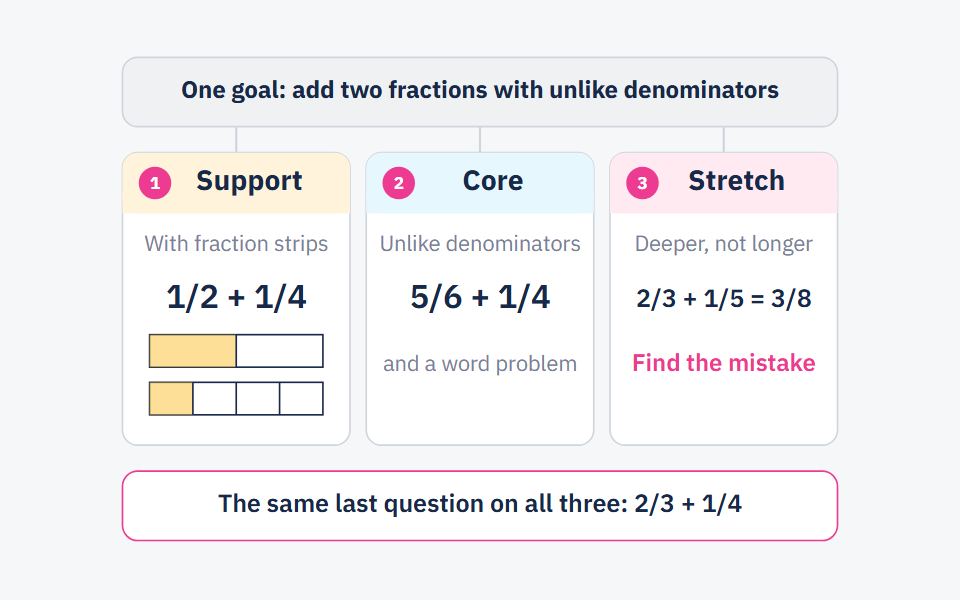
| Materials, tools and equipment | The board; a worksheet at two levels; small cards for the exit card; fraction strips drawn on the worksheet for students who need them. |
| Teaching strategies | Direct instruction (التدريس المباشر) for the presentation, cooperative learning (التعليم التعاوني) for pairs. Write the number for each from your own copy. |
| Assessment strategy | Observation (الملاحظة) while you go round in guided practice; pen-and-paper (القلم والورقة) for the exit card. |
| Assessment tool | A checklist (قائمة الرصد), yes or no for each outcome and each student. The ministry's booklet lists rating scales and checklists as tools for observation but names no tool for pen-and-paper, so using the checklist for the exit card is our call. |
| Self-reflection | Pleased with and Challenges I met stay empty until you've taught the lesson. Suggestions for improvement holds the three rules below. |
| Time | Procedure | Outcome no. |
|---|---|---|
| 5 | Introduction (التمهيد). Four questions on the board: a fraction equal to with denominator 12 (); the least common multiple of 4 and 6 (12); (); simplify (). | Prior learning |
| 10 | Presentation (العرض). Worked example : the common denominator is 12, so . A second example that simplifies: . Write down beforehand the error you expect, adding tops and bottoms, as in written as . | 1, 2 |
| 10 | Guided practice in pairs (تدريب بإشراف المعلم): ; ; . For a pair that's stuck, ask for the smallest number both denominators divide into. Then decide. Are about 8 in 10 answers right? If not, reteach before students work alone. | 1, 2 |
| 15 | Students work alone. Six core problems: ; ; ; ; ; . Extension for early finishers: Salma read a third of a book on Saturday and a quarter of it on Sunday, so of the book; and . | 1, 2 |
| 5 | Exit card (closing assessment, التقويم الختامي). Item A: , with the first step shown. Item B: , which checks outcome 2 on a sum students haven't met before. | 1, 2 |
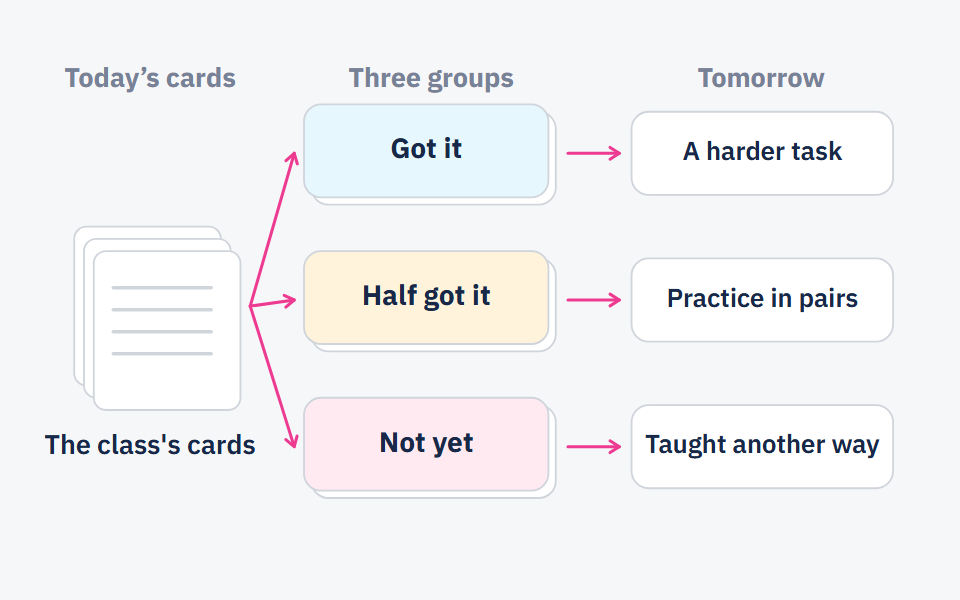
Write the three rules in the suggestions box before the lesson, one for each kind of exit card. If a student couldn't find a common denominator, the next lesson opens with three problems on that step. Anyone who added straight across and wrote for item A starts with fraction strips, then comes back to the rule. If the sum's right but needs simplifying, a quick reminder will do. Wiliam doesn't sort cards like this. The three groups are our routine. The card itself is in our exit ticket template.
We left the first two reflection boxes empty on purpose, because they're for during and after the lesson and we've no lesson of our own to report. The extension problems sit in the procedures instead of a third outcome, because you can't check an outcome only some students attempt.
| Field | What we wrote |
|---|---|
| Prior learning | A battery is a source of electrical energy; the danger of playing with mains electricity at home |
| Specific outcomes | 1. Students build a simple circuit from a battery, wires and a bulb. 2. Students explain why the bulb lights when the circuit is closed and goes out when it's opened |
| Materials, tools and equipment | A battery, three wires and a small bulb for each group |
| Teaching strategies | Direct instruction to demonstrate, then cooperative learning in groups of four |
| Assessment: strategy and tool | Performance-based assessment while groups build, with a verbal rating scale: built it alone, built it with help, didn't build it |
| Procedures and time | 5 min: the opening question, why does a torch light up when you press its button? 10: you build the circuit in front of the class and open and close it. 20: each group builds the circuit and draws it. 10: each group explains why the bulb went out when they undid a wire |
| Field | What we wrote |
|---|---|
| Prior learning | Reading fully vowelled words; what a main idea is |
| Specific outcomes | 1. Students read the text aloud accurately and with expression. 2. Students find the text's main idea and write it in one sentence |
| Materials, tools and equipment | The textbook, the board, and a slip of paper for each student |
| Teaching strategies | Direct instruction for the model reading, then cooperative learning as students read in pairs |
| Assessment: strategy and tool | Observation during reading aloud, with a checklist (reads without errors, observes punctuation); pen and paper for the main-idea sentence |
| Procedures and time | 5 min: a short talk about the lesson's picture. 10: you read the text aloud, then students take turns. 15: each student reads a paragraph to a partner and together they pick out new words and their meanings. 10: each student writes the main idea in one sentence. 5: three sentences are read out and corrected on the board |
How to fill in the harder fields
Specific outcomes
Write each outcome as a verb you can see, what it acts on and the condition, as in “adds two fractions with different denominators by finding a common denominator”. Skip understands and knows. You can't watch either one happen. The form counts attitudes as outcomes too, so appreciates is fine if it's something students say or do. Number the outcomes so each procedure and assessment points back to one.
Assessment strategy and tool
The form wants both boxes filled. The strategy is how you gather evidence. The tool is what you record it on. The ministry's booklet on assessment strategies and tools names five strategies (performance-based assessment, communication, self-review, observation, pen-and-paper) and five tools. Those are a checklist, a rating scale, a verbal rating scale, a learning log and an anecdotal record, which is a short note of what a student did and in what situation.
A verbal rating scale describes each level of performance in a few words. US teachers would call it something close to a rubric (see our rubric guide).
Procedures and time
Cut the new content into small steps with a short task after each, and for every step write what students do as well as what you do, with its minutes and outcome number. Put the decision point in beforehand. Mid-lesson, it's easier to follow a decision than to make one.
Prior learning
List what the lesson depends on (concepts, skills, facts or rules) and write your review questions straight from that list. Then a gap shows up in the first five minutes instead of halfway through the worked example.
Three common mistakes in the fields, and how to avoid them
An outcome you can't check
“Students understand adding fractions” gives you nothing to look for on an exit card. Which answer would show they've got there? If you can't say, rewrite it with a verb you can see, such as adds or writes. Then you can write the exit question straight from it.
A strategy with no tool, or a tool with no strategy
Write observation and stop there, and you reach the end of the period with nothing on paper to go back to. Checklist on its own has the opposite gap. It doesn't say how you'll fill it in.
Procedures that only describe you
If every row starts with “the teacher explains”, the plan says nothing about what students do for 45 minutes. A close cousin is a Time column that adds up to more than the period, so the last procedure gets cut, and in our example that's the exit card.
If your form isn't Jordan's
Oman's ministry has an official electronic lesson-preparation form, issued in March 2024. For Egypt we found no official form, just a template site that lists the usual columns, so treat that column as common practice. We found no Saudi form at all. The sheet still works there, where outcomes are called نواتج التعلم. Grade, unit title and lesson title look much the same on Oman's form, so the table leaves them out.
| On this sheet (Jordan's book) | Oman (ministry, 2024) | Egypt (unofficial template) |
|---|---|---|
| Subject (المبحث) | مادة (in the header, تحضير مادة) | المادة |
| Dates (التاريخ من ... إلى) | اليوم والتاريخ، الحصة، الشعبة | تاريخ الشرح |
| Prior learning (التعلم القبلي) | التعلم القبلي/ التمهيد/ المفاهيم | None |
| Vertical and horizontal links (التكامل الرأسي والأفقي) | None | None |
| Specific outcomes (النتاجات الخاصة) | الأهداف/ المخرجات التعليمية | الأهداف الإجرائية (also الأهداف السلوكية) |
| Materials, tools and equipment (المواد والأدوات والتجهيزات) | الوسائل ومصادر التعلم | مصادر التعلم |
| Teaching strategies (استراتيجيات التدريس) | الاستراتيجيات/ طرق التدريس | None |
| Procedures and time (الإجراءات والزمن) | آلية التنفيذ/ الأنشطة التدريبية/ التعليمية | الأنشطة، الزمن |
| Assessment strategy and tool (التقويم) | التقويم التكويني، التقويم الختامي | التقويم |
| Homework, optional line (الواجب البيتي) | الواجب المنزلي | الواجب المنزلي |
| Self-reflection (التأمل الذاتي) | ملاحظات المعلم | None |
| No field; write it inside procedures | نشاط إثرائي/ علاجي، تفريد التعليم | None |
Oman's form also has boxes for enrichment and remedial activities and for individualised learning. Our sheet doesn't, so put those in the procedures, as the example does with its extension problems.
Frequently asked questions
- Where can I get a free lesson plan template PDF?
- Right here. The download button gives you a single A4 PDF, no sign-up needed. There's no Word version. If you'd rather type, String drafts a lesson plan from your topic that you can edit and print, and it's free for teachers.
- Can I use this sheet instead of my ministry's required form?
- That's your school's call. We follow the field names and order of Jordan's planning book, but the ministry didn't issue or endorse the sheet, and we've found nothing saying it can replace the book. It's safest as a draft you copy into the book, which also has a cover page and daily follow-up table we left out.
- How do I write specific outcomes (learning objectives)?
- Use a verb you can see, then what it acts on and the condition, such as “writes the sum in simplest form”. Avoid understands and knows. Our post on learning objectives has more examples.
- What do I write under assessment, the strategy or the tool?
- Both. The strategy is how you gather evidence, like observation. The tool is what you record it with, like a checklist. On the Jordanian form, take each number from the page ج list in your copy, or write 6 and the name if yours isn't listed.
- Does it work for subjects other than maths?
- Yes. No field is tied to a subject, and the subject has its own box in the header. Only the example's content would change.
Sources
Every fact in this post that we did not produce ourselves comes from one of these sources.
- Principles of Instruction: Research-Based Strategies That All Teachers Should Know (Barak Rosenshine) — American Educator, 2012 (Spring issue)
- How to Write a Lesson Plan (Jennifer Gonzalez) — Cult of Pedagogy, 2026-09-01
- Classroom Assessment: Minute by Minute, Day by Day — ASCD, 2005-11-01
Written with String's editorial team: we use AI for research and first drafts, and a person checks every fact and every source before anything is published. How we write
Grade 6 mathematics · Jordan
Teaches Grade 6 mathematics in Jordan and writes here about teaching maths from inside the classroom.