Differentiation without tripling your prep: one fractions worksheet at three levels
A differentiated worksheet keeps one goal for the whole class and offers three ways to reach it: a support sheet with something to lean on, a core sheet, and a stretch sheet that is deeper, not longer. Here are all three for adding fractions in Grade 6, and a way to sort students onto them in two minutes from exit tickets.
A worksheet at three levels: adding fractions with unlike denominators
A free printable PDF, no sign-up.
- Definition
- Differentiated instruction: Keeping one lesson goal for the whole class while the task that leads to it changes with what each student can do right now. Also called differentiation or differentiated teaching.
What you need before you start
- One goal with a verb you can see on paper: “add two fractions with unlike denominators and write the answer in simplest form.”
- Yesterday's exit tickets, or one question you ask at the start of the lesson.
- A core sheet you write first, then derive the other two from.
- Extra time the first time only; later sheets are built on the same template.
In “The Goals of Differentiation” (ASCD's Educational Leadership, November 2008), Carol Ann Tomlinson calls differentiation “student-aware teaching” and asks that the task “fit” what a student can do now. Work that is always too hard keeps a student busy avoiding humiliation instead of learning; work that is always too easy teaches them to mark time instead of meeting a challenge. Among the teacher's tools she lists task options with common learning goals — which is exactly what the three sheets are: one goal, three tasks.
The three sheets: one goal, one shared last question
The problems were written for this post, not copied from a textbook; they suit Grade 6. The last question on every sheet is the same: . There is no answer key on this page, so solve the problems yourself before you hand them out.
What is different: a worked example first, a drawn fraction strip, denominators where one divides the other in the first problems, and a steps card at the top.
Steps card: 1. Find a number both denominators divide into. 2. Rewrite each fraction with that denominator. 3. Add the numerators; keep the denominator. 4. Simplify if you can.
- Worked example: . Shade one half on the first strip and one quarter on the second, then compare.
- (use the strip cut into six parts)
- (hint: find the first number in both the 2 and the 3 times tables)
- (hint: the common denominator is 12)
What is different: denominators where neither divides the other, some answers that simplify or come out above one, and a word problem. No strip and no worked example.
- , then write the answer in simplest form
- , and write the answer as a mixed number
- A recipe uses cup of milk and cup of water. How many cups of liquid are in the recipe?
What is different: deeper problems, not more of them: three fractions, a missing fraction, a mistake to explain, and a question with more than one answer.
- What fraction, added to , makes ?
- A student wrote . Explain the mistake in one sentence, then correct it.
- A water tank was filled to in the morning, and a further of the full tank in the afternoon. Is it more than half full? How much more until it is full?
- Write two fractions with different denominators that add up to . Can you find a second pair?
- , then explain why the answer cannot be .
Notice what did not change between the sheets: the goal, the last question and the working time. What changed is what supports the student on the support sheet, and how deeply they think on the stretch sheet — not the number of problems.
The steps: from one sheet to three
Write the goal in one sentence, and keep it the same on all three sheets
If the goal differs between sheets, you have three lessons, not one differentiated lesson. The goal here: add two fractions with unlike denominators and simplify the answer.
Write the core sheet first
It is what you expect of most of the class in this lesson. The other two sheets are derived from it, so you never start from a blank page three times.
Build the support sheet by adding support, not by removing the goal
Add a worked example, a fraction strip, easier numbers at the start, and a steps card. But keep the last two problems at the level of the goal, so the student reaches it before the sheet ends.
Build the stretch sheet with depth, not volume
Ten more problems of the same kind punish the student who finished early. Ask instead for a mistake explained, a missing fraction, or a problem with more than one right answer.
Put the same question at the end of all three sheets
This shared question is your next exit ticket: it tells you whether every student reached the goal, whichever sheet they started on.
Group students in two minutes
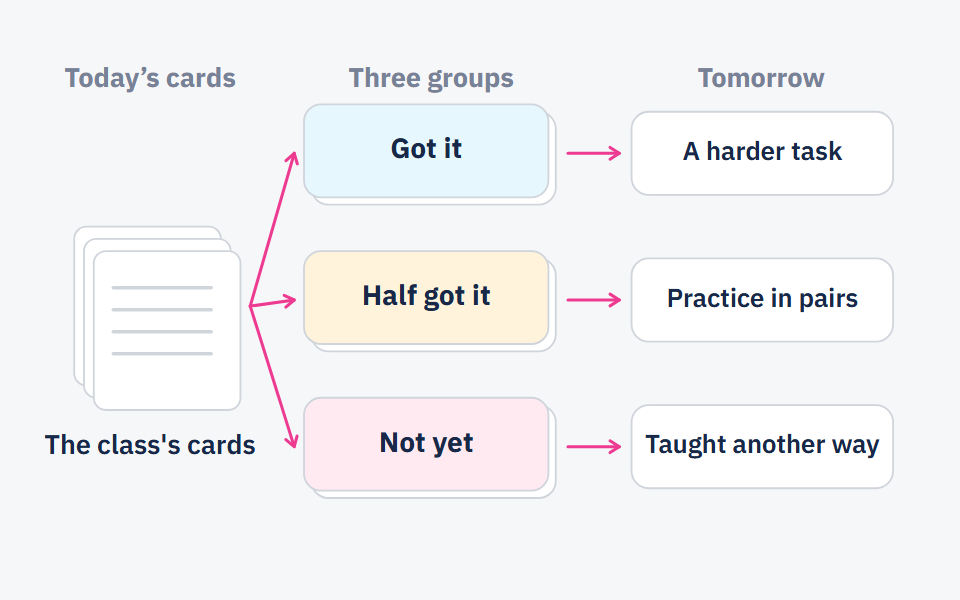
From the exit tickets, as in the next section. Do not mark the tickets; just sort them.
Change the groups every lesson
Tomlinson describes the teacher in a differentiated classroom as flexible with time, seating and student groupings. A level describes today's need; it is not a name for the student.
Grouping students in two minutes from exit tickets
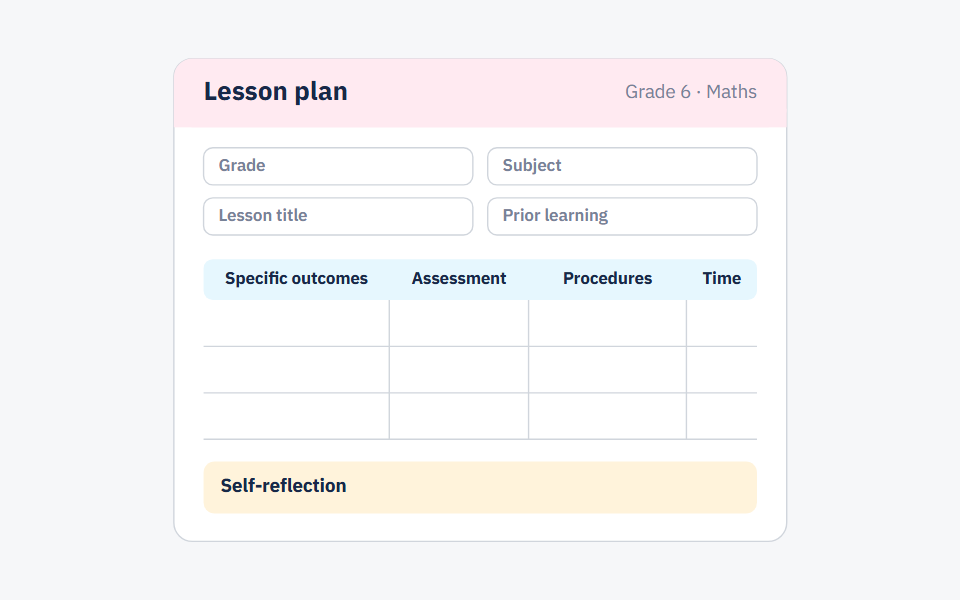
“Classroom Assessment: Minute by Minute, Day by Day” (ASCD, November 2005), by Dylan Wiliam, describes the exit pass as an index card on which each student writes an answer and hands it in before leaving — sometimes used to decide where the next day's lesson begins. That is what you do here: yesterday's question was with “write the first step you took”, as in the lesson plan.
| Pile | What you see on the ticket | Sheet |
|---|---|---|
| Wrong answer | Added the numerators and the denominators to get , or got the common denominator wrong | Support |
| Partly right | The common denominator is right, but there is an arithmetic slip, or no step is written | Core |
| Right | The answer is right and in simplest form, and the first step is written clearly | Stretch |
No tickets from yesterday? Ask the same question at the start of the lesson with four answers on the board, and have each student hold up the card for the letter they chose (A, B, C, D). The same article describes these cards: the whole class answers at once, and you see who understood and who did not. There are more ticket examples in the exit-ticket guide.
When differentiation does not work
- When the support sheet becomes a student's permanent seat: if they get the shared question right, start them on the core sheet tomorrow. The shared question is the way out of the support sheet.
- When the gap sits one step before the goal: a student who does not know what means will not be rescued by a support sheet on addition. They need time with you on the meaning of a fraction itself — that is the job of a remedial plan, not a worksheet.
- When students read the sheets as a ranking: never write “weak” or “advanced” on a sheet. Label them with neutral symbols — circle, square, triangle — and change who gets which symbol every lesson.
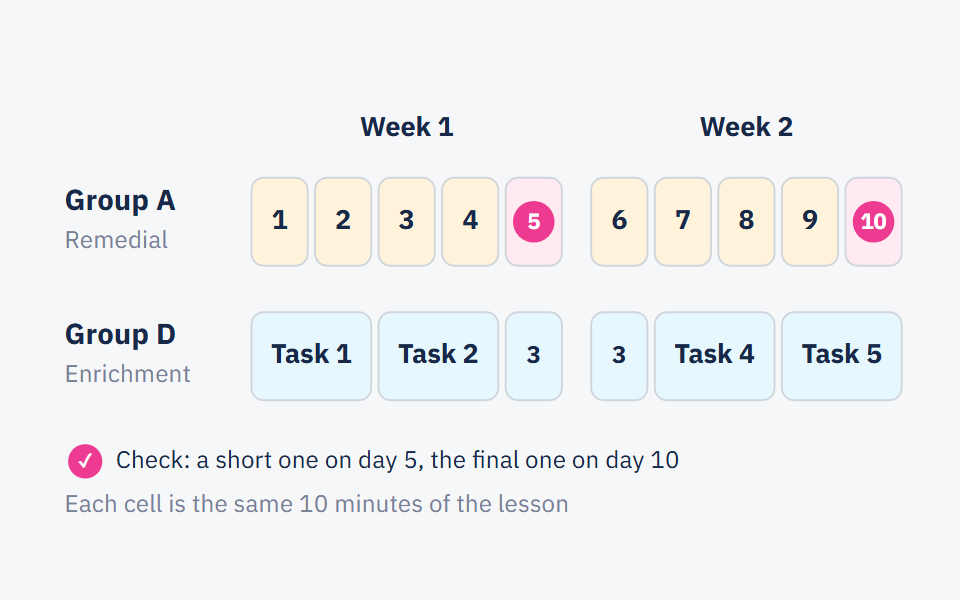
- When you have no time for three sheets: start with two levels, as in the lesson plan: core for everyone, harder for early finishers. Add the support sheet when the exit tickets show you need it.
The most honest limit: the first time takes longer than a single sheet. That shrinks once you keep the three sheets as a template and change only the numbers for the next lesson.
Frequently asked questions
- What is the difference between differentiated instruction, differentiated teaching and differentiated learning?
- All three name one idea: one goal, with different routes to it depending on what the student needs. “Instruction” and “teaching” describe the teacher's work; “learning” describes what happens for the student.
- Does differentiation mean a different worksheet for every student?
- No. Three levels cover what you see on exit tickets: did not get it, half got it, got it. The groups change every lesson, based on the shared question.
- How do I differentiate maths in a large class?
- Start with a sheet at two levels, a shared question at the end, and exit tickets sorted into piles. You do not need to move students between seats; only the sheet changes.
- Should students choose their own level?
- Let students on the core sheet move to stretch once they have the first three problems right. The support sheet is your call, made from the ticket — and tell the student it is for this lesson only.
- Where can I get a free differentiated worksheet PDF?
- At the top of this page: all three sheets on one printable page, to cut into three. For another lesson, make one in String for free.
Sources
Every fact in this post that we did not produce ourselves comes from one of these sources.
Written with String's editorial team: we use AI for research and first drafts, and a person checks every fact and every source before anything is published. How we write
Grade 6 mathematics · Jordan
Teaches Grade 6 mathematics in Jordan and writes here about teaching maths from inside the classroom.