Private lessons: when you need them and when you don't
Private lessons help when three things come together: a specific gap you can name, a date the school alone cannot get your child to in time, and a child who agrees. If the cause is sleep, worry or a week that is already full, extra hours will not fix it; try the teacher and a home routine first, and if you do start lessons, give them one goal and judge them after four weeks.
Private lessons — a decision checklist for parents
A free printable PDF, no sign-up.
The question may come after a disappointing mark, a note from the teacher, or an exam date drawing near. The answer does not start with finding a tutor, but with a simpler question: what exactly is your child missing, and why? Here you will find four questions to decide with, a table that sets private lessons beside three alternatives, what to ask a tutor before starting, and how to judge the lessons after four weeks. Tonight, take one step: write down, in one sentence, what your child is missing. If you can't, that is the first thing to ask the teacher.
- Definition
- Private lessons: Extra teaching outside school lessons, for one student or a small group, arranged by the parents with a teacher or tutor.
The decision in four questions, in order
Answer the questions in the order shown in the figure at the top of the page. The first “no” tells you what to do before lessons; lessons come after four “yes” answers.
Can you name what they are missing in one sentence?
“Weak at maths” is not enough; “can't add two fractions with different denominators” is. Lessons need a goal, and a goal starts from a specific gap. The EEF review of small group tuition says it is most likely to be effective if it is targeted at pupils' specific needs, and that diagnostic assessment can be used to decide how best to target support. If you don't know the gap, ask the teacher, or start with how to know your child's level.
Is it a gap in the subject, not sleep, worry or tiredness?
If your child goes to bed late, an extra hour comes out of their sleep; sleep before an exam has where to start. If they refuse to study at all, a tutor won't change that alone; start with when your child refuses to study. And if their week is already full of homework and activities, remember that the EEF summary on homework reports some evidence that the impact of homework diminishes as the time pupils spend on it increases.
Have you tried the teacher and a home routine for three weeks?
We suggest starting with what is closest: a talk with the teacher and a short home routine on that same gap, for three weeks. The details are in the next section.
Is there a date coming, and does your child agree?
An exam with a date gives lessons a clear end. A child who asked for help walks into the lesson wanting it. If your child refuses, ask why before you book anything.
Private lessons and three alternatives, on the same criteria
We compare the four options on what matters to the decision: when each one fits, what it asks of you, and what to watch for. They are not rungs you must climb; a talk with the teacher may be enough on its own.
| Option | Fits when | Asks of you | Watch for |
|---|---|---|---|
| A talk with the teacher | You don't know the gap yet, or want to know what the school offers | A meeting, and three written questions | Leaving with one specific step, not a general impression |
| A short home routine | The gap is specific and small, and there is time | We suggest 15 to 20 minutes, four days a week | Asking and showing a similar example, not solving it for them |
| Small group lessons | Other students share the gap, as in revision before an exam | Asking how many students and at what level | Group size: the EEF review says effectiveness drops noticeably above six or seven |
| One-to-one lessons | The gap is your child's own, and the date is close | Weekly follow-up on what happens in the lessons | A tutor who does the homework, or lessons cut off from what class covers |
What does the evidence say? In its review of one to one tuition (last updated July 2021), the UK's Education Endowment Foundation draws on 123 studies. The review is written for schools and describes tuition that schools organise, not lessons arranged by parents. It says one to one tuition is very effective on average, at about five additional months' progress; that it is more likely to make an impact when it is additional to, and explicitly linked with, normal lessons; and that short, regular sessions appear to have the most impact: about 30 minutes, three to five times a week, over a set period of up to ten weeks.
Its review of small group tuition — one teacher, teaching assistant or tutor with two to five pupils — puts the average impact at about four additional months' progress, with the rule of thumb that the smaller the group, the better, and suggests small groups may be a sensible approach to trial before considering one to one tuition. The one-to-one review also warns that a large share of its studies were not independently evaluated, and that evaluations by organisations connected with the approach, such as commercial providers, typically show larger impacts. So judge lessons by what you see in your child's notebook, not by what anyone promises.
What to try first: three weeks with the teacher and at home
Ask the teacher for a short talk
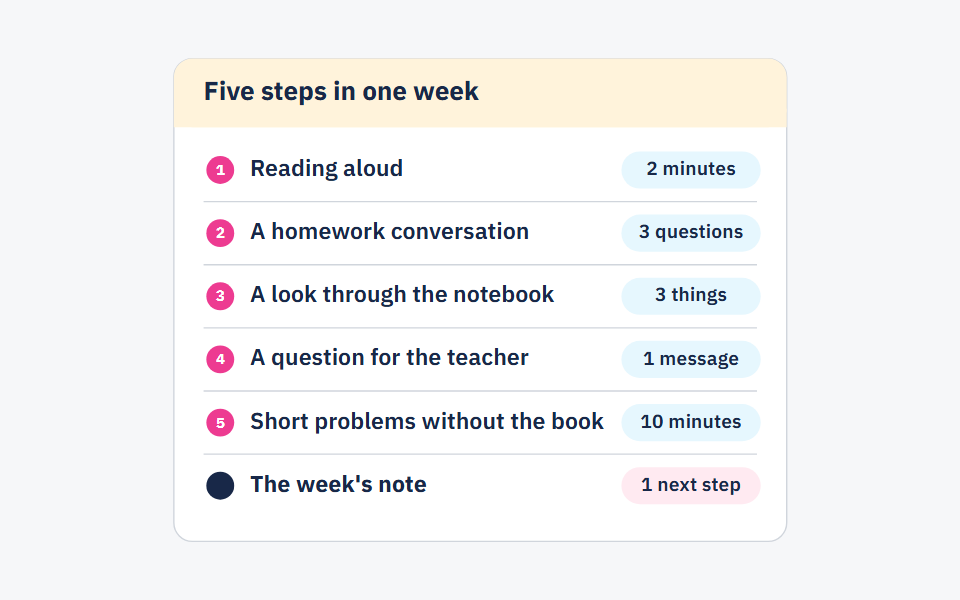
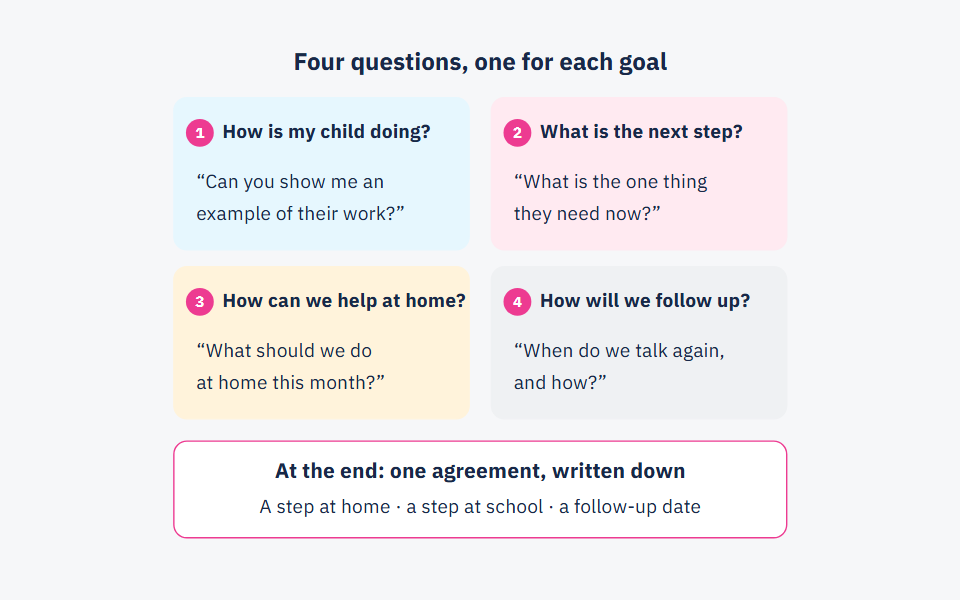
Ask three questions: what exactly are they missing? Does the school offer support, such as a catch-up class or revision session? And what should we practise at home this month? Questions for the parent-teacher meeting has a card to prepare with.
Agree on a short routine
We suggest 15 to 20 minutes, four days a week, on the gap the teacher named and nothing else — not the whole subject.
Help without doing it for them
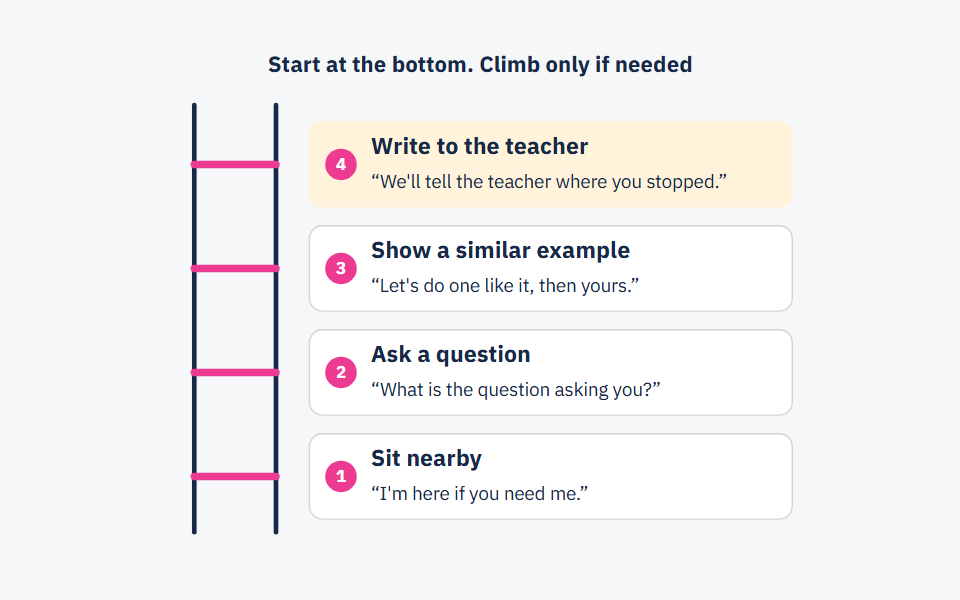
Sit nearby, ask a question, show a similar example, and tell the teacher what is still hard. These are the rungs of the homework help ladder.
Look again after three weeks
Has what was hard become easier? Ask the teacher the same question again. If you both see progress, carry on. If nothing has changed and the date is close, that is the time to think about lessons.
If your child uses the String for Families app, it tells you each evening where they got it right and where they hesitated in what they played from their own syllabus, which gives you something specific to ask the teacher about.
What to ask a tutor before you start
These questions are not a test for the tutor; they are how the two of you agree on what you will judge the lessons by after four weeks. Beside most of them is the answer you are looking for.
- “What will you work on in the first four weeks?” A good answer names the same gap you named.
- “How will we know they have made progress?” A good answer: a short check at the start, and the same at the end of week four.
- “Will you look at the school notebook and build on what they do in class?” The EEF review says impact is more likely when tuition is linked with lessons.
- “Who does the homework in a session?” The only acceptable answer: your child, with the tutor asking and explaining.
- “How long is a session, how often, and for how long overall?” Look for a plan with an end.
- “If it's a group, how many students are in it, and are they at your child's level?”
- “Do you mind if I share your notes with the teacher?”
- “What do we do if we see no progress after four weeks?”
How to judge the lessons after four weeks
Four weeks is the period we suggest for a first judgement. The EEF review links optimum impact to a set period of up to ten weeks, so four weeks need not be the end of the lessons, but it is long enough to see the direction. Look at four things:
| What to look at | A sign it is working | A sign it is not |
|---|---|---|
| The same short check at the start and the end | Fewer mistakes in the same skill | The same mistakes |
| The teacher's view | Notices a difference in class without being told | Has noticed nothing |
| Homework in this skill | Needs less of your help than before | Needs more, or the tutor does it |
| Your child | Goes to lessons without a fight, and can say what they learned | Tiredness, refusal, or less sleep |
If the signs are good, set a new goal for another four weeks, or stop if your child has reached what they needed. If they are not, change one thing — the goal, the tutor or the number of sessions — or stop. Lessons with no goal and no end date become a habit that is hard to drop. If tiredness or trouble sleeping persists, note that UNICEF lists both among the common signs of anxiety; talk to the school counsellor or your child's doctor before adding sessions.
When this checklist is not enough
This checklist is for a gap in one subject. If the difficulty shows up in several subjects and comes back year after year, or the school suggests a specialist assessment, make that decision with the school, the counsellor and the specialist — not with a private tutor alone. And if the school itself runs catch-up classes, start there; they are already linked to class.
Frequently asked questions
- Is private tutoring worth it?
- It can be, when it targets a specific gap and is linked to what your child does in class. The EEF review says one to one tuition is effective on average, and more likely to make an impact when it is additional to and linked with lessons — but it reviews tuition organised by schools, and the results of its studies vary a lot.
- When should I look for a tutor for my child?
- When you can name what they are missing in one sentence, the cause is a gap in the subject rather than sleep or worry, you have tried the teacher and a home routine without progress, there is a date coming, and your child agrees to lessons.
- How many tutoring sessions a week?
- The EEF review says short, regular one-to-one sessions — about 30 minutes, three to five times a week, for up to ten weeks — appear to have the most impact. Ask for a short plan with an end, not open-ended lessons.
- One-to-one or a small group?
- If other students share the gap, start with a small group: the EEF review suggests trying it before one to one tuition, and says effectiveness drops noticeably above six or seven students. If the gap is your child's own and the date is close, one-to-one fits better.
Sources
Every fact in this post that we did not produce ourselves comes from one of these sources.
- Teaching and Learning Toolkit: One to one tuition — Education Endowment Foundation, 2021-07 (review last updated)
- Teaching and Learning Toolkit: Small group tuition — Education Endowment Foundation, 2021-07 (review last updated)
- Teaching and Learning Toolkit: Homework — Education Endowment Foundation, 2021-08 (review last updated)
- What is anxiety? — UNICEF Parenting, n.d., read 2026-10-22
Written with String's editorial team: we use AI for research and first drafts, and a person checks every fact and every source before anything is published. How we write
Founder and CEO, String
“I grew up in a house of teachers.” I spent a year designing the STEM program for one of the largest school groups in Saudi Arabia, have written curriculum by hand, trained robotics coaches and sold software into schools, then left that job to build String in Amman.