When your child refuses to study: five calm steps
Don't start by persuading; start with the reason: is the homework too hard, too long, is your child tired, or is it something else? Then shrink the task to ten minutes that start the same way every day. Tonight there is one question: “What's the hardest part of this homework?”
When they refuse to study — the steps card
A free printable PDF, no sign-up.
Your child says, “I don't want to study,” and shuts the notebook. Arguing at that moment makes the evening longer and leaves the notebook shut. The refusal is the answer to a question nobody has asked yet: why? Here are five steps in order, the sentence to say at each, what to avoid, and when it becomes a matter for the teacher, the school counsellor or a doctor.
What you need
- Ten minutes of your time, close by, with something quiet of your own — not your phone.
- A clock or timer your child can see.
- The homework itself, with the notebook open at the first question.
- A fixed place to study, at a table.
- A small sheet of paper to write down what got done.
The five steps
Find the reason before you ask for anything
Sit beside them and ask calmly: “What's the hardest part of this homework?” Then wait. If they say “All of it,” ask: “Which question would you like to leave till last?” The answer points to one of four reasons in the table below, and each reason has a different next step.
Shrink the task: a ten-minute start
Say: “Just ten minutes, then we decide together.” Put the clock in front of them and make the task small and specific: the first two questions, or one paragraph, not “all of it”. When the ten minutes are up, keep your word: either they carry on, or they rest for five minutes and then start another ten. Ten minutes is our suggestion, not a number from a study; what matters is a start small enough to begin.
A start ritual: the same time and the same steps
Choose together a fixed time and a fixed place, and three steps that come before study every day in the same order, for example: a glass of water, the phone in another room, the notebook open at the first question. The Education Endowment Foundation's guidance report (2018) says a daily homework routine that is clearly communicated to children and reinforced with praise and rewards can increase the time spent on homework and improve how well that time is used. Leave them a choice inside the ritual, such as which subject comes first or where they sit; UNICEF's 3 ways to help motivate your teen says teenagers are more likely to feel motivated when they are given options.
Choose your words
Say what you want them to do, not what you want them to stop doing. UNICEF's advice on positive discipline says telling your child exactly what you want them to do is much more effective than telling them what not to do. If you feel angry, take five slow, deep breaths before you answer, which is advice from the same page. The table in the next section puts the sentences side by side.
Close with two questions
When the time is up, ask: “What did you get done?” and then: “What will we start with tomorrow?” Write both answers on the small sheet, and praise something specific you saw: “You started on your own today without me reminding you.” Then that's it for tonight. UNICEF suggests getting creative with rewards: a short break, a favourite snack, or time with a friend once they finish.
Four reasons for refusing, and a step for each
| Reason | What you may hear or see | The step |
|---|---|---|
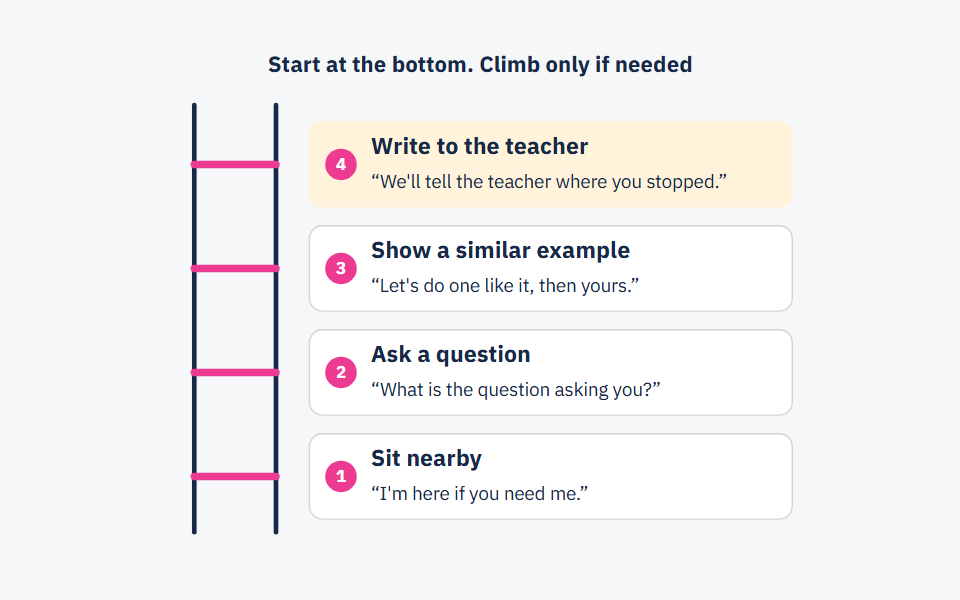
| It's too hard | “I don't get it,” or they sit on the same question for a long time. | Don't teach the lesson from the start. Ask a question that takes them back to what they know, follow the homework help ladder, and write to the teacher if they are still stuck. |
| It's too long | “This is too much,” or they count the pages before starting. | Split it in front of them into ten-minute pieces, and cover the rest with a sheet of paper. |
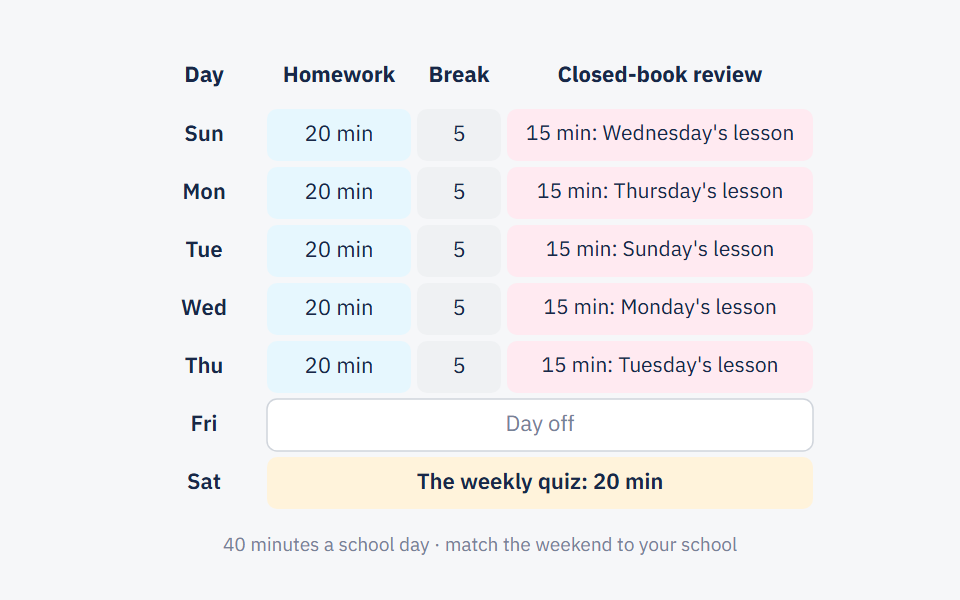
| Tired or hungry | Yawning, rubbing their eyes, or refusing after a long day. | A snack and a short rest, then a ten-minute start. If it happens every evening, look again at study time and bedtime in a weekly study timetable. |
| Something else | A falling-out with a friend, a screen waiting, or something at school they don't mention. | Put the notebook aside for a while and listen. If it keeps happening, read the section “When to talk to the teacher, the counsellor or a doctor”. |
What to say, and what to avoid
| Instead of | Say | Why |
|---|---|---|
| “You're not getting up until it's done.” | “Just ten minutes, then we decide together.” | A small start is one they can begin; an open-ended promise feels endless. That is our view. |
| “You're lazy.” | “What's the hardest part?” | A label ends the conversation; a question points you to the reason. |
| “Stop playing with your pen.” | “Write the first answer here.” | UNICEF says telling a child exactly what you want them to do is more effective than telling them what not to do. |
| “Your brother doesn't need all this help.” | “You started on your own today. That's progress.” | UNICEF advises praise that is sincere and celebrates effort, not talent. Comparing them with a brother praises neither of them. |
| “If you don't study, no phone for a month.” | “After the first ten minutes, you get a break.” | UNICEF advises calm, realistic and consistent consequences, explained to the child in advance as a warning and a chance to change. A big punishment announced in anger is hard to carry out. |
A full example: one evening
This example was written for this post; it is not a real child's story. A Grade 4 pupil has 12 maths questions for homework and says they won't do them.
| Time | What happens | What the parent says |
|---|---|---|
| Minute 0 | They shut the notebook; you sit beside them. | “What's the hardest part of this homework?” |
| Minute 2 | They say: “It's 12 questions.” The reason is length, not difficulty. | “We're not doing 12 now. Just the first three, in ten minutes.” |
| Minute 4 | They start with the clock in front of them; you sit nearby reading a book. | Nothing, unless they ask for you. |
| Minute 14 | The ten minutes are up, and three questions are done. | “That's ten. Carry on, or a five-minute break?” |
| Minute 15 | They choose the break. | — |
| Minute 20 | They come back and do three more questions in ten minutes. | — |
| Minute 30 | 6 of the 12 questions are done. | “What did you get done? What will we start with tomorrow?” Then: “You came back on your own after the break.” |
In this example the child did half the homework in half an hour, without an argument. The remaining six questions are either another ten minutes tonight, if they want it, or a note to the teacher saying the homework took longer than expected; How much should you help with homework? has a model for that note.
When to talk to the teacher, the counsellor or a doctor
The five steps are for an ordinary evening. These situations mean it is bigger than homework:
- The teacher: when they refuse one subject every evening for weeks, or say the homework covers something not taught yet. Take the small sheets with you; Questions for the parent-teacher meeting has a card to prepare with.
- The school counsellor: when you think the cause is the school itself rather than the homework, such as a problem with classmates or with a teacher.
- A doctor: when you see signs listed on UNICEF's page on anxiety, such as stomach problems, trouble sleeping, or feeling panicky or on edge, and the worry has started to interfere with school, home or play; or what its page on depression lists, such as persistent sadness, loss of interest in friends and activities they normally enjoy, and withdrawal from others. UNICEF says your health-care provider can refer your child for assessment, and that only a doctor or mental health professional can diagnose a condition.
- Straight away: if your child talks about harming themselves, or has harmed themselves, don't wait: get help from emergency services or a health-care professional, as UNICEF advises.
These steps organise the evening; they don't diagnose anything. And remember what UNICEF says about a child's anxiety: it does not reflect your parenting, and it is not done on purpose.
When the steps don't work
The steps fail when the cause is the homework itself: homework that is longer or harder than your child can manage every night. Then neither ten minutes nor a start ritual will help, and the answer lies with the teacher, not at home. They also fail when the rules change every evening; a ritual dropped for two days becomes something to bargain over again. If the evenings haven't changed after two weeks, a period we suggest, gather what you wrote on the small sheets and ask to talk to the teacher.
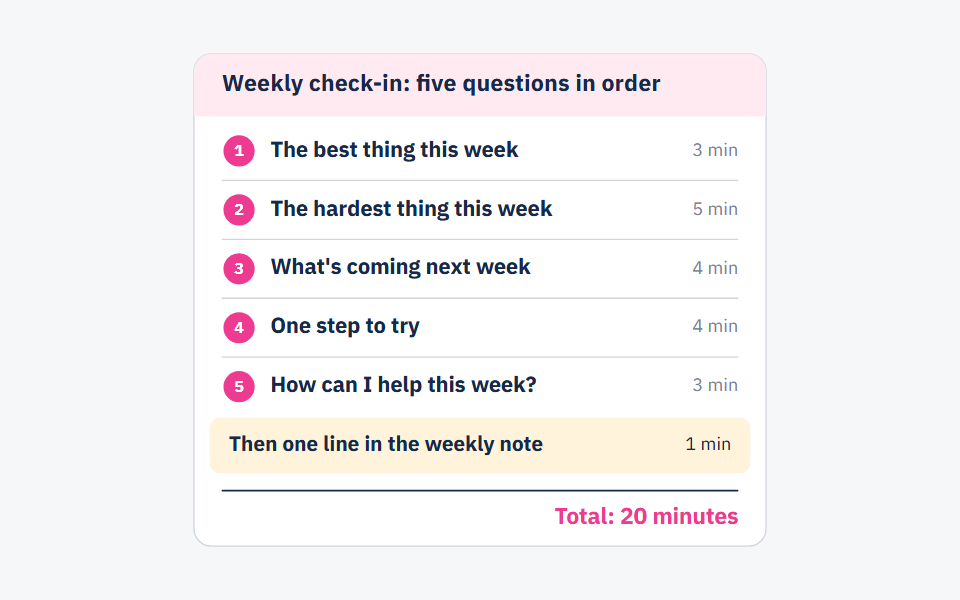
A short weekly conversation about school can sometimes bring the reason out before it reaches the notebook; A weekly 20-minute school check-in with your child has the question card.
Frequently asked questions
- My child doesn't want to study. What do I do?
- Don't start by persuading. Ask: “What's the hardest part of this homework?” Then ask for just ten minutes with the clock in front of them, and decide together afterwards whether they carry on or take a break.
- Should I punish my child for refusing to study?
- A big punishment announced in anger is hard to carry out. UNICEF advises calm, realistic and consistent consequences explained in advance as a warning and a chance to change, and taking five deep breaths before you respond.
- Is a reward for studying a bribe?
- UNICEF suggests rewards such as a short break, a favourite snack, or time with a friend after finishing. We suggest keeping them small and agreed before the start, not an offer made when they refuse.
- How do I motivate my child to study?
- Offer choices inside the routine, such as which subject comes first or where they sit, and praise the effort you saw rather than how clever they are. Those are two of the three ways UNICEF gives for motivating teenagers.
Sources
Every fact in this post that we did not produce ourselves comes from one of these sources.
- Working with Parents to Support Children's Learning: Guidance Report — Education Endowment Foundation, 2018
- 3 ways to help motivate your teen — UNICEF Parenting, undated (read 2026-10-22)
- How to discipline your child the smart and healthy way — UNICEF Parenting, undated (read 2026-10-22)
- What is anxiety? — UNICEF Parenting, undated (read 2026-10-22)
- What is depression? — UNICEF Parenting, undated (read 2026-10-22)
Written with String's editorial team: we use AI for research and first drafts, and a person checks every fact and every source before anything is published. How we write
Founder and CEO, String
“I grew up in a house of teachers.” I spent a year designing the STEM program for one of the largest school groups in Saudi Arabia, have written curriculum by hand, trained robotics coaches and sold software into schools, then left that job to build String in Amman.