Questions for the parent-teacher meeting: a one-page card
Walk in with four questions, one for each goal: how is my child doing, what is the next step, what do we do at home, and when do we follow up — and ask for an example of their work behind every answer. Walk out with one agreement in writing: a step at home, a step at school, and a date to follow up.
Parent-teacher meeting question card
A free printable PDF, no sign-up.
The parent-teacher meeting (a parents' evening or parent-teacher conference, depending on where you live) is usually short, and much of it can go on general phrases: “Excellent,” “needs to focus more.” That is not the teacher's fault or yours; a general question gets a general answer. This card gives you specific questions grouped by what you want to leave with, what a useful answer sounds like, and a way to close the meeting with one agreement. Print it, and pick just four questions.
Before the meeting: ten minutes at home
- I asked my child: what is easiest in this subject right now, and what is hardest?
- I picked one sheet or page of their recent work to ask about.
- I wrote my concern in one sentence, if I have one.
- I picked four questions from the card, one from each group.
- I know how many minutes I have, and with which teacher.
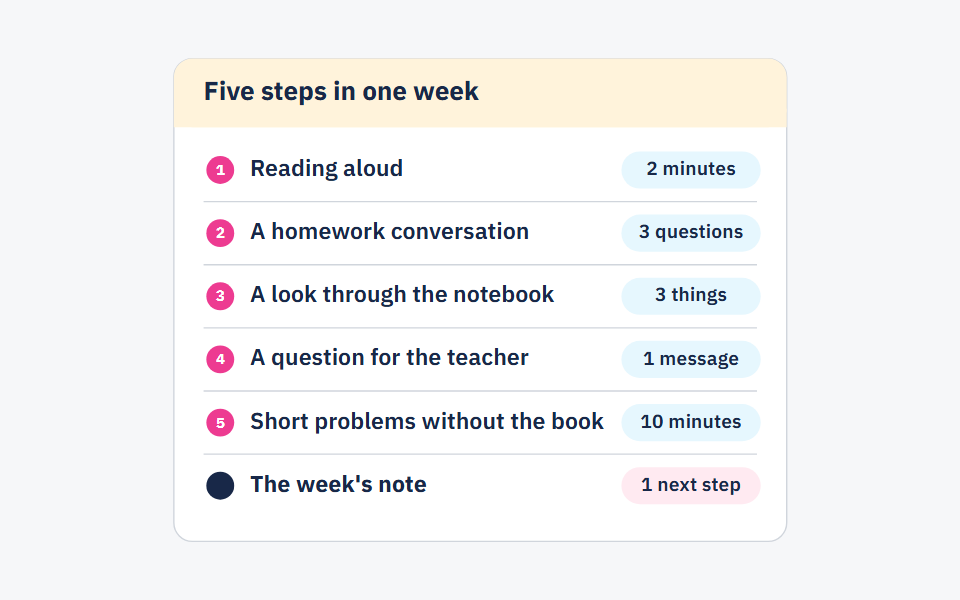
If you are not sure what to ask, How to know your child's level gives five short checks across a week, which hand you an example of their work to build your question on.
The card: questions grouped by goal
1. How is my child doing — and what is the evidence?
- What can they do now that they couldn't at the start of term?
- Could you show me an example of their work that shows it?
- Where are they compared with what is expected in this grade?
2. What is the next step?
- If you picked one thing they need right now, what would it be?
- What mistake keeps coming back in their work?
- What is coming up in the next few weeks — new topics, or tests?
3. How can we help at home?
- What is the one thing we should do at home this month, and how much time does it need?
- How do you teach this skill in class, so we don't explain it a different way?
- Is there anything we should not do?
4. How will we follow up?
- How will we know in a few weeks that the step worked?
- When do we talk again, and how?
- Who do we contact at school if we need to before then?
Some of these questions have research behind them. The Education Endowment Foundation's guidance report “Working with Parents to Support Children's Learning”, written for schools in 2018, says that in secondary school the evidence is strongest for giving parents factual information about their children's progress, such as homework completion and grades, and about upcoming tasks such as tests. It warns against sending parents difficult curriculum content they don't know how to respond to. So ask the teacher for a step you can take, not a lesson to re-teach.
What a useful answer sounds like
A useful answer contains an example from your child's work, or a step you can take. A general answer is not a failing on the teacher's part; it just needs a second question. These examples were written for this post:
| If you hear | Ask | A useful answer sounds like |
|---|---|---|
| “They're doing excellently” | “What do they do well? And what's their next step?” | “They write a well-ordered paragraph; the next step is backing up their opinion with an example” |
| “They need to focus more” | “When does that happen? On what kind of task?” | “They stop on long problems after the second step” |
| “They need to revise at home” | “Revise what, exactly? And for how long?” | “The 7 and 8 times tables, five minutes a day” |
| “They got 14 out of 20” | “What did they get wrong? Could I see the paper?” | “They answered the direct comprehension questions and missed the inference ones” |
Ask for the comment before the mark. “Classroom Assessment: Minute by Minute, Day by Day” (Educational Leadership, November 2005) draws on a study by Butler (1988): when students receive a grade and a comment, they ignore the comment. It calls for comments that tell students what they need to do to improve. The same goes for the meeting: the mark tells you where your child stands; the comment tells you the next step.
How to close the meeting with one agreement
Sum up what you heard in one sentence
Two minutes before time is up, say: “If I've understood, the most important thing they need right now is…”. If the teacher corrects you, you now have the accurate picture.
Agree on one step at home
One step, with its time: “Ten minutes of reading aloud, four nights a week.” A long list doesn't get done.
Ask about a step at school
“And what will you do in class for this?” It might be an extra question in the lesson, a practice sheet, or follow-up from the school counsellor.
Set the follow-up date and channel
A date, not “soon”: “We'll message on the school app in three weeks, and I'll send a page of their work.”
Write the agreement on the card
Write it while you are still in the meeting, and read it back to the teacher. At home, tell your child what the teacher said they do well first, then the one step.
- What they need most right now: to read a word problem to the end before starting to solve it.
- At home: read one word problem aloud and say what it asks before solving it, four nights a week.
- At school: the teacher asks them “What is it asking?” before the first problem in class.
- Follow-up: a message on the school app in three weeks, with a photo of a page of their work.
If your child uses the String for Families app, what its daily read describes each evening — where they got it right and where they hesitated — can help you bring a specific question to the meeting.
Why these four groups
- Without evidence, “excellent” and “weak” stay opinions; an example from their work is something you can build on.
- Without a next step, the meeting describes the past and changes nothing in the weeks ahead.
- Without a step at home, you leave with general advice like “keep an eye on them” and no idea what to do tonight.
- Without a follow-up, the agreement ends at the classroom door, and nobody knows whether it worked.
If the meeting brings hard news
The teacher may say your child is struggling a lot, or that their behaviour is a concern. Ask for two examples, ask how long they have seen it and what the school has tried, and don't decide anything in the meeting itself. If a learning difficulty, anxiety or attention problem comes up, ask about the school counsellor, and ask for a specialist's view if the school advises it; neither the meeting nor this card diagnoses anything.
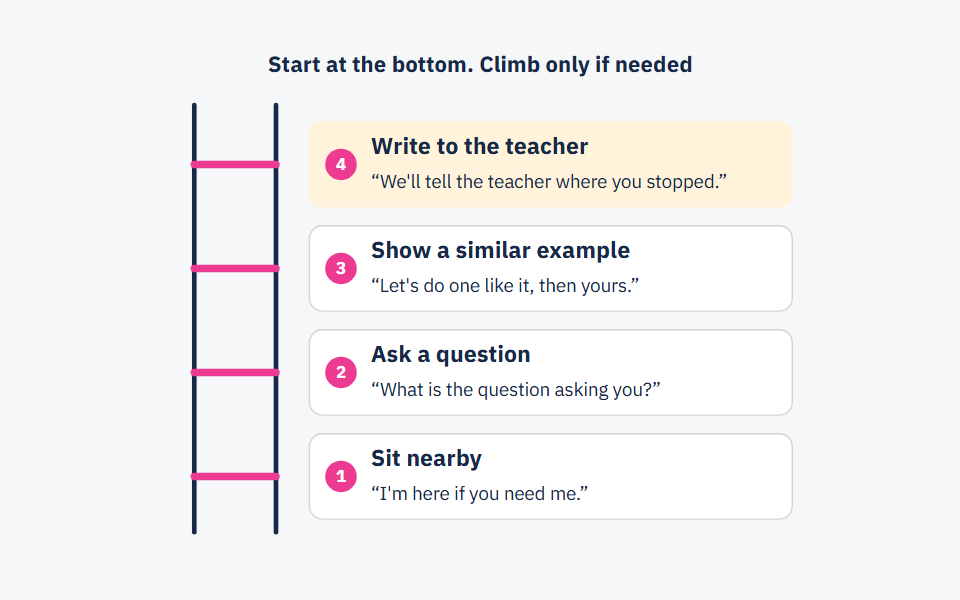
If the step you agreed on is about homework, the homework help ladder shows how to carry it out without doing the homework for them.
Frequently asked questions
- What should I ask my child's teacher at a parent-teacher conference?
- One question per goal: what your child can do now, with an example from their work; what the next step is; what to do at home; and when to follow up. Four questions are enough.
- What should I ask if the meeting is very short?
- Two questions: “What is the one thing they need right now?” and “What should we do at home for it?” Then ask for a time to follow up.
- Should I bring my child to the meeting?
- Follow what the school asks. If they come, ask that they start by saying what they find easy and hard, and that they hear the agreement at the end.
- What if the school has no meeting scheduled?
- Ask for a short appointment the way the school prefers, and say in your request what you want to ask, so the teacher comes prepared.
Sources
Every fact in this post that we did not produce ourselves comes from one of these sources.
- Working with Parents to Support Children's Learning: Guidance Report — Education Endowment Foundation, 2018
- Classroom Assessment: Minute by Minute, Day by Day — ASCD (Educational Leadership), 2005-11-01
- What is anxiety? — UNICEF Parenting, n.d., read 2026-10-22
Written with String's editorial team: we use AI for research and first drafts, and a person checks every fact and every source before anything is published. How we write
Founder and CEO, String
“I grew up in a house of teachers.” I spent a year designing the STEM program for one of the largest school groups in Saudi Arabia, have written curriculum by hand, trained robotics coaches and sold software into schools, then left that job to build String in Amman.