How to know your child's level at school without waiting for an exam
Short checks spread over a week show you where your child stands and what to do next, with a weekly note to print. The first is two minutes of reading aloud, tonight.
The week's note
A free printable PDF, no sign-up.
You might be waiting for the exam mark to see how your child is doing. It arrives weeks after the lesson, though, and it won't tell you why it came out that way or where to start next.
You can find out more from home, with no test and no pressure, by spreading short checks over a week and taking what you notice to the teacher. Start tonight. Ask your child to read you a page from their reader for two minutes, then ask what happened on the page.
How to spread the checks over a week
Ask about everything at once and your child may feel they're sitting an exam and tell you what they think you want to hear. So give each day its own short step, and move the days around to suit your week.
| Day | Step | Time | What to look for |
|---|---|---|---|
| 1 (tonight) | Reading aloud | Two minutes, then a question | Do they read without stopping much, and can they retell it in their own words? |
| 2 | A homework conversation | Three questions | Can they explain it in their own words, and do they know where they got stuck? |
| 3 | A look through the notebook | 10 minutes, on your own | The teacher's comments, unfinished work, a mistake that keeps coming back |
| 4 | A question for the teacher | A single message | Does the teacher see what you see, and what would they suggest you do at home? |
| 5 | Short problems without the book | 10 minutes | What they can do on their own |
| End of the week | The week's note | 10 minutes | A step for next week |
How to do each step, and what to do with what you see
Reading aloud
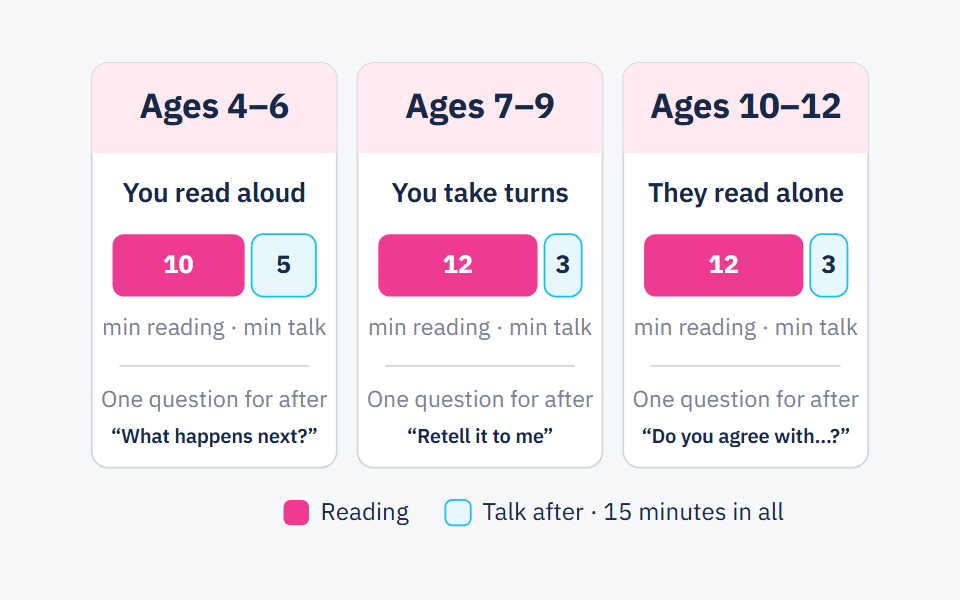
Pick a page from the class reader they haven't practised this week and let them read without stopping them at every slip. Then ask, “What happened on this page?” If they read without many stops and can retell it, keep the daily reading as it is. If they stumble over words, try reading together for ten minutes a day, a paragraph each. If they read well but can't retell it, stop after each paragraph with a short question. Our reading plan for home has more.
A homework conversation
Sit with them during homework or just after. Ask what they learned today, then have them pick a question they've solved and “explain it to me like I don't know it.” Last, ask where they got stuck. While they explain, listen for how they're thinking about the problem, and write down where they hesitated, in their own words, to take to the teacher. For how much to help with the homework itself, see our post on homework help.
A look through the notebook
Do this alone, in about ten minutes, so your child doesn't feel you're going through their things. In the last three weeks of pages, look for the teacher's corrections and comments, work started and never finished, and a mistake that turns up on different pages. Write down one repeated mistake with an example, since a mistake that keeps coming back may deserve a closer look than a one-off.
A question for the teacher
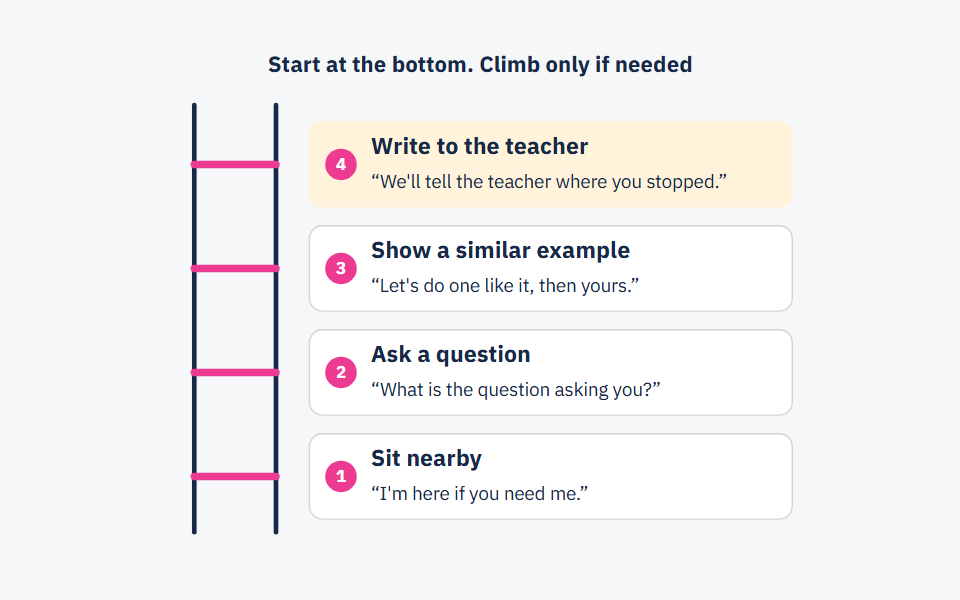
Write to the teacher, however your school prefers parents to get in touch, with a question built on what you saw. You could write, “I've noticed the same mistake on several pages of my child's notebook. Do you see it in class too, and what would you suggest we work on at home?” If they suggest something, try it for a while, then tell them what changed.
Short problems without the book
Write three to five questions from this week's lessons, say maths problems like the homework, five spelling words or a question on a science or social studies text. Tell your child there's no mark and it isn't a test, and let them work without the book. What they get wrong becomes short practice at the end of the week. The questions are useful practice in themselves, too. A 2013 review by Dunlosky and colleagues, reported by the Association for Psychological Science, put practice testing among the most useful study techniques and rereading and highlighting among the least.
The week's note
At the end of the week, write down what you saw at each step, as you saw it, without turning it into a verdict. Pick a step for next week, two at most, and keep the note beside the ones that follow.
If your child uses the String for Families app, its Daily Read describes each evening's play from their class syllabus, how long it lasted, where they got it right and where they hesitated. It's another view to set beside what you've seen yourself.
A filled-in week's note to copy from
The week below is one we made up for an imaginary child in Grade 4. It shows what the parent noticed at each step and what they decided next. Fill in yours the same way on the printable page.
| Step | What I noticed | Next step |
|---|---|---|
| Reading | Read the page without many stops, stumbled on two long words, retold the story correctly in two sentences | No change. Daily reading as it is |
| Homework | Explained an addition problem correctly. Said they don't know where to start on word problems | Read word problems aloud together before solving them |
| Notebook | Forgot to carry in multiplication on three pages, for example instead of 144 | Make this mistake my question to the teacher |
| Teacher | Sees the same mistake in class and suggests five short multiplication problems every other day | Five problems every other day, for two weeks |
| Short problems | Solved two of three alone. Got the third wrong, again on carrying | A similar problem with different numbers at the end of the week |
The steps stay the same in every subject. What you look at and what you ask will change, as the table shows.
| Subject | What to look at | What to ask your child | What to ask the teacher |
|---|---|---|---|
| Reading | A page from the class reader they haven't practised this week. Do they stop at long words, skip words, or stop at the end of a sentence? | “What happened on this page?” | “Do they read at the same pace in class? How would reading at home help?” |
| Maths | A mistake that repeats across notebook pages, like forgetting to carry in multiplication | “Explain this problem to me like I don't know it.” | “Do you see the same mistake in class? How many problems should we practise?” |
| Spelling | Five words from this week's lesson, written without the book | “Which word were you unsure about?” | “Is their spelling in class stronger or weaker than on spelling tests?” |
| Science or social studies | Whether they can say something from the lesson in their own words instead of reciting it | “If you explained this lesson to a friend, what would you say?” | “Which part of this lesson do students usually find hard?” |
How to read the report card and the teacher's comments next to what you saw at home
The report card comes at the end of term with a mark for each subject, sometimes with a short comment from the teacher. A mark (or grade, depending on where you live) arrives after the lessons are over. It tells you where your child ended up. It can't tell you which part was hard.
| What the report card gives you | What it doesn't show | What you add |
|---|---|---|
| A mark for each subject, sometimes with a comment from the teacher | Why the mark came out that way, and which part was hard | The repeated mistake, where they hesitated, what they did on their own |
| A picture of the end of term | The weeks before it | Your weekly notes, several weeks in a row |
So read the teacher's comment before the mark. Writing for teachers in Educational Leadership in 2005, Dylan Wiliam says research shows that students given a grade and a comment ignore the comment, and look first at the grade, then at their neighbour's. If the comment is vague or missing, put the mark next to your weekly notes and see whether the mistake you kept finding in the notebook belongs to the subject where the mark was lower. Then ask the teacher.
Your nearest chance to sit down with the teacher may be the parent-teacher conference (parents' evening in some schools, open day in Jordan), and it's usually short. Bring your weekly note and a question or two from the list below, so you leave with a step you know how to start. There's also a printable question card for the meeting.
Questions ready for the teacher
- I've noticed this mistake keeps coming back in my child's notebook (give the mistake and an example). Do you see it in class too?
- What step would you suggest we work on at home this week?
- What does my child do in class without help, and where do they need it?
- What does this mark reflect? What did my child get right, and what did they miss?
- How will I know the step we agreed on has helped, and when should we talk again?
When to talk to the teacher or counsellor, and how to start
You don't have to wait for the exam to talk to the school. If your notes show any of these, write to the teacher or ask to meet, and bring an example from the notebook or the week's note.
- The same mistake is still in the notebook after two weeks or more of trying the teacher's suggestion.
- Your child avoids reading or homework again and again, putting it off or finding a reason to drop it.
- What you see at home is clearly different from the marks or the teacher's comments, in either direction.
- Your child's worry about school keeps coming back and stays on your mind.
If it's anxiety you're worried about, UNICEF's page for parents says that when a child's anxiety starts interfering with school, home or play, they may need support from a mental health professional. Talk to the school counsellor (counselor, if you're in the US), who knows what the school offers and where to turn. If the school thinks your child needs a specialist assessment, it'll suggest one and tell you how to go about it.
What to do when the checks turn into an argument
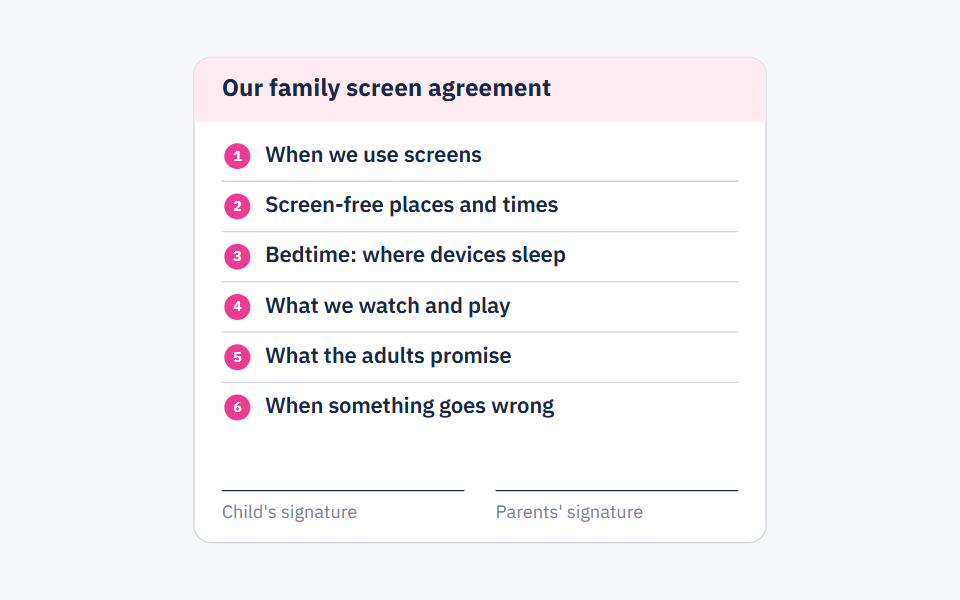
Your child may get fed up with all this, refusing to read or getting cross when you ask about homework. If so, stop for a whole week, then come back with a single step when they're calm. Compare what they do today with their own earlier pages, never with their siblings or classmates. If you'd like a fixed time for the checks, the family screen-time agreement works for this too.
Frequently asked questions
- How do I know my child's level at school from home?
- Spread short checks over a week, from reading aloud to a few problems without the book. Write what you saw in the week's note and go over it with the teacher, who sees your child in class every day.
- Do I need a placement test?
- Not to start with. A general test may not follow your child's class syllabus, and the notebook and the teacher are closer to what the school asks of them. If the school sees a need for a specialist assessment, it'll suggest one.
- What should I do if my child is behind in school?
- Pick a step for this week, take an example from the notebook to the teacher and ask what support the school offers. Compare your child with last week, never with their siblings. If the gap's still there after a few weeks, go back to the teacher and the counsellor with your notes.
- Are exam marks and the report card enough to tell me my child's level?
- A mark is a number that comes once the lessons are over, and the teacher's comment and the notebook explain it. Read the comment before the mark, and ask the teacher what your child got right and what they missed.
- What can I say so my child doesn't feel tested?
- Tell them the short problems don't get a mark. Instead of “Did you understand?”, which is easy to answer with a yes, say “Show me how you did this one.” And keep to a step a day.
Sources
Every fact in this post that we did not produce ourselves comes from one of these sources.
- What is anxiety? — UNICEF Parenting, n.d., read 2026-10-22
- Classroom Assessment: Minute by Minute, Day by Day — ASCD (Educational Leadership), 2005-11-01
- Which Study Strategies Make the Grade? — Association for Psychological Science, 2013-01-10
Written with String's editorial team: we use AI for research and first drafts, and a person checks every fact and every source before anything is published. How we write
Founder and CEO, String
“I grew up in a house of teachers.” I spent a year designing the STEM program for one of the largest school groups in Saudi Arabia, have written curriculum by hand, trained robotics coaches and sold software into schools, then left that job to build String in Amman.