Sleep before an exam: why the all-nighter does not work
A child aged 13 to 17 needs at least 8 hours of sleep, and one aged 6 to 12 at least 9, and during sleep the brain builds what helps it learn and remember. The extra hour of revision at midnight is paid for with the sleep they need in the morning.
Sleep in exam week — a card for the bedroom
A free printable PDF, no sign-up.
- Definition
- Recommended sleep for students: 9 to 12 hours per 24 hours for children aged 6 to 12, and 8 to 10 hours for teens aged 13 to 17, as listed on the CDC's “About Sleep” page (15 May 2024), based on recommendations from the American Academy of Sleep Medicine (AASM).
The night before an exam, staying up looks sensible: one more hour of revision, one more page of notes. But that hour comes out of sleep, and sleep is not time lost from studying. While we sleep, says the US National Heart, Lung, and Blood Institute, the brain gets ready for the next day and forms new pathways that help us learn and remember. Here is how much sleep your child needs at their age, what health bodies say about sleep and memory, and an exam-week routine to start tonight: set the wake-up time, then count back to bedtime.
How much sleep does your child need?
The numbers are ranges, and the bottom of the range is the floor. To turn them into a bedtime, start from the wake-up time and subtract the bottom of the range. This table does it for a child who wakes at 6:30:
| Age | Recommended hours | Waking at 6:30, asleep by |
|---|---|---|
| 6 to 12 | 9 to 12 hours | 21:30 |
| 13 to 17 | 8 to 10 hours | 22:30 |
| 18 and over | 7 hours or more | 23:30 |
The last column is when they are actually asleep, not when they get into bed; if your child takes a while to drop off, move the time earlier by that much. The American Academy of Pediatrics (AAP) notes that teens' sleep-wake cycles shift up to two hours later at the start of puberty, so don't be surprised if your fifteen-year-old isn't sleepy at ten. That is why the routine below starts from the wake-up time, not the bedtime.
What sleep does for memory
The US National Heart, Lung, and Blood Institute (NHLBI), part of the National Institutes of Health, says the following on two pages last updated in 2022:
- Sleep helps with learning and the formation of long-term memories, on its page “Why Is Sleep Important?”.
- While you sleep, your brain is getting ready for the next day, forming new pathways to help you learn and remember information, on its page “How Sleep Affects Your Health”.
- A good night's sleep improves learning and problem-solving skills, according to studies the same page cites.
- Sleep deficiency can cause problems with learning, focusing and reacting, and trouble making decisions, solving problems and remembering things.
- Children who don't get enough sleep might be overly active and have problems paying attention, and their school performance can suffer. Teens may get lower grades and feel stressed, the same page says.
In plain words: what your child read in the evening needs a night's sleep to settle, and a morning exam needs attention that doesn't come after a short night. The NHS page “Help your child beat exam stress” (last reviewed 8 March 2023) says good sleep improves thinking and concentration, and that most teenagers need 8 to 10 hours' sleep a night.
Why the all-nighter doesn't work
The same NHS page says it plainly: cramming all night before an exam is usually a bad idea. The reason pulls together what came before: the extra hour is paid for with the sleep that what they studied needs in order to settle, and with the attention they need in the exam hall.
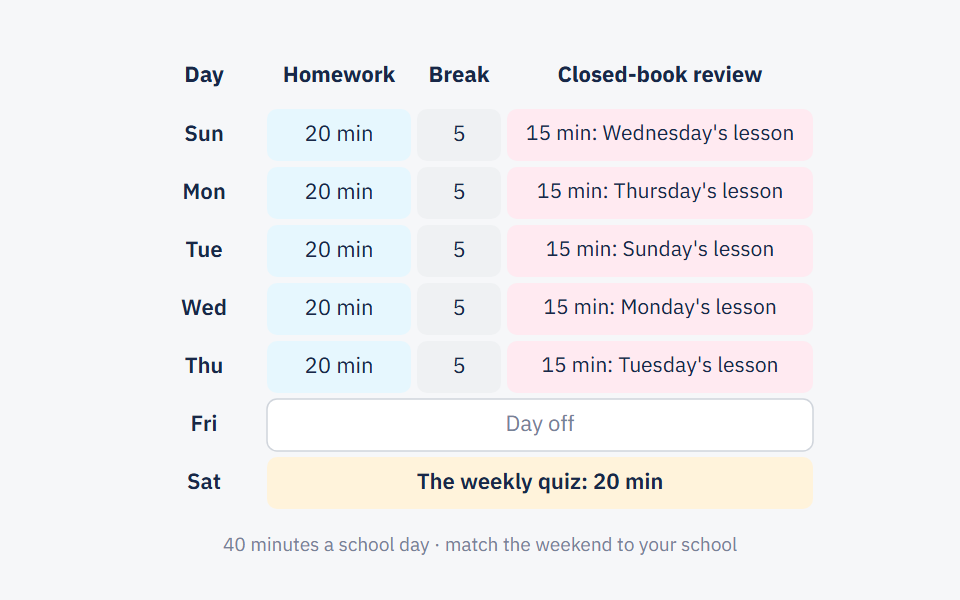
Staying up is usually the sign of an earlier problem, not a fix for it: revision left for the last night. The real fix starts a week earlier, with revision spread across the days, as in the weekly study timetable. If the night before arrives with a lot still left, pick the most important part with your child, review it, then let them sleep on time.
An exam-week routine
These steps bring together what the sources advise; where a step is our own, we say so:
Fix the wake-up time, weekends included
The AAP advises the same waking time on weekdays and weekends. Choose the time for exam day and start using it at the beginning of the week.
Count back from the wake-up time to bedtime
Subtract the bottom of the range for their age from the wake-up time, as in the table above; that is the latest they should be asleep.
Screens off an hour before sleep
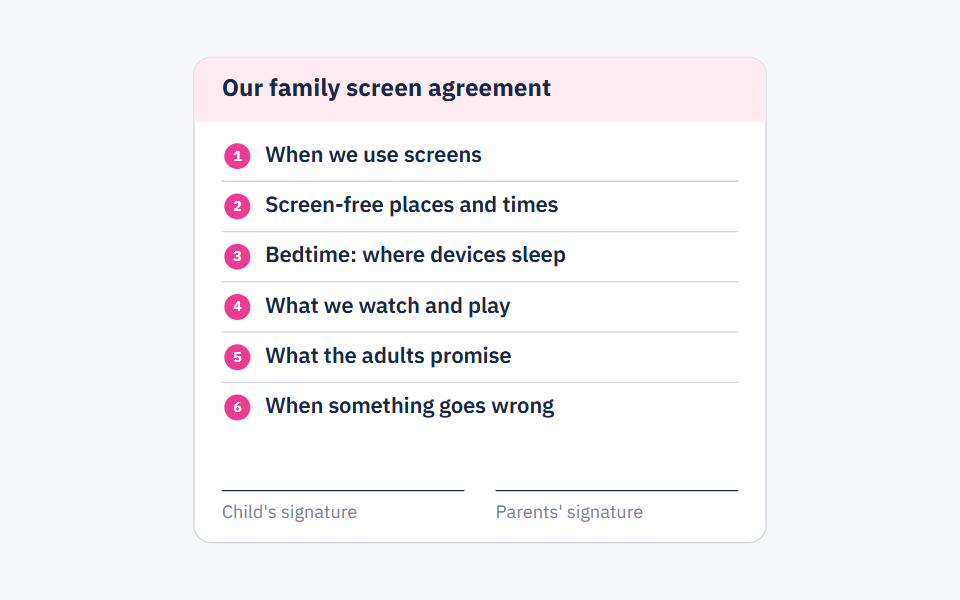
The AAP advises turning off all screens at least 60 minutes before bedtime, and keeping them out of the bedroom, especially overnight. The CDC's general sleep tip is to turn off electronic devices at least 30 minutes before bedtime; we use the hour here because the AAP's advice is written for children. If screens are a running argument at home, a family screen-time agreement is a template you write together.
A short review on paper, then stop
Our advice: a short review of the key points after the screens go off is fine, on paper rather than a phone, and then the notebook closes. Nothing new in these minutes.
Half an hour to wind down, no studying
The NHS suggests about half an hour to wind down before bed, away from studying, TV and screens.
A quiet, cool room
Among the CDC's tips for better sleep: a bedroom that is quiet and relaxing, at a cool temperature.
- Wake up: 6:30, every day of the week.
- Bottom of the range for their age: 8 hours, so the latest time to be asleep is 22:30, because 8 hours after 22:30 is 6:30.
- Screens off: 21:30, an hour before sleep.
- Short review on paper: 21:30 to 22:00.
- Wind down, no studying: 22:00 to 22:30.
When to ask a doctor
The AAP advises discussing your child's sleep habits and problems with your paediatrician, and says most sleep problems are easily treated. If your child struggles to fall asleep for weeks, or sleeps enough hours and still wakes tired, ask your paediatrician or family doctor.
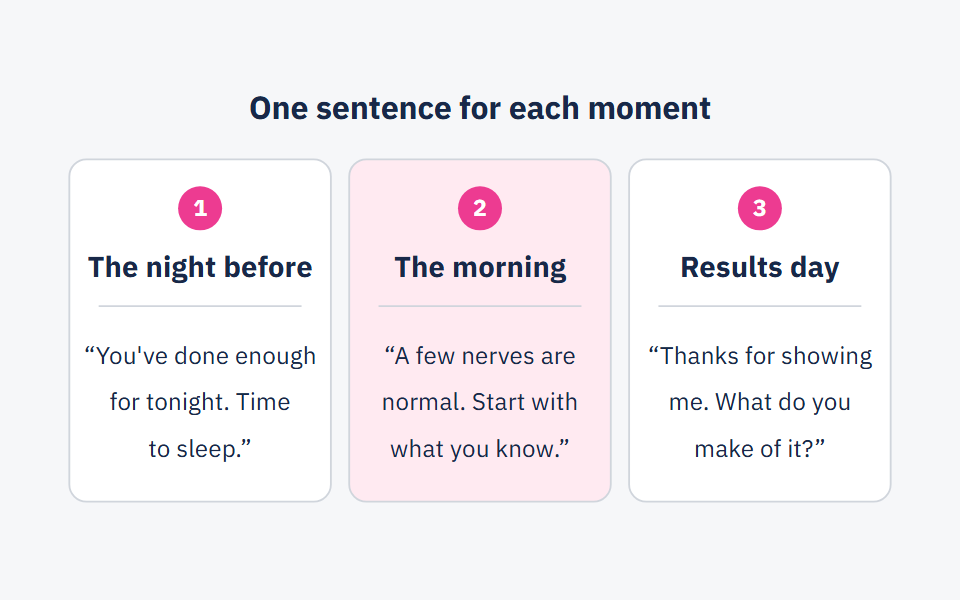
If worry is what keeps them awake, note that the NHS lists not sleeping well among the signs of exam stress in children, advises seeking help if anxiety is severe, persists and interferes with everyday life, and says that seeing a GP is a good place to start. You can also start with the school counsellor. What to say to your child before an exam has sentences that ease ordinary nerves on the night before. This post describes a routine; it does not diagnose anything.
Frequently asked questions
- How much sleep does a student need before an exam?
- The need doesn't change on exam night: 9 to 12 hours for children aged 6 to 12, and 8 to 10 hours for teens aged 13 to 17, according to the CDC.
- Is pulling an all-nighter before an exam a good idea?
- The NHS says cramming all night before an exam is usually a bad idea, and that good sleep improves thinking and concentration. It works better to review the most important part, then sleep on time.
- Should my child revise right before bed?
- A short review on paper after the screens go off is fine; that is our advice. Then half an hour with no studying before sleep, as the NHS suggests.
- How much sleep do high school students need?
- 8 to 10 hours per 24 hours for ages 13 to 17, and 7 hours or more from 18, according to the CDC.
Sources
Every fact in this post that we did not produce ourselves comes from one of these sources.
- About Sleep — U.S. Centers for Disease Control and Prevention (CDC), 2024-05-15
- Healthy Sleep Habits: How Many Hours Does Your Child Need? — American Academy of Pediatrics (HealthyChildren.org), 2026-08-07 (last updated)
- Why Is Sleep Important? — National Heart, Lung, and Blood Institute (NIH), 2022-03-24 (last updated)
- How Sleep Affects Your Health — National Heart, Lung, and Blood Institute (NIH), 2022-06-15 (last updated)
- Help your child beat exam stress — NHS (UK National Health Service), 2023-03-08 (last reviewed)
Written with String's editorial team: we use AI for research and first drafts, and a person checks every fact and every source before anything is published. How we write
Founder and CEO, String
“I grew up in a house of teachers.” I spent a year designing the STEM program for one of the largest school groups in Saudi Arabia, have written curriculum by hand, trained robotics coaches and sold software into schools, then left that job to build String in Amman.