Where does your time go? A one-week log that shows the paperwork hours
Log everything you do outside lessons for one week, in five categories, and keep what you do at school apart from what you take home. On the last school day, add up the columns and pick just three of the biggest tasks: one to cut or shrink, one to batch into a fixed slot, and one to hand off or reuse.
Teacher time log — one week
A free printable PDF, no sign-up.
This is for the teacher who feels the evenings vanish into paperwork but can't say exactly which paperwork. Surveys give you a whole country's averages; a one-week log gives you your own week. All it takes is noting the time when a task starts and ends, and adding it up when the day is done.
The log: five categories, and a column for what goes home
Log everything you do for school outside the lessons themselves, for seven days in a row. Don't log the lessons; your timetable already has them. Each category has one definition, so you never hesitate over where a task goes:
| Category | What goes in it | Examples |
|---|---|---|
| 1. Planning and preparation | Everything you do to get a lesson ready | Lesson plans, worksheets, slides, finding resources, printing |
| 2. Marking and feedback | Everything you do with students' work after they hand it in | Marking notebooks and tests, writing comments, recording marks in your own book |
| 3. Admin | What the school or the authority asks for that isn't tied to one lesson | Attendance, entering marks in the system, reports and forms, committees, duty |
| 4. Communication | What you write or say to anyone other than your students in class | Parent messages and calls, meetings with colleagues and leaders, message groups |
| 5. Other | Whatever fits none of the four | Cover lessons, events and trips, training |
Pick an ordinary week
Not an exam week, and not the first week of term. The week you measure is the week you will change.
Note it as it happens, add it up at day's end
On a card in your pocket or in your phone's notes: the category number from 1 to 5, the start and end time, and the task in two words. When the day is done, move the totals into the table in hours, to the nearest quarter. Don't fill the table from memory at the end of the week; memory rounds.
Keep home apart from school
In the “of which at home” column, write what you did after leaving school, in the evening or at the weekend. That column tells you where your evenings go.
Keep the task names
The category tells you where to look; the task tells you what to change. “Marking 8 hours” is not enough to decide on; “homework notebooks 5 hours” is.
A worked example: an invented week, and what it shows
We wrote these numbers to illustrate the method; they are not a real teacher's data. They are in hours, outside lessons.
| Category | At school | At home | Total |
|---|---|---|---|
| Planning and preparation | 3 | 4.5 | 7.5 |
| Marking and feedback | 4 | 4 | 8 |
| Admin | 4.5 | 0.5 | 5 |
| Communication | 1.5 | 1.5 | 3 |
| Other | 1 | 0 | 1 |
| Total | 14 | 10.5 | 24.5 |
The five biggest tasks of the week, as noted at the time:
- Marking homework notebooks line by line: 5 hours (marking).
- Making worksheets from scratch: 3.5 hours (planning).
- Writing the weekly plan: 2 hours (planning).
- Copying marks from the mark book into the online system: 1.5 hours (admin).
- Answering parent messages scattered through the evening: 1.5 hours (communication).
What it shows: 10.5 of the 24.5 hours, more than a third of the hours logged, were worked at home, most of it planning and marking. And the single biggest task was marking notebooks, not admin.
On the last school day: reading the log in twenty minutes
Add up the columns
The total for each category, the home column, and the overall total. Three numbers at the top of the card.
Rank tasks, not categories
List the five biggest tasks with their hours from your daily notes. That list, not the table, is what you decide on.
Ask three questions about each task
Do students learn something from it they would not learn otherwise? If not, cut it or shrink it. Does it come in scattered bits at many times? Batch it into a fixed slot. Could someone else do it, or have you done it before? Hand it off or reuse it.
Pick three tasks only
One for each decision. Write on the card what you will change from the first day of next week. Three changes you can keep; ten you will have dropped within two weeks.
Log another week three weeks later
Compare the same three tasks. If one of them took no less time, or more, undo that change and try another.
Three changes from the example, in detail
- Cut or shrink — homework notebooks: instead of marking every line, choose one question to mark in each notebook, note the repeated mistakes on a single sheet, and open the next lesson with five minutes on them for the whole class. If your school requires every page to be marked, show it the log before you change anything.
- Batch — parent messages: set two fixed reply slots a week, twenty minutes after school each, and tell parents about them in one message. Whatever arrives in between waits, except what the school defines as urgent.
- Hand off or reuse — worksheets: if a colleague at your school teaches the same grade, split the unit: each of you makes the sheets for half the lessons and you swap. Save each sheet under the lesson's name so you can return to it next year. If you ask an AI tool for the draft, what to check before printing is in lesson prep with AI, and twenty Arabic prompts for lesson prep has templates to fill in.
If the weekly plan takes a whole evening, the one-page weekly plan template sets out an order for writing it at school on the last day of the week.
What surveys say about teacher time, with dates
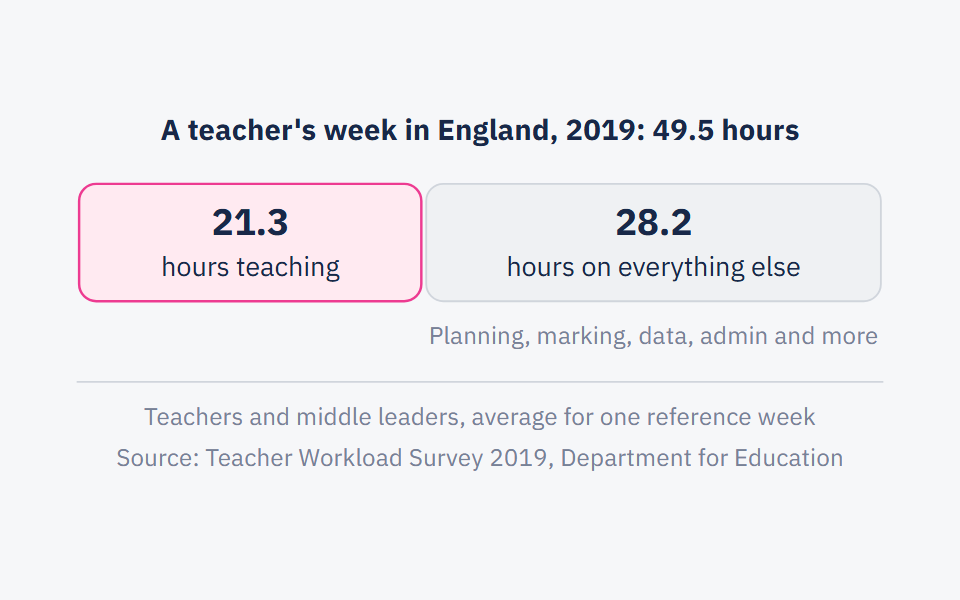
In England, the Teacher Workload Survey 2019, run by the National Foundation for Educational Research (NFER) for the Department for Education, with its brief published in October 2019, asked 7,287 teachers and school leaders in March 2019 about their hours in one specific “reference week”. Teachers and middle leaders reported an average of 49.5 hours that week, of which 21.3 were teaching. Primary teachers and middle leaders reported an average of 12.5 hours worked during weekends, evenings or other out-of-school hours, and their secondary colleagues 13.1.
In the same survey, most primary teachers said they still spent too much time on planning, marking and data management, alongside general administrative work; most secondary teachers said the same of marking, data management and general admin. Most respondents said their schools had changed their approach to data tracking, behaviour, marking and appraisal in the previous two years to reduce workload, but only a minority of those in such schools, typically around 20% or less, felt it had reduced theirs. The one exception was changes to primary schools' marking and feedback policies: 40% of primary respondents said those had reduced their workload. The lesson we take from it: a change is not enough on its own; measure the same task before and after.
In the US, 84% of teachers in a Pew Research Center survey said there is not enough time in their regular work hours for tasks like grading, lesson planning, paperwork and answering work emails, and 81% of those said simply having too much work is a major reason. 54% said balancing work and personal life is very or somewhat difficult for them. The survey covered 2,531 US public K-12 teachers from RAND's American Teacher Panel, from 17 October to 14 November 2023, and was published on 4 April 2024.
In the OECD's Results from TALIS 2024, published on 7 October 2025, teachers spend 23 hours a week on teaching on average, their single most time-consuming task. Yet teaching accounts for only about 43% of full-time teachers' self-reported working time across all their tasks, on average, and in most of the education systems surveyed it is not the majority of the workload. So more than half of the working time goes to things other than teaching, and that is the part your log measures.
And in a Gallup and Walton Family Foundation survey published on 14 October 2026, of 1,952 US K-12 educators, 85% said helping a student through something difficult makes them feel they matter a great deal, while administrative tasks were by far the least likely to give them that sense.
We found no published survey with this level of detail on teachers' hours in Arab countries. The numbers above are other countries' averages: they tell you the problem is common, not where your own time goes. The log does that.
When the log won't help
- An unusual week: exam week or the first week of term shows you that week alone. If it is all you have, log another week a month later.
- Tasks you don't control: forms the school or authority requires are not yours to drop. Take the log to your leadership with its numbers: “this task takes me an hour and a half every week” is stronger than a complaint. For a principal who wants to measure it across the school, there is a method in how to measure the teacher time a tool really saves.
- Logging takes time too: a few minutes a day. So never log more than a week at a time, and don't make it a permanent habit; once a term is enough to see whether your changes have held.
Frequently asked questions
- How many hours a week do teachers work?
- In England, teachers and middle leaders reported an average of 49.5 hours in the March 2019 week the Teacher Workload Survey asked about, 21.3 of them teaching. In the OECD's TALIS 2024, teaching averaged 23 hours a week, only about 43% of full-time teachers' reported working time. We found no comparable published figure for Arab countries.
- What counts as teacher admin work?
- In this log: attendance, entering marks in the system, reports and forms, committees and duty. In England's 2019 survey, most teachers said they spent too much time on data management and general administrative work.
- Should I log the lessons I teach?
- No. Your timetable already has them; the log is for what you do outside them. Log cover lessons only, under “other”.
- How do I reduce teacher workload without my students losing out?
- Start with tasks students learn nothing from that they would not learn otherwise, such as copying marks from one place to another, or marking students never read. Then log another week to check the change really saved time.
Sources
Every fact in this post that we did not produce ourselves comes from one of these sources.
- Teacher Workload Survey 2019: research brief, DFE RB951 (Matt Walker, Jack Worth, Jens Van den Brande, NFER) — Department for Education (England), 2019-10
- What's It Like To Be a Teacher in America Today? — Pew Research Center, 2024-04-04
- Teachers Using AI Say It Frees Up Time for What Matters Most (Megan Brenan) — Gallup (with the Walton Family Foundation), 2026-10-14
- Results from TALIS 2024: The State of Teaching — OECD, 2025-10-07
Written with String's editorial team: we use AI for research and first drafts, and a person checks every fact and every source before anything is published. How we write
Founder and CEO, String
“I grew up in a house of teachers.” I spent a year designing the STEM program for one of the largest school groups in Saudi Arabia, have written curriculum by hand, trained robotics coaches and sold software into schools, then left that job to build String in Amman.