A teacher's time is not free
The hours a teacher spends on paperwork after class have a price, and the teacher pays it out of their evenings. The right tool writes the draft and leaves the decision with the teacher, so some of that time comes back.
The argument in one sentence
This is an opinion piece, and its argument fits in one sentence: every hour a teacher spends after class writing something a tool could draft is an hour with a price, and the teacher pays it out of their evenings and weekends. So it is not enough to ask of any tool for teachers whether it is free. The question that matters is how many hours it gives back, and where those hours go.
Where this view comes from
It comes from a story String's founder tells on the About page, quoted here as written:
I grew up in a house of teachers. Both my parents and both my sisters. So I had heard about the paperwork long before I understood it.
On the same page he says he understood it after a year designing the STEM program for one of the largest school groups in Saudi Arabia. He went looking for what had driven the results and found instead where the time had gone: most of the effort from the teachers and the management team “had been spent on solving software problems and administration. Not on teaching. On making the tools work.” Then he writes the sentence this post takes its title from:
Education does not suffer from a shortage of good software. It suffers because none of it shares a brain, and the teacher is expected to be that brain, for free, on their own time.
What the numbers say, and where they come from
The figures below come from the United States and England, and they should not be read as figures for schools in the Arab world. The first two surveys measure working hours, and they point the same way: contracted hours do not hold what is asked of a teacher. The third measures which tasks make classroom staff feel they matter.
| Country and date | Who was asked | What it found |
|---|---|---|
| United States; Pew Research Center, April 4, 2024 | 2,531 public K-12 teachers on RAND's American Teacher Panel, October 17 to November 14, 2023 | 84% say there is not enough time in their regular work hours for tasks like grading, lesson planning, paperwork and answering work emails |
| England; Department for Education, October 2019 | 7,287 teachers, middle leaders and senior leaders in 404 schools, March 2019 | Teachers and middle leaders averaged 49.5 hours in the reference week, 21.3 of them teaching |
| United States; Gallup and the Walton Family Foundation, October 14, 2026 | 1,952 K-12 educators — teachers, paraprofessionals and other classroom staff — July 28 to August 14, 2026 | Administrative tasks are by far the least likely to give educators a strong sense that they matter |
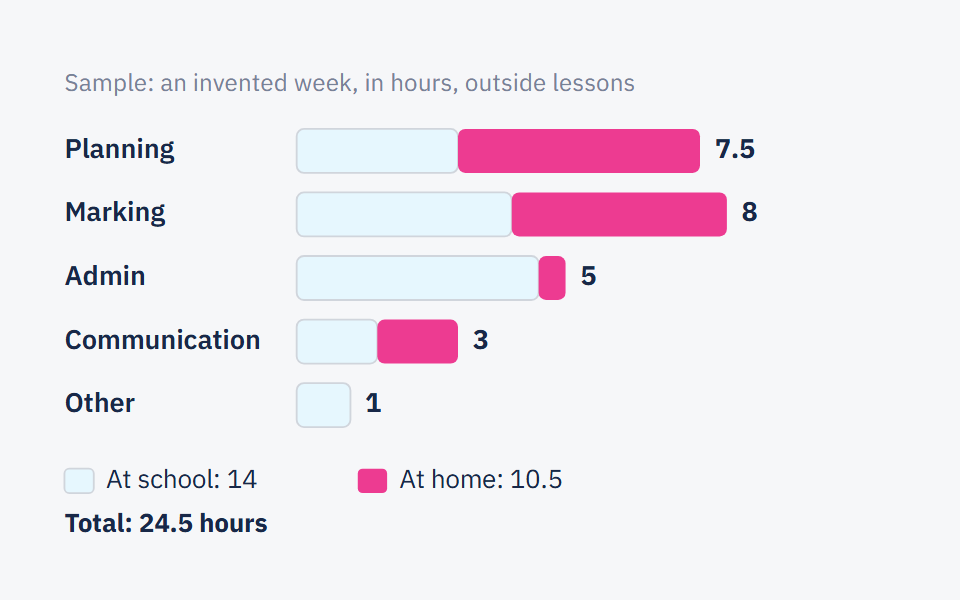
In the Pew survey, 81% of teachers who say there is not enough time name simply having too much work as a major reason. In England's Teacher Workload Survey 2019, primary teachers and middle leaders reported an average of 12.5 hours during weekends, evenings or other out-of-school hours, and their secondary colleagues 13.1. Seventy per cent of the primary group and 76% of the secondary group strongly disagreed with the statement “I can complete my assigned workload during my contracted hours”. Most said they still spent too much time on marking, data management and general administrative work, and primary staff added planning to that list.
In the same Gallup survey, 59% of those surveyed say they used AI tools during the 2025-2026 school year. Nearly two-thirds of those users say it gave them more time for the parts of teaching that matter most: 13% “a lot more time” and 51% “somewhat more time”. Earlier, on July 8, 2025, The 74 reported a Gallup and Walton Family Foundation survey of 2,232 U.S. public school teachers in which weekly AI users saved almost six hours of work per week.
Why we say it is not free
When people say marking and planning are “part of the job”, they are right. But look at who pays for that part when contracted hours cannot hold it:
- The teacher pays with their evenings. That is what England's figures on evening and weekend hours say, and what 84% of U.S. teachers say about their regular work hours.
- They pay with the part of the job that gives it meaning. In the Gallup survey, the activities most likely to make educators feel they matter involve working directly with students: 85% say helping a student through something difficult makes them feel they matter a great deal. An hour spent on an admin form is an hour not spent with a student.
- The school pays when it picks a tool without asking about time. A tool whose cost in teacher time is never measured against what it gives back can add work instead of removing it. England's survey has a close example, as the next section shows: changes schools made to reduce workload, which notable minorities of respondents said had added to it.
That is why we say a teacher's time is not free. Whoever designs a tool for teachers, or chooses one for them, should count the hours before counting the features.
The strongest case against this view
The strongest objection is not that teachers do not get tired. It is this: planning and marking are not just paperwork, they are the thinking itself. A teacher who writes their own test questions is thinking about their students while they write, and a teacher handed a ready-made draft may lose that thinking, then spend as long reviewing and correcting it as writing it would have taken.
The objection has numbers behind it. In Gallup's 2026 survey, 7% of AI users say it cost them time rather than saving it, and 29% say it had no effect either way. The 74 reported in July 2025 that 28% of U.S. teachers still oppose AI tools in the classroom. And in England, most respondents said their schools had changed their approaches to data tracking, behaviour, marking and feedback, and teacher appraisal specifically to reduce workload, yet in most cases only a minority, typically around 20% or less, felt the changes had reduced their workload, and notable minorities said the changes had added to it.
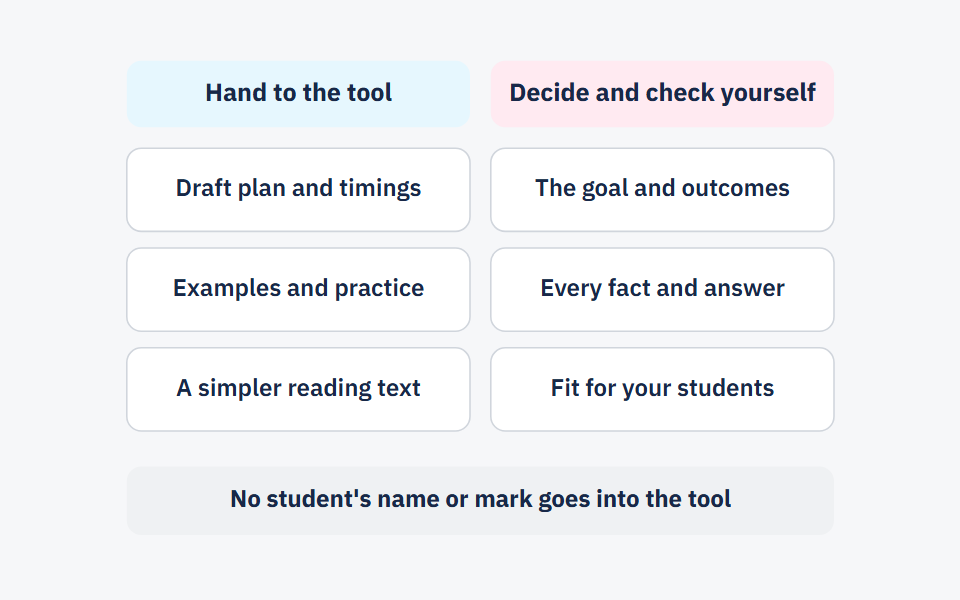
Our answer is that the objection is half right. The mistake is handing the tool the decision. The fix is handing it what needs no decision: formatting the sheet, a second version at an easier level, many questions of one type, the first draft of a letter the teacher then rewrites. The goal, the last question of the lesson, the judgement on a student's work and the sentence that reaches a parent stay with the teacher. Preparing lessons with AI sets out what to hand over and what to check.
What would change this view? A teacher who logs a week and finds that reviewing what the tool wrote takes as long as writing it, or longer. Then the tool gives nothing back and should be dropped. So we are not asking you to believe this argument. We are asking you to measure it.
What to do on the first day of your week
List this week's paperwork
Everything you write outside lessons: plans, worksheets, tests, marking, messages, reports.
Time each task while you do it
Write the start and end time at the task itself, not at the end of the week; memory rounds. One week's time log has a ready table for it.
Pick the task that repeats most
It may be the worksheet, the short quiz or the weekly plan: something you write every week in the same shape.
Ask a tool for the draft, and time the review
Write the request with your class and lesson in it, review and edit the draft, and note how long that took. Compare it with your usual time.
Decide in advance where the saved hour goes
Write it down before you start: a student you will follow up, a question you will prepare for tomorrow, an evening you will not work. If the tool saves nothing after two or three weeks, drop it.
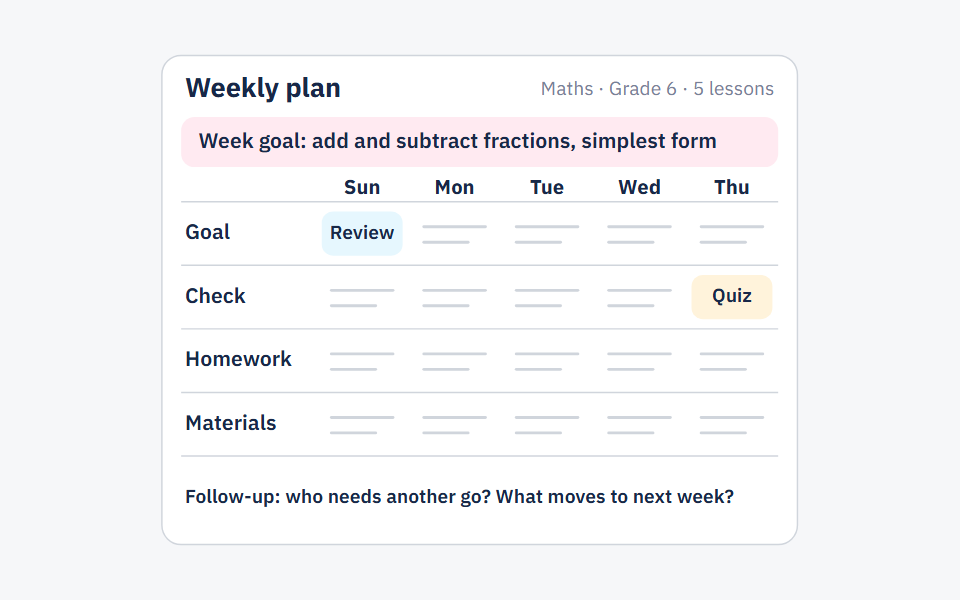
String Studio is one of these tools: you write a request and get a draft plan, worksheet or test, which you review and edit before printing it or sharing it with your students as a link.
Frequently asked questions
- How many hours do teachers work a week?
- It varies by country and phase. In England, teachers and middle leaders in the Department for Education's 2019 survey reported an average of 49.5 hours in the reference week, 21.3 of them teaching.
- What takes up teachers' time outside lessons?
- In Pew's survey of U.S. teachers: grading, lesson planning, paperwork and answering work emails. In England's 2019 survey, most teachers said they spent too much time on marking, data management and general administrative work.
- Does AI really save teachers time?
- In Gallup's 2026 U.S. survey nearly two-thirds of users said it gave them more time for the parts of teaching that matter most; 7% said it cost them time and 29% said it had no effect. Your own week's log is what answers it for you.
- How can I reduce teacher workload without lowering the quality of my work?
- Hand over what needs no decision — formatting, extra versions, the first draft — and keep the decisions: the goal, the last question of the lesson, the judgement on a student's work. Then measure the difference with one week's log, and start in String if you want to try it.
Sources
Every fact in this post that we did not produce ourselves comes from one of these sources.
- What's It Like To Be a Teacher in America Today? — Pew Research Center, 2024-04-04
- Teacher Workload Survey 2019: research brief (DFE RB951) — Department for Education (England), 2019-10
- Teachers Using AI Say It Frees Up Time for What Matters Most (Megan Brenan) — Gallup, 2026-10-14
- Survey: 60% of Teachers Used AI This Year and Saved up to 6 Hours of Work a Week (Lauren Wagner) — The 74, 2025-07-08
Written with String's editorial team: we use AI for research and first drafts, and a person checks every fact and every source before anything is published. How we write
Founder and CEO, String
“I grew up in a house of teachers.” I spent a year designing the STEM program for one of the largest school groups in Saudi Arabia, have written curriculum by hand, trained robotics coaches and sold software into schools, then left that job to build String in Amman.