Report-card comments: honest, kind phrases for every level
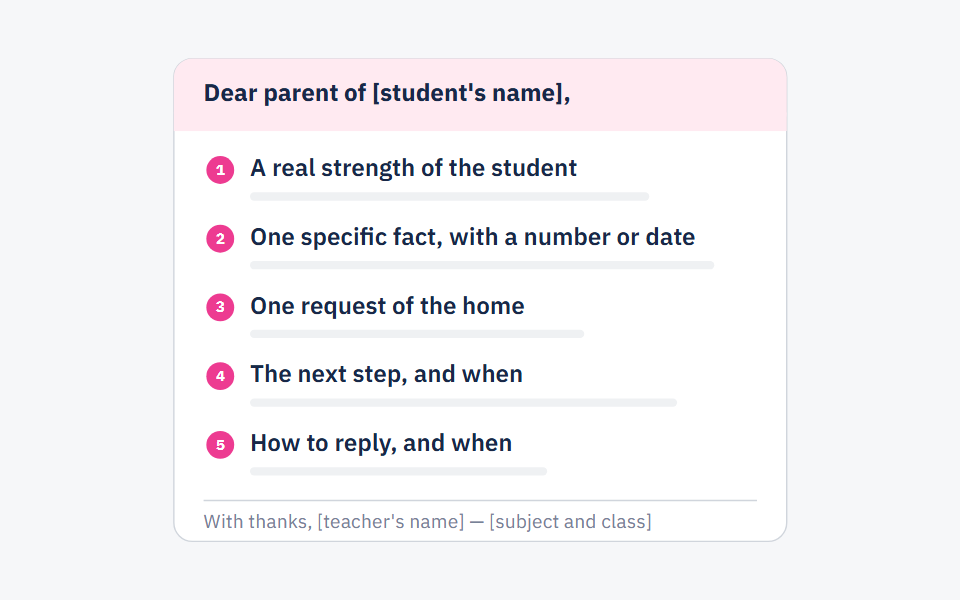
A good report-card comment is two lines: one real strength from the student's work, and one next step that tells the family what to do, with no labels about the child. Here is the rule, 40 comment stems by level and area, and five vague comments rewritten.
Report-card comments — 24 stems
A free printable PDF, no sign-up.
- Definition
- Report-card comment: Two or three lines a teacher writes beside a student's marks at the end of a term, telling the family and the student what the student can actually do, and what their next step is.
The rule: one real strength, one next step, no labels
Report cards are full of lines like “hard-working student” and “needs to put in more effort”, and a family can do nothing with either. The Education Endowment Foundation's guidance report “Teacher Feedback to Improve Pupil Learning” (UK, June 2021) says feedback that focuses on a learner's personal characteristics, or offers only general and vague remarks, is less likely to be effective. It says that if praise is given, it may be more effective for a specific task or subject achievement than general praise such as “great work”.
In a field experiment published by Matthew Kraft and Todd Rogers as a Harvard Kennedy School working paper (October 2014), teachers sent weekly one-sentence individualised messages to the parents of high school students in a credit recovery programme. The share of students who failed to earn course credit fell from 15.8% to 9.3%, and the messages emphasising what students could improve, rather than what they were doing well, produced the largest effects. A report card is not a weekly message, but what we take from the study is that the next-step line is the one a family acts on.
The EEF's “Working with Parents to Support Children's Learning” (2018) says school communications with parents are likely to be more effective if they are personalised, linked to learning and framed positively, and lists inaccessible language and professional jargon among the barriers to working with parents. From these three sources we build the rule:
- One real strength, with evidence from their work: a skill or a piece of work you can see in their notebook or test, not a trait.
- One next step: one, not three, written so the student and family know what to do, and when you will follow it up.
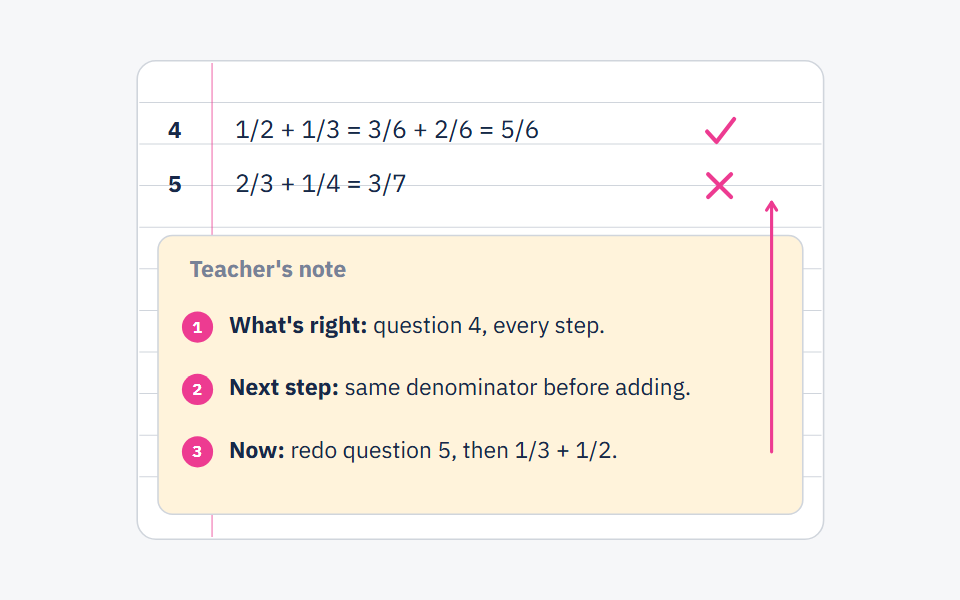
- No labels about the child: describe what they do, not what they are. “Interrupts classmates in discussion” can change; “disruptive” tells the family nothing to do.
Add a line about home only when home has a short, specific part to play, such as reading one page aloud each evening. Do not ask families to teach what they do not know.
40 comment stems, by level and area
Fill the brackets from the student's own work. Pick one strength stem and one next-step stem per student, no more.
Excelling
- Learning · strength: [Name] has mastered [skill] and applies it to problems they have not seen before.
- Learning · strength: explains their method in [topic] clearly enough for classmates to follow it.
- Learning · next step: to justify each step of their working in writing, not just the answer.
- Learning · next step: is ready for [harder task], and will get more of it next term.
- Effort · strength: checks their work before handing it in and corrects their own mistakes.
- Effort · strength: chooses the harder task when given the choice.
- Effort · next step: to stay with a hard problem longer before moving on.
- Behaviour · strength: helps classmates when asked, without giving them the answer.
- Behaviour · strength: listens to classmates in discussion and builds on what they say.
- Behaviour · next step: to give classmates the first chance to answer in discussion.
- Progress · strength: their marks in [skill] rose from [–] to [–] this term.
- Progress · strength: now solves [type of problem] they avoided at the start of term.
- Progress · next step: their goal for next term: [a specific goal you can check].
On track
- Learning · strength: solves core [topic] problems with correct, ordered steps.
- Learning · strength: understands [concept] and can give an example of their own.
- Learning · next step: [skill] in word problems — they solve them as numbers and stumble when they are written in words.
- Learning · next step: to check each answer a second way before moving on.
- Effort · strength: hands in complete homework on time.
- Effort · strength: asks when they do not understand, and comes back to it until it is clear.
- Effort · next step: to redo what they got wrong after marking, not just read the mark.
- Behaviour · strength: starts work when asked, without reminders.
- Behaviour · strength: works in a group and does their part in it.
- Behaviour · next step: to take part in discussion more — their answers help the class when they do.
- Progress · strength: has improved in [skill] since [month]: they now [what they do now].
- Progress · strength: makes fewer mistakes in [skill] than at the start of term.
- Progress · next step: to keep what they have reached in [skill] with short weekly practice.
- Progress · next step: their goal for next term is [goal]; we will check it together in [when].
Needs support
- Learning · strength: [Name] knows [what they have secured, e.g. times tables to 5], and we will build on it.
- Learning · strength: solves [skill] when the steps are written in front of them.
- Learning · next step: one next step: [one specific skill], which we will work on [when and how].
- Learning · next step: needs to secure [earlier skill] before [new topic].
- Effort · strength: attempts problems even when they are hard for them.
- Effort · strength: comes to support sessions and brings their questions.
- Effort · next step: to write down what they know in a problem, even when they cannot solve all of it.
- Behaviour · strength: treats classmates with respect.
- Behaviour · strength: focuses when sitting [near the board / in a small group].
- Behaviour · next step: to start the task in the first five minutes of the lesson; we will help with a written first step.
- Progress · strength: now solves [n] of [n] in [skill], up from [n].
- Progress · strength: [skill] has improved since [support] began, and it needs to continue.
- Progress · next step: at home, [a short, specific activity, e.g. ten minutes of reading aloud every day] will help.
Three complete comments, one for each level
Excelling: [Name] solves multi-step ratio problems without help, and explains their method clearly enough for classmates to follow it. Their next step is to justify each step of their working in writing, not just the answer, and next term they will get problems that ask for it.
On track: [Name] solves core fraction problems with correct, ordered steps, and hands in complete homework on time. Their next step is word problems: they solve them as numbers and stumble when they are written in words. It will help if they read you one problem each evening and say what it asks before solving it.
Needs support: [Name] knows the times tables to 5 and uses them confidently, and attempts problems even when they are hard. Their next step is one thing: the 6, 7 and 8 tables. We will practise them for five minutes at the start of every lesson, and it will help if you ask three questions from them each evening.
Five vague comments, made useful
| Instead of | Write | What changed |
|---|---|---|
| “Excellent student.” | “Solves multi-step ratio problems without help. Next step: write a justification for each step.” | The skill is named, and a step added |
| “Lazy and doesn't care.” | “Handed in [6 of 12] homework tasks this term, and what came in was mostly correct. We need all of them; I will send you a list of anything missing every Thursday.” | A fact with numbers instead of a label, and a step with a date |
| “Needs to put in more effort.” | “In fractions they know the rule and slip in the arithmetic. Next step: check every answer with an estimate before writing it down.” | Exactly where the effort goes, and what it looks like |
| “Disruptive.” | “Interrupts classmates in discussion; when they wait their turn, their contributions are useful. Our goal is a raised hand and a wait, with a signal we have agreed.” | Behaviour that can change, instead of a verdict |
| “Weak.” | “Reads short texts fluently and stumbles on long words. We will work on splitting words into syllables; it will help if they read you one page aloud each evening.” | A real strength first, then where the difficulty is and what to do |
Words to avoid, and what to write instead
| Avoid | Why | Write instead |
|---|---|---|
| “lazy”, “careless”, “disruptive” | A label for the child, not the work, and nothing for the family to do | What they do, in numbers: “handed in 6 of 12 homework tasks” |
| “clever”, “gifted” | Praise for a trait; praise works better on a specific achievement | What they did: “solved the hardest test question two ways” |
| “always”, “never” | Rarely accurate, and read by the student as a verdict | When exactly: “in three of the last four tests” |
| “weak”, “low level” | Does not say where the difficulty is | The skill: “stumbles on dividing fractions” |
| Comparisons with classmates or siblings | Measures them against others, not against what they learned | Compare them with themselves at the start of term |
| “has not met the learning outcomes” | Professional jargon that may not reach home | The skill in the family's words: “cannot add fractions yet” |
| “has ADHD”, “has a learning disability” | A diagnosis is not the teacher's to write on a report card | What you see in class, and a meeting with the family and the school counsellor |
Forty comments in one sitting: the method
Collect one piece of evidence per student before you write
From the last test or their notebook: one question they got right and one they got wrong. Analysing test results in a simple table shows how to gather that for the whole class at once, and if the paper passed the twelve pre-print checks, each question points to a single objective.
Place students in the three levels by evidence, not impression
A quiet student is not necessarily on track, and a talkative one is not necessarily excelling. Look at the evidence you collected.
Choose two stems per student and fill the brackets from their evidence
One strength and one next step from their level. If home has a short, specific part to play, add that line.
Read every comment as the parent
Do I know what to do tomorrow? Is there a word I do not understand? Does it describe my child, or judge them?
Make sure no comment repeats word for word in the class
The stems repeat; what goes in the brackets does not. A repeated comment tells a parent it was not written for their child.
When a report-card comment is not enough
A report card arrives once or twice a year, so it should never be the first place a family hears about a problem. Repeated absence, a sharp drop, or a change in a student's behaviour should come up in a call or a meeting before the report card; parent letter templates for six common situations has what to write then. The messages in the Kraft and Rogers study were weekly, not an end-of-term report.
What goes on the report card once a term goes in exercise books every week by the same rule: feedback phrases for student work has thirty short stems for what a student got right and their next step.
Frequently asked questions
- What should I write in report card comments?
- Two lines per student: one real strength based on their work, and one next step that tells the family what to do, with no labels about the child. Pick from the 40 stems above by level, and fill the brackets from their work.
- How do I write report card comments for struggling students without hurting them?
- Start with something the student really can do, however small, then write one next step and how you will help with it. Avoid “weak” and “low level”; name the skill they are stumbling on instead.
- Are positive, encouraging comments enough?
- Encouragement alone does not tell the family what to do. In the Kraft and Rogers study, messages about what students could improve had the largest effects, more than messages about what they were doing well. Make the encouragement a specific strength, then add the next step.
- Can I write the same comment for every student?
- No. The stems repeat, but what goes in the brackets comes from each student's work. A comment that fits any student tells your student's family nothing.
Sources
Every fact in this post that we did not produce ourselves comes from one of these sources.
- The Underutilized Potential of Teacher-to-Parent Communication: Evidence from a Field Experiment (Matthew A. Kraft and Todd Rogers), HKS Faculty Research Working Paper RWP14-049 — Harvard Kennedy School, 2014-10
- Teacher Feedback to Improve Pupil Learning: Guidance Report — Education Endowment Foundation (EEF), 2021-06-11
- Working with Parents to Support Children's Learning: Guidance Report (Matthew van Poortvliet, Nick Axford and Jenny Lloyd) — Education Endowment Foundation (EEF), 2018
Written with String's editorial team: we use AI for research and first drafts, and a person checks every fact and every source before anything is published. How we write
Founder and CEO, String
“I grew up in a house of teachers.” I spent a year designing the STEM program for one of the largest school groups in Saudi Arabia, have written curriculum by hand, trained robotics coaches and sold software into schools, then left that job to build String in Amman.