Messages to parents: ready templates for six common situations
A message to parents that lands the way you meant it has five parts: a real strength of the student, one specific fact, one request, a dated next step, and a way to reply. Here are six complete messages built that way; copy one and fill in the brackets.
Message to parents — printable skeleton
A free printable PDF, no sign-up.
- Definition
- Message to parents: A short message a teacher writes to a student's family about one matter, so they know what happened, what the school will do, and what is being asked of them.
The rule: five parts in every message
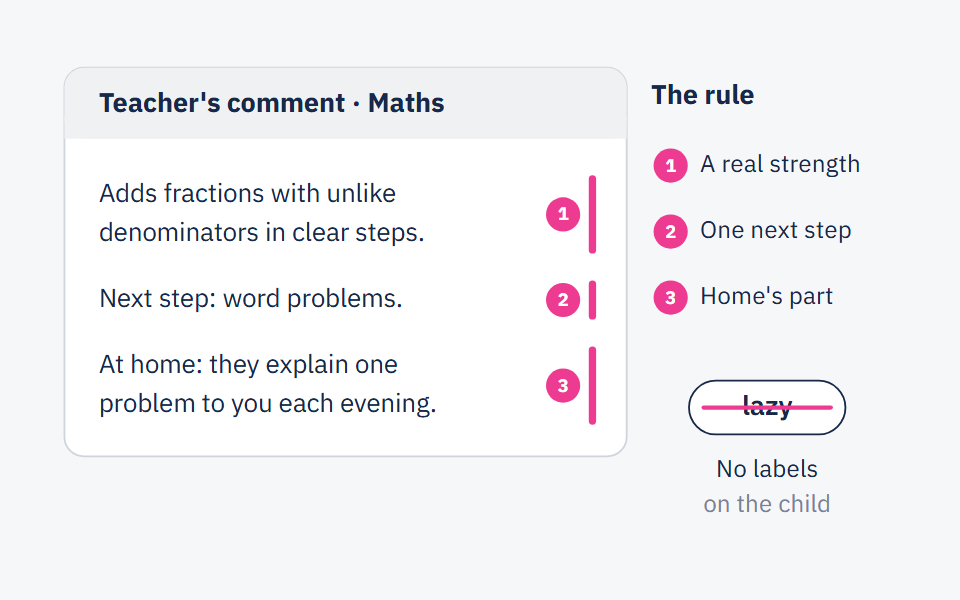
The six situations on this page differ, but every message is built in the same order. Write the five parts in this order, and add nothing else:
| Part | What to write | What to avoid |
|---|---|---|
| 1. A real strength | Something you have seen in this student yourself: asks questions, joins in, helps classmates | Praise that fits any child: “Your son is an excellent student” |
| 2. One specific fact | What happened, with a number or a date: “answered two of six questions” | Verdicts: “lazy”, “careless”, “weak” |
| 3. One request | One thing the home can do this week | A list of five requests, none of which gets done |
| 4. The next step | What the school will do, and when you will write again | A message that stops at the problem |
| 5. How to reply | The channel and the time: reply to this message, or call the school at set hours | “Feel free to reach out” without saying how |
Why a strength first, then a specific request? In a field experiment published by the Harvard Kennedy School (Kraft and Rogers, October 2014), teachers sent a weekly one-sentence message, individual to each student, to the parents of high-school students in a credit recovery programme. The share of students who failed to earn course credit fell from 15.8% to 9.3%. Messages about what students could improve had larger effects than messages about what they were doing well. So the message opens with a strength, to be read calmly, but its weight sits on the one request.
Everything in square brackets [ ] is yours to fill in. Do not send a message with a bracket left in it.
The six messages in full
Subject: How [student's name] is doing in [subject]
Dear parent of [student's name],
I am writing so we can follow [student's name]'s progress in [subject] together. [He/She] [a strength you have seen, e.g. asks when something is unclear, and tries a problem before giving up], and that will help with the next step.
Over the last two weeks I have noticed that [he/she] is struggling with [the skill, e.g. adding fractions with unlike denominators]: [he/she] answered [number] of [number] questions on it in the short quiz on [date].
At school, [he/she] will practise this skill [what you will do, e.g. for ten minutes in a small group twice a week] until [date]. I would ask one thing of you at home: [one request, e.g. ask [him/her] each evening to explain one problem from [his/her] notebook to you].
I will write to you on [date] with what has changed. If you have a question before then, reply to this message or call the school on [number] at [days and hours].
With thanks, [teacher's name], [subject] teacher — [class]
Why it is written this way: the fact is a number from a piece of paper, not a description of the child: a short quiz or an exit ticket. What the school will do comes before what the home is asked to do, so the message does not read as handing the problem to the family. If the gap covers more than one skill, that calls for a remedial plan, not a single message.
Subject: Something that happened in [subject] on [date]
Dear parent of [student's name],
I am writing because I want us to work together for [student's name]. [He/She] [a strength, e.g. is well liked by classmates and volunteers to help in class].
On [day and date], in [subject], [what happened, as actions, e.g. [he/she] left [his/her] seat three times during independent work and did not go back when I asked]. I spoke with [him/her] after the lesson, and we agreed that [what you agreed].
Please talk with [him/her] about it calmly, and ask how [he/she] saw what happened; [he/she] may know something I did not see.
I will keep an eye on this until [date]. If it happens again, I will invite you to a short meeting with me and [the school counsellor]. If it improves, I will write and tell you that too. To reach me: [channel and time].
With thanks, [teacher's name], [subject] teacher — [class]
Why it is written this way: describe the act, not the child. “Left [his/her] seat three times” is a fact both sides can agree on; “disruptive” is a verdict that puts the reader on the defensive. Never name another student, even one who was involved. Promising to write if things improve turns the follow-up into care rather than a threat.
Subject: [Student's name]'s absences in recent weeks
Dear parent of [student's name],
We miss [student's name] in class; [he/she] [a strength, e.g. is one of the first to answer at the start of a lesson].
[He/She] has been absent [number] days since [date], most recently on [date]. On those days [he/she] missed [what was missed, e.g. two lessons on fractions and a short quiz].
I know absences have many causes, and some may be outside your control. If there is anything the school can help with, please tell me.
I would ask one thing: let me know the reason for the absences if you can, so we can agree how [he/she] will catch up. When [he/she] is back, I will give [him/her] [what you will give, e.g. a sheet summarising the two lessons]. To reach me: [channel and time].
With thanks, [teacher's name], [subject] teacher — [class]
Why it is written this way: give the total number of days, not “has missed a lot”. In a study published in Nature Human Behaviour in 2018 (Rogers and Feller), the parents of 28,080 high-risk students from kindergarten to 12th grade were randomly assigned, and some received personalised information about their child's absences several times over the year; the most effective versions cut chronic absenteeism by 10% or more, partly by correcting parents' mistaken beliefs about their child's total absences. Attendance Works, a US initiative, warns against assuming that absent students or their parents do not care: many absences are excused, often for illness or transport problems. The limits and consequences of absence are set by your school's and authority's rules; follow them, and do not make the first message a reminder of penalties.
Subject: Good news about [student's name]
Dear parent of [student's name],
I am glad to be writing to you this time with good news about [student's name].
In [lesson or activity, and date], [he/she] [exactly what [he/she] did, e.g. solved a problem two ways, then explained both ways to the class at the board]. This shows [what it means, e.g. that [he/she] understands the idea, not just the steps].
Thank you for [something whose effect you have seen from home, e.g. keeping up with [his/her] homework]; it shows in [his/her] work.
Please tell [him/her] that I wrote to you; hearing it from you may mean more than hearing it from me. In the coming weeks I will suggest [a next challenge, e.g. harder problems in the same unit]. This message needs no reply, but I would be glad to hear from you at [channel].
With thanks, [teacher's name], [subject] teacher — [class]
Why it is written this way: specific praise tells the student and the family what is worth repeating; “excellent” tells them nothing. If you know nothing about support at home, delete the thank-you line: do not write what you have not seen. And send a message like this before you need a hard one, so the hard one is not the first thing they hear from you.
Subject: An invitation to a short meeting about [student's name]
Dear parent of [student's name],
I would like to meet you to talk about [student's name], who [a strength, e.g. always tries to finish [his/her] work in class].
The topic: [one sentence, e.g. [his/her] progress in reading this term, and what we can do together]. It will take [length, e.g. 20 minutes], in [place], with [who will attend, e.g. me and the school counsellor].
I can offer two times: [day, date and time] or [day, date and time]. If neither works for you, please suggest another.
Please confirm by replying to this message before [date]. If there is a question you would like us to cover, write it in your reply so I can prepare.
With thanks, [teacher's name], [subject] teacher — [class]
Why it is written this way: a parent invited to a meeting with no topic arrives expecting the worst. So the message states the topic in one sentence, the length and who will be there, and offers two times rather than one. Its one request is to confirm, and the parent's own question in the reply makes the meeting a conversation from the start.
Subject: A change to [subject] homework from [date]
Dear parents of [class],
Thank you for keeping up with your children's [subject] homework. I am writing to tell you about a change to how it works.
From [date], homework will be [the new routine, e.g. one sheet on Sundays and Tuesdays instead of homework every day], and it should take no more than [length, e.g. 20 minutes]. The reason: [one sentence, e.g. so I can check every sheet and hand it back marked in the next lesson].
I would ask one thing of you: if the homework takes longer than that, write on the sheet how long it took, and do not do it for your child. That is how I will know the homework needs adjusting.
I will review this routine after [number] weeks and tell you what I decide. For any question: [channel and time].
With thanks, [teacher's name], [subject] teacher — [class]
Why it is written this way: a message about a change says three things: what changes, when, and why in one sentence. Its request turns families into a source of information instead of substitute teachers in the evening. It goes to every family in the class, so it names no student.
Four mistakes that make a message read the wrong way
- A verdict instead of a description: “Your son is careless” ends the conversation before it starts. Write what you saw, with a number or a date, and leave the verdict out.
- More than one matter in one message: absence, homework and behaviour together make a message with no clear starting point. Pick the most important, and write about the rest later.
- Naming another student, or comparing: “All his classmates have finished the unit” helps the family with nothing, and naming another child shares what is not theirs to know.
- Writing while angry: write the message, then reread it the next day before you send it. If a word in it describes the child rather than what the child did, delete it.
Paper, text message or phone call?
- Text message or email: for thanks, meeting invitations and homework changes. Quick, and both sides keep a copy.
- A written letter through the school: for absence and behaviour, with a copy in the student's file, following your school's rules for contacting families.
- A call or a meeting: when the matter is sensitive, or when it happens again after a message. Write the message anyway, so the five parts are in front of you while you talk.
In every case, use the school's official channel, and never send a message about one student to the class group. If your school has an official form for contacting families, use it first; these templates do not replace it, but they help you fill in its fields. Comments written on report cards follow a similar method in report card comments.
Frequently asked questions
- How do I write a letter to parents about absence?
- Give the number of days absent, the date of the latest one and what the student missed; ask about the reason without accusing; make one request; then say when you will follow up. Template 3 on this page is ready for it.
- What should a thank-you note to parents say?
- Say exactly what the student did and when, what it shows, and thank the family for something whose effect you have really seen. Then ask them to tell the student you wrote.
- Should the message be formal or casual?
- Plain and polite. Formal enough to stand if it reaches the school office, simple enough for any family to read: short sentences and everyday words.
- What if the parent does not reply?
- Wait until the date you gave in the message, then try another channel, such as a call from the school instead of a text. Tell the counsellor or the office if the matter is absence or behaviour that keeps happening.
- Where can I get a parent letter template as a PDF?
- At the top of this page: the message's skeleton on one printable page, with a table of the fact and the request for each of the six situations. If you want a draft to edit on screen, make it in String for free.
Sources
Every fact in this post that we did not produce ourselves comes from one of these sources.
- The Underutilized Potential of Teacher-to-Parent Communication: Evidence from a Field Experiment (Matthew A. Kraft, Todd Rogers) — Harvard Kennedy School, Faculty Research Working Paper RWP14-049, 2014-10
- Reducing Student Absences at Scale by Targeting Parents' Misbeliefs (Todd Rogers, Avi Feller) — Nature Human Behaviour, vol. 2 (listed by Harvard Kennedy School), 2018 (Spring)
- Chronic Absence: The Problem — Attendance Works, undated page (copyright 2026), read 2026-10-22
Written with String's editorial team: we use AI for research and first drafts, and a person checks every fact and every source before anything is published. How we write
Founder and CEO, String
“I grew up in a house of teachers.” I spent a year designing the STEM program for one of the largest school groups in Saudi Arabia, have written curriculum by hand, trained robotics coaches and sold software into schools, then left that job to build String in Amman.