Six routines that make classroom management easier mid-term
A calm class mid-term does not need new rules. It needs six routines every student knows: entering with a task on the board, the attention signal, handing out materials, asking for help, moving into groups, and the last two minutes. For each one, here is what you say, how to rebuild it in a week, and the sign that it works.
The six routines — a card for the teacher's desk
A free printable PDF, no sign-up.
- Definition
- Classroom routine: A fixed way of doing something that happens every lesson — coming in, handing out sheets, moving into groups — practised until students do it without being told each time.
Why classroom management starts with routines, not sanctions
By mid-term, students know their teacher and know where the rules give way. The Education Endowment Foundation's guidance report “Improving Behaviour in Schools” (UK, 2019) notes that misbehaviour often happens around the start and end of lessons and when students move around. Its appendix includes a checklist for teachers with two plain items: have clear routines for transitions and for stopping the class, and teach children the class routines.
The Department for Education's “Behaviour in Schools” advice for England (February 2024) asks that any behaviour expected of pupils become a commonly understood routine — entering class, for example — and that routines be simple for everyone to understand and follow.
The arithmetic is simple in a class of 40: if handing out sheets takes four minutes and you do it twice a lesson, eight of your 45 minutes go on distribution alone. Routines give those minutes back and spare you repeating the same instructions every day. The six below are in the order they happen in a lesson.
The start: entering and the attention signal
1. Entering, with a task on the board
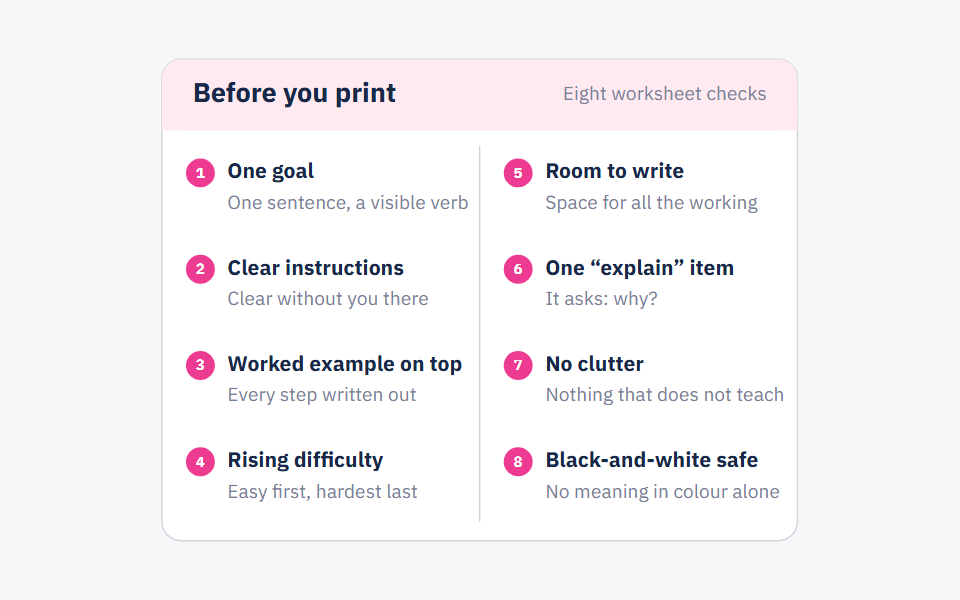
Stand at the door and greet students as they come in. On the board — in the same corner every day — is a short task that takes three minutes and needs no explanation: two questions from yesterday, or one problem that leads into today. Students start while you are still at the door, so the lesson does not wait for everyone to sit and settle. In a large class the task goes on the board, not on paper, so nothing needs handing out. The same rules for a good worksheet apply: one goal, and instructions a student can follow alone.
Why it works: the EEF report describes greeting students at the door as very low cost, with promising early results for behaviour, though the studies are small. A ready task fills the minutes when disorder usually starts.
- What you say: “Good morning. Come in, sit down and start the task on the board — you have three minutes.”
- In the first week: write the task before the first student arrives, and do not start teaching until the three minutes are up. If the class comes in loudly, calmly send them back to the door once and have them come in again.
- The sign it works: two minutes after the bell, most pens are moving and you have not said a word.
2. The attention signal
One signal that never changes, meaning: stop, put your pen down, look at me. Raise your hand, count down from three, then wait until the room is completely quiet. Do not talk over the noise — do it once and the class learns that the signal is a suggestion. In a class of 40, the back rows cannot hear you, but they can see hands: ask everyone who sees your hand to raise theirs, and the signal reaches the back of the room without you raising your voice.
- What you say: “Three, two, one. Pens down, eyes on me.”
- In the first week: practise it three times in a row in the first lesson, and say after each one how many seconds it took. Then use it every time you need the class, without exception.
- The sign it works: the room is quiet within five seconds of the count ending, and you start speaking at your normal volume.
Mid-lesson: materials, help and groups
3. Handing out and collecting materials
Name one leader for each row of desks, and change them every month. Before the lesson, count each row's sheets into a pile; each leader takes their pile and passes it along the row. To collect, students pass sheets towards the aisle, each one on top of the last, and the leader brings them to your desk. Only the row leaders move, not the whole class, and you never walk the rows.
- What you say: “Row leaders, take your row's sheets. Names first, before anything else.”
- In the first week: time the hand-out out loud, write the number in a corner of the board, and challenge the class to beat it next lesson.
- The sign it works: sheets reach the last student in under a minute, and come back in under a minute.
4. Asking for help without stopping the lesson
In a large class, all work stops when the teacher stands at one desk explaining loudly enough for everyone to hear. The alternative is a fixed sequence every student knows when stuck: reread the question, ask a partner quietly, then put an agreed sign on the desk — a folded card, a pen laid crosswise — and move on to the next question until you arrive. When you get there, give one next step, not the whole answer; short feedback phrases has ready wording for that. If three students are stuck on the same question, use the attention signal and answer it once, for everyone.
- What you say: “If you're stuck: reread it, ask your partner, then put the sign up and carry on. Nobody waits with their hand in the air.”
- In the first week: write the three steps on a large sheet next to the board. When a hand goes up, point at the sheet without a word.
- The sign it works: you no longer answer the same question five times a lesson, and nobody sits idle waiting for you.
5. Moving into groups
When desks are fixed in rows, do not move students between desks. Students in the odd-numbered rows (first, third, fifth) turn to face the row behind, and every four facing each other is a group. Keep the groups for a few weeks, number them, and put each group's task and each member's role on the board before you say “Go” — an instruction given after the movement is heard by nobody.
- What you say: “When I say ‘Go’, the odd rows turn round. You have twenty seconds, and the task is on the board. Go.”
- In the first week: practise turning round and back twice with no task, just to time the movement. Then add the task.
- The sign it works: the movement takes under 30 seconds, and the talk afterwards is about the task, not about who sits where.
The end: the last two minutes
6. The last two minutes
Stop teaching two minutes before the bell, however much is left. In the first minute every student answers one question on a slip of paper — the exit ticket that tells you what the class understood. In the second, students collect the slips and materials and straighten the desks. Then you dismiss the class, row by row — not the bell.
Why it works: the end of a lesson is one of the seams where misbehaviour clusters, as the EEF report above notes. Two protected minutes keep it calm and give you what tomorrow's lesson is built on.
- What you say: “Two minutes left. Answer the exit question and hand your slip to your row leader. The bell doesn't end the lesson — I do.”
- In the first week: set an alarm for two minutes before the bell. This is the first routine to vanish when the explanation runs long.
- The sign it works: the slips are on your desk before the bell, and the class leaves without a crush at the door.
How to rebuild the routines in one week
Rebuilding mid-term is harder than building in the first week, because students already have habits. So do not add all six routines in one day, and do not announce them as new rules. Tell the class plainly that from today you are changing how you work, and why, then train them as you would for any skill: explain, show, have them do it, and repeat it if it is not right. The EEF report says effective training in classroom management involves three things: reflecting on your own approach, trying a new approach, and reviewing progress over time. So do not judge a routine on its first day.
Day 1: entering and the attention signal
Start with these two because everything after them depends on them. Explain each in a minute, then practise it two or three times.
Day 2: materials
Name the row leaders and time the first hand-out. Remind the class of yesterday's two routines with one sentence before their moment, not after the class gets them wrong.
Day 3: asking for help, and groups
Put the help steps up next to the board, and practise turning into groups and back with no task.
Day 4: the last two minutes
Stop teaching when the alarm goes, even if you have not finished. This day tests whether you mean it more than any other.
Day 5: all routines, no explanation
Notice which routine slipped, and rehearse that one alone next week. The ones that worked need only a reminder before their moment.
When routines are not enough
Routines fail when the teacher drops them in week two: a routine kept one day and skipped the next teaches students to wait for the day it is skipped. They weaken when students arrive from another teacher's lesson run in a completely different way, which is why the EEF report calls consistency at whole-school level paramount in implementation. If you can, agree at least the entering routine and the attention signal with the other teachers of the same class.
And routines are for the whole class, not for a student whose difficult behaviour keeps recurring despite them. The same report says universal systems are unlikely to meet every student's needs, and that students with more challenging behaviour need an approach adapted to them. When you see that, talk to your school counsellor and to the student's parents, and do not make the whole class carry one student's load.
Frequently asked questions
- What is the difference between classroom management and discipline?
- Discipline is what a teacher does after behaviour happens. Classroom management is wider: arranging the lesson and its routines so that less needs disciplining in the first place. The routines in this post are management, not discipline.
- Do these routines work with 40 or more students?
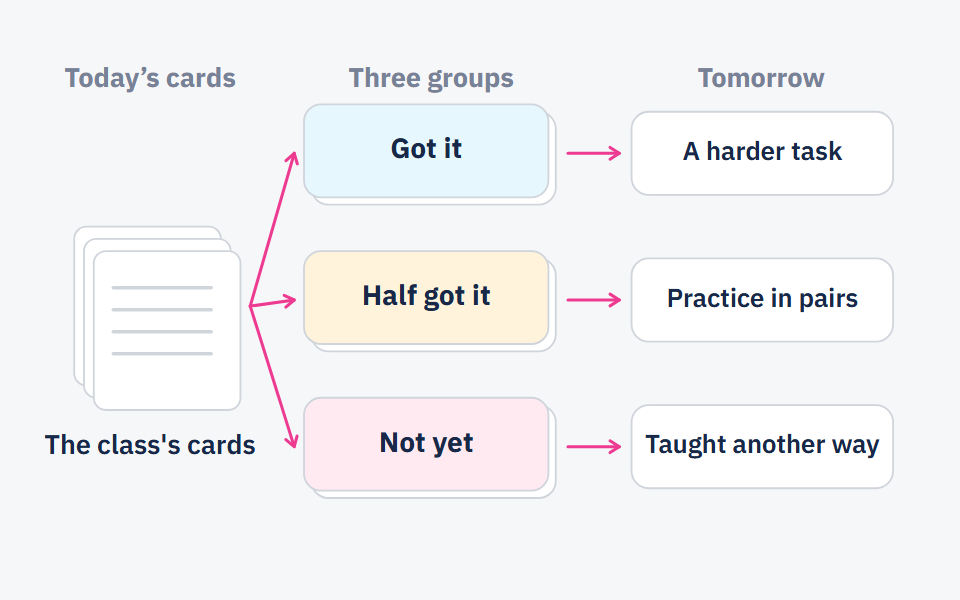
- They were written for that: the task is on the board, not on paper; materials go through row leaders; the signal is seen rather than heard; and groups form by turning round, not by moving desks. Checking what every student understood in a large class is a method that goes with them.
- It's halfway through the term — is it too late to build routines?
- No. A week is enough to rebuild them if you add them in stages and practise them with the class, as in the plan above. Worse is waiting for next term while the old habits set.
- Are routines enough for classroom management and behaviour change?
- Routines prevent a lot of the behaviour that would need changing, because they fill the seams where it happens. They do not replace an individual plan for a student whose difficult behaviour keeps recurring; that is built with the school counsellor and the parents.
Sources
Every fact in this post that we did not produce ourselves comes from one of these sources.
- Improving Behaviour in Schools: Guidance Report — Education Endowment Foundation (EEF), 2019 (PDF undated in print; file metadata 2019)
- Behaviour in Schools: Advice for headteachers and school staff — Department for Education (England), 2024-02
Written with String's editorial team: we use AI for research and first drafts, and a person checks every fact and every source before anything is published. How we write
Founder and CEO, String
“I grew up in a house of teachers.” I spent a year designing the STEM program for one of the largest school groups in Saudi Arabia, have written curriculum by hand, trained robotics coaches and sold software into schools, then left that job to build String in Amman.