Two review lessons before the end-of-term exam: a ready plan
Don't reteach the units in a review lesson; test students in it. Lesson one is a closed-book retrieval quiz followed by a round on your own class's mistakes; lesson two, two or more days later, is mixed practice, a review game and a list each student uses to check what they know.
Two review lessons before the end-of-term exam — the plan
A free printable PDF, no sign-up.
- Definition
- Retrieval review: A review in which students recall what they learned from memory, through a short quiz, questions or a game, instead of the teacher explaining it again or the students rereading it.
The last week before the end-of-term exam is tight, and the temptation is to reteach the units one after another. This plan does the opposite: two 45-minute lessons in which students talk and write more than you do, and at the end of which you know what your class has actually forgotten. The example is Grade 6 maths, but the plan works for any subject.
Why a quiz rather than an explanation, and two lessons rather than one
The review of learning strategies by John Dunlosky and colleagues, as summarised in a release from the Association for Psychological Science (January 2013), gave two strategies the highest overall utility rating: practice testing and distributed practice. The release says that spreading out studying over time and quizzing yourself before the big test are highly effective learning strategies, that both have been shown to boost students' performance across many different kinds of tests, and that their effectiveness has been repeatedly demonstrated for students of all ages. Summarisation, highlighting and underlining, and rereading were among five techniques that received a low utility rating.
In “Principles of Instruction” (American Educator, Spring 2012), Barak Rosenshine writes that material that is not adequately practised and reviewed is easily forgotten, and that even at secondary level, classes with weekly quizzes scored better on final exams than classes with only one or two quizzes during the term. So the plan is built on a quiz, not an explanation, and on two lessons with two or more days between them, not one lesson on the last day.
The plan: two lessons, minute by minute
| Minutes | What happens in class | What you prepare |
|---|---|---|
| 15 | Closed-book retrieval quiz: ten short questions mixed across all the units, each student working alone | Ten questions, one or two per unit, in an order that does not follow the units |
| 7 | Self-marking: you write the answers on the board, each student marks their own paper in a different pen, then you count hands for each question | The answers, and a small table on the board for the number of mistakes per question |
| 18 | Mistakes round: four cards, each with one of your class's mistakes and no name, worked on in pairs | Four mistakes collected from the term's quizzes, exit tickets and notebooks |
| 5 | Exit slip: “Write the two topics you need most, and one question you still don't understand” | Small slips of paper |
| Minutes | What happens in class | What you prepare |
|---|---|---|
| 5 | Three questions: the three that most students got wrong in lesson 1, with new numbers | The mistake tally from lesson 1 |
| 20 | Mixed practice at two levels, with ten of the minutes spent with a small group chosen from the exit slips | A sheet with problems from every unit, not grouped by unit |
| 12 | A review game in teams | Ten written worked answers, some right and some with a mistake |
| 8 | Self-check list: each student marks each skill and writes what they will practise at home | The list printed, one line per skill in the units |
The days between the two lessons are part of the plan, not an accident: the three questions at the start of lesson 2 are a second retrieval of what students forgot in lesson 1, after some time has passed. We suggest holding lesson 1 about a week before the exam, so there is time to act on what it shows.
Lesson 1, step by step
Retrieval quiz (15 minutes)
Open with: “Books closed, and there's no mark on this. I want to know what's still in your memory, not what's in the book.” A mark makes students leave a question blank when they are unsure, and you need their mistake as it is.
Self-marking and counting hands (7 minutes)
Write the answers on the board and have each student mark in a different colour. Then ask, “Hands up if you got question 1 wrong,” write the number under it, and go on to question 10. The three questions with the highest counts open lesson 2.
Mistakes round (18 minutes)
Show one card about every four minutes. Each pair answers three questions: Where exactly is the mistake? Why did it look right to the person who wrote it? Correct it and check. Then one pair explains to the class and you write the correction. Rosenshine notes that cooperative learning gives students the chance to get feedback from their peers about correct as well as incorrect responses.
Exit slip (5 minutes)
Collect the slips and sort them after the lesson: students who wrote the same topic sit with you in lesson 2. The full sorting method is in the exit-ticket guide.
Here is an example retrieval quiz for Grade 6 maths, written for this post, for a term covering fractions, decimals, ratio and percentages. Change the questions to match the units in your book. The answers are not here, so solve the questions yourself before you print.
| Question | Unit |
|---|---|
| 1. | Fractions |
| 2. Order from smallest to largest: , , , | Decimals |
| 3. In a bag, the ratio of red beads to blue beads is , and there are 40 beads, all red or blue. How many blue beads are there? | Ratio |
| 4. | Fractions |
| 5. Write as a decimal. | Decimals |
| 6. What is 25% of 360? | Percentages |
| 7. | Fractions |
| 8. | Decimals |
| 9. | Fractions |
| 10. Write a word problem whose working is . | Fractions |
The mistakes round: where the cards come from
The four cards are the most important thing you prepare, and they come from your own class's papers: the term's short quizzes, exit tickets and notebooks. Pick the mistakes that came up again and again, not the strangest, and copy each one in your own handwriting without the student's name. Here are four mistakes of the kind these units produce, written for this post to show the format; replace them with your class's own:
| Card | What the student wrote (wrong) | Correct | The idea behind it |
|---|---|---|---|
| 1 | Adds the numerators together and the denominators together, as with whole numbers | ||
| 2 | is bigger than “because 45 is bigger than 5” | , which is bigger than | Reads the digits after the point as a whole number |
| 3 | Puts the decimal point in the wrong place | ||
| 4 | Boys to girls in a class of 30: boys , girls | Five parts of 6: 12 boys and 18 girls | Divides the total by each number in the ratio separately |
The IES guide on teaching fractions (September 2010) calls the first mistake common, and you will find its cause and fix in Why students add the denominators. The guide also names the third: a common error when multiplying decimals is to misplace the decimal point, and it suggests having students estimate the answer first. So on card 3, ask: “ is close to 4, and is less than a half. Can the answer be 9?” On card 4, checking shows the mistake on its own: , not 30.
Lesson 2, step by step
Three questions (5 minutes)
The three questions most students got wrong, with new numbers, solved by each student alone on a slip. Then the answers go on the board straight away.
Mixed practice (20 minutes)
One sheet with problems from every unit, not grouped by unit, because the exam won't tell students which unit a question comes from. We suggest two levels: core for everyone, and harder for early finishers. You spend ten minutes with the group that wrote the same topic on their exit slip.
The “right or wrong?” game (12 minutes)
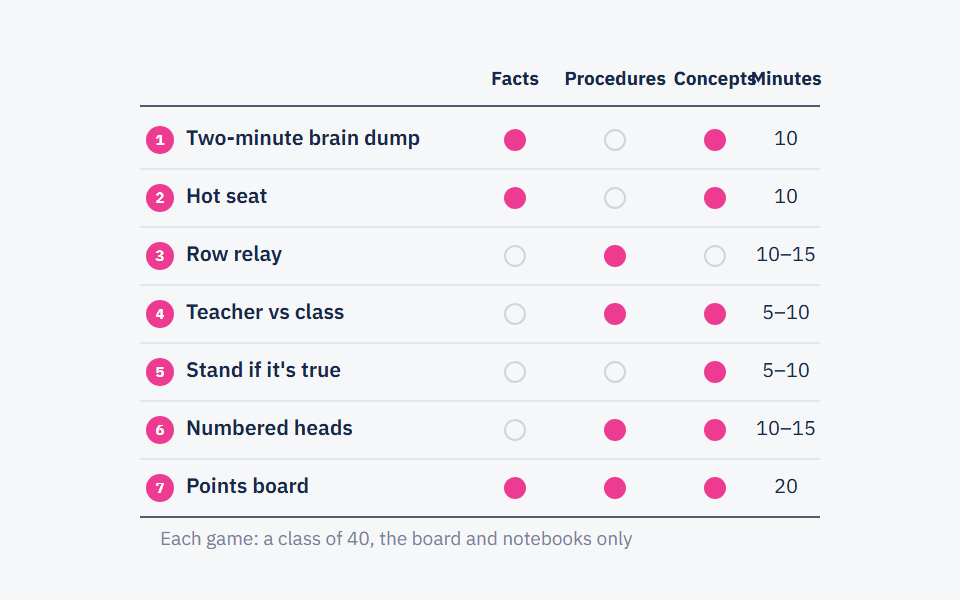
Split the class into four teams. Show a written worked answer and give each team thirty seconds to decide: right or wrong? A team that says “wrong” only gets the point once it writes the correct version. Make about half the worked answers wrong. Seven exam review games that need no equipment has other games.
Self-check list (8 minutes)
Each student marks every skill in one of three columns: I can, I need practice, I can't yet. At the bottom they write two skills they will practise at home, and where from: a page in the book or a question in the notebook.
Self-check list — an example for Grade 6 maths, first term
- I can add two fractions with unlike denominators, and subtract one from the other.
- I can multiply and divide fractions.
- I can compare and order decimals.
- I can multiply decimals, and check where the point goes by estimating.
- I can convert between fractions, decimals and percentages.
- I can find a percentage of a quantity.
- I can solve a ratio problem when the total is given.
The same plan in other subjects
| Subject | Retrieval quiz | Mistakes-round cards |
|---|---|---|
| Arabic | Short questions on grammar and spelling, and one comprehension question on a short paragraph | Sentences from students' writing with a repeated grammar or spelling mistake |
| Science | Definitions, parts of a diagram to label, and one “why?” question | A wrong explanation of an experiment or a phenomenon written by a student |
| English | Vocabulary, verb forms, and a sentence to complete | Sentences with a mistake in verb tense or word order |
Four mistakes that spoil a review lesson
- Reteaching the units: you talk and they listen, and at the end of the lesson you don't know what they forgot. A quiz tells you; an explanation doesn't.
- One lesson on the last day: there is no time to act on what it shows, and no time passes between the first retrieval and the second.
- A mistakes round with names: a student who sees their mistake shown with their name learns not to write. Copy the mistake in your own hand and credit the card to “our class”.
- A game with no deliberate mistakes: a game where every question is easy is fun, but it shows you nothing. Put your class's own mistakes into the worked answers.
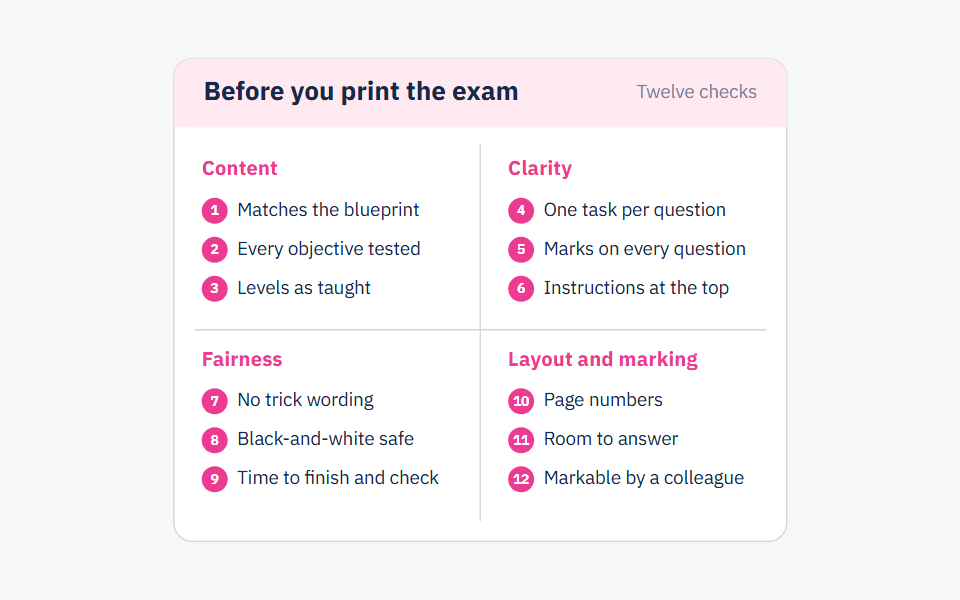
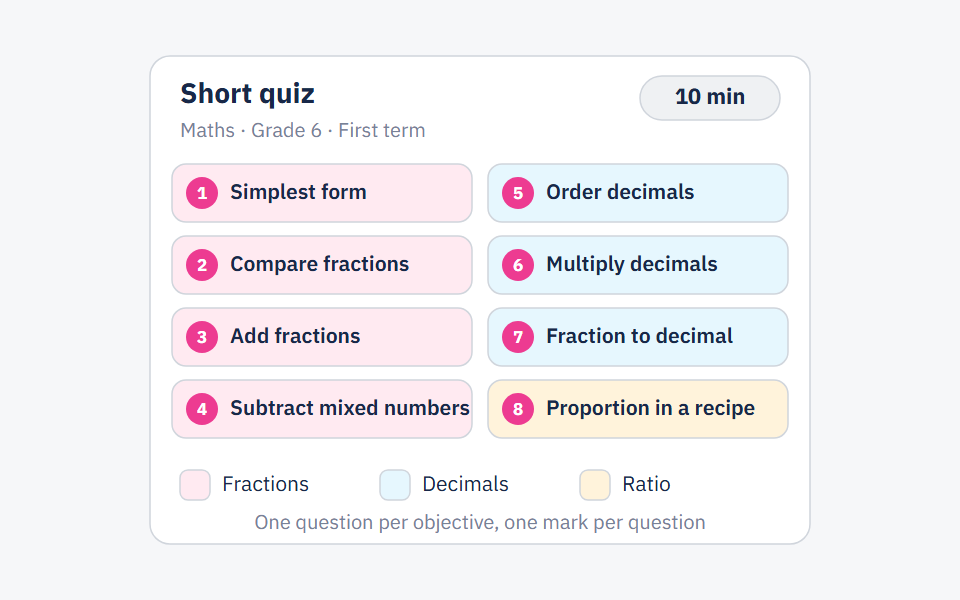
The whole plan fails when most of the class gets most of the quiz wrong: that doesn't need review, it needs a unit retaught, so add a lesson for it before lesson 2. And when you write the exam itself, Before you print the exam: twelve checks has what to check, and the Grade 6 maths short quiz is another set of first-term questions.
Frequently asked questions
- How do I review with students before the end-of-term exam?
- Test before you explain: a short closed-book retrieval quiz shows what they forgot, then a round on their mistakes, then a second lesson two or more days later for mixed practice. The full plan with its minutes is on this page.
- Should the review quiz be graded?
- No. A mark makes students skip a question when they are unsure, and you need their answer as it is to know what they forgot. Students mark their own papers, and you count the mistakes per question.
- How many review lessons are enough before an exam?
- We suggest two, with two or more days between them, the first about a week before the exam. If most of the class gets most questions wrong, add a lesson to reteach the unit before the second.
- Where can I get a free review lesson plan PDF?
- At the top of this page: both lessons with their minutes on one printable page, no sign-up, with space for your class's four mistakes.
Sources
Every fact in this post that we did not produce ourselves comes from one of these sources.
- Which Study Strategies Make the Grade? (on Dunlosky, Rawson, Marsh, Nathan and Willingham, Psychological Science in the Public Interest, January 2013) — Association for Psychological Science, 2013-01-10
- Principles of Instruction: Research-Based Strategies That All Teachers Should Know (Barak Rosenshine) — American Educator, 2012 (Spring issue)
- Developing Effective Fractions Instruction for Kindergarten Through 8th Grade (Siegler et al.), IES Practice Guide NCEE 2010-4039 — Institute of Education Sciences, What Works Clearinghouse (via ERIC), 2010-09
Written with String's editorial team: we use AI for research and first drafts, and a person checks every fact and every source before anything is published. How we write
Grade 6 mathematics · Jordan
Teaches Grade 6 mathematics in Jordan and writes here about teaching maths from inside the classroom.