Why students add the denominators, and the three-minute fix
A student who writes is not making a random slip: they are adding a fraction the way they add two whole numbers, because they don't yet see that the denominator sets the size of the piece. The fix starts with size, not the rule: the student first estimates that the sum is more than a half, then cuts the half and the third into sixths, then counts them.
Adding the denominators — a card for the teacher
A free printable PDF, no sign-up.
- Definition
- Adding the denominators: A student adds two fractions by adding the numerators together and the denominators together, for example writing , which is wrong; the answer is .
You see it in Grade 6 notebooks every year, sometimes after you have already taught common denominators. The cause is not carelessness or a weak memory: the mistake has its own logic for the student, and it won't go away until the student sees for themselves that their answer is impossible. Here is that logic, one question that reveals it in a minute, and a three-minute fix with fraction strips.
Why the mistake makes sense to the student
The Institute of Education Sciences (IES) practice guide on teaching fractions from kindergarten to Grade 8 (September 2010) calls this a common mistake and explains it: students who err this way are misapplying their knowledge of whole number addition and subtraction to fraction problems, and failing to recognise that denominators define the size of the fractional part and that numerators represent the number of this part. The guide adds a second source of support for the mistake: the same approach is correct for multiplying fractions.
Elsewhere the guide says that many common misconceptions, adding the numerators and then the denominators among them, stem from not understanding that fractions are numbers with magnitudes. Look at the problem from the student's seat:
- A fraction looks like two numbers: a 1 above a line and a 2 below it. The student has added numbers for six years: top with top, bottom with bottom.
- Multiplication rewards it: is right when you multiply the numerators and the denominators. Why would addition be different?
- Our own words help the mistake along: when we say “the top number and the bottom number”, we describe two separate numbers, not one.
One diagnostic question that shows the cause in a minute
Don't ask only “What is ?” The answer tells you there is a mistake but not why. Ask about size first, then about the calculation. The guide suggests that teachers ask students for an initial estimate and an explanation of their thinking before they compute, and gives the example of a student who estimated that is more than , then added the numerators and denominators to get : the teacher can then note that this answer cannot be right, because is less than .
“Hala painted of the classroom wall and Sami painted of the same wall, and neither painted any part the other had painted. (a) Together, did they paint more than half the wall or less? Explain in a sentence. (b) Work out what fraction of the wall they painted together.”
| Answer to (a) | Answer to (b) | What it means | What you do |
|---|---|---|---|
| More than half, with a reason | Understands both the size and the rule | Moves on to practice | |
| More than half, with a reason | (wrong) | Has a sense of size, but the wrong rule overrides it | The first minute of the fix is usually enough: show them that their two answers contradict each other |
| Less than half, or no reason | (wrong) | Sees the fraction as two separate numbers, not one number with a size | All three minutes, then strips for some days before the rule |
If you want to know before the unit who has this mistake and who has others, the diagnostic test before the unit has eight questions, each catching one fraction misconception.
The three-minute fix: size first, then the rule
The guide says that visual representations showing equivalent fractions, such as a number line or a fraction strip, can illustrate the need for common denominators and for the matching changes in numerators. The three steps below are the order we suggest for that. You need a strip for one whole, a strip for a half, a strip for a third, and six strips for sixths, all cut from the same length, in card or drawn on the board.
Minute one: is the answer more than a half?
Lay the half strip under the whole and put the third strip next to it. Ask: “Have we gone past the middle of the whole?” Then lay the student's strip underneath and say: “Your answer is shorter than the half on its own. Can we add something to a half and end up with less than a half?” Don't say the answer is wrong; let the student say it.
Minute two: pieces of the same size
Say: “We can't count halves and thirds together; they are pieces of different sizes.” Then ask: “Which piece fits exactly into a half, and exactly into a third?” Try quarters first if someone suggests them: they fit into a half but not into a third. Then sixths: a half is three sixths, and a third is two sixths.
Minute three: count the pieces
Three sixths and two sixths: how many sixths? Five. Write in front of the student: . Then ask: “Why did the denominator stay 6?” The answer you want: because the size of the piece didn't change; we only counted the pieces. Check against the estimate: is more than a half, as we expected in minute one.
Only after these three minutes, name the rule: “The common denominator is the size of the piece that fits into both fractions.” The rule is now the name of something the student has seen, not an order to memorise.
Say this, not that
These are sentences we suggest in place of ones that strengthen the mistake without meaning to; the last column says why. The fourth row is close to what the IES guide on improving mathematical problem solving (May 2012) suggests: when a student solves a problem incorrectly, ask what questions they should have asked themselves, rather than providing the correct answer.
| Instead of | Say | Why |
|---|---|---|
| “The numerator is the top number and the denominator is the bottom one.” | “The denominator tells you the size of the piece; the numerator counts the pieces.” | The first describes two numbers; the second describes one |
| “You can't add fractions with different denominators.” | “We can't count pieces of different sizes together yet. Let's cut them into equal pieces.” | The problem is size, not a ban whose reason the student doesn't know |
| “Find the least common multiple.” (as your first words) | “Which piece fits exactly into a half and exactly into a third?” | The LCM answers this question; name it after the student finds it |
| “Wrong, the answer is .” | “Is your answer more or less than ? And is one of the fractions you added.” | The student finds the contradiction and remembers it |
| “In addition we don't add the denominators; in multiplication we multiply them.” | “Half of a third is a sixth. A half plus a third is more than a half.” | The meaning of the operation instead of a second rule stacked on the first |
| “Add the numerators and keep the denominator.” | “Three sixths and two sixths: how many sixths?” | The student counts pieces of one size, and sees why the denominator stays |
What to do in the next lessons
Three minutes fix the idea, but they don't build the habit. We suggest that for the next few days students start every addition problem with one line of estimate: “More or less than ? More or less than 1?” Then they calculate, then compare the answer with the estimate. The guide suggests posing problems that cannot be solved quickly by mental computation, since there is no point estimating the answer to a problem that can be solved quickly and accurately in your head. Here are four problems written for this post, easiest first:
- : more or less than ? Then calculate.
- : more or less than ? Then calculate.
- : more or less than 1? Then calculate.
- : more or less than 1? Then calculate.
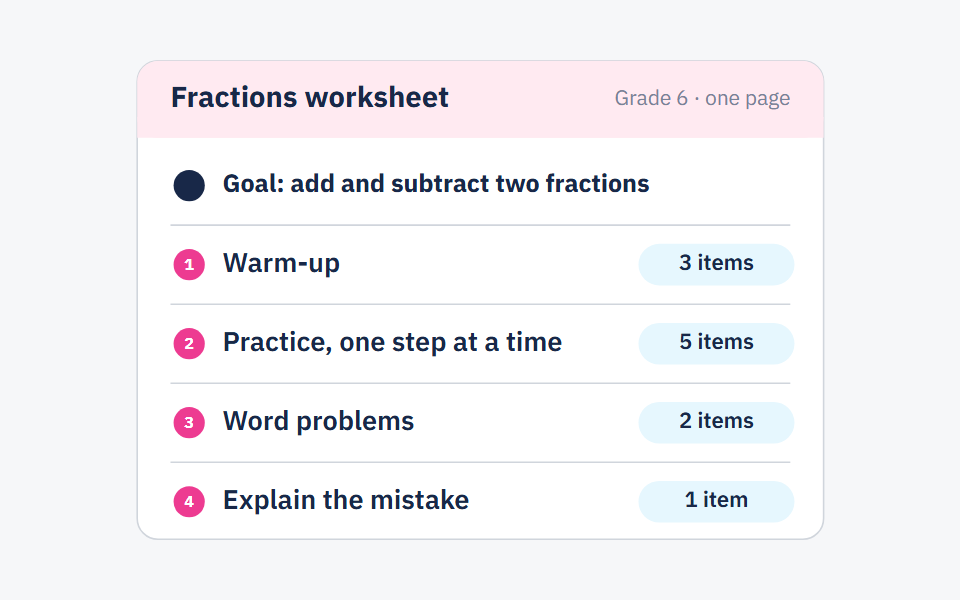
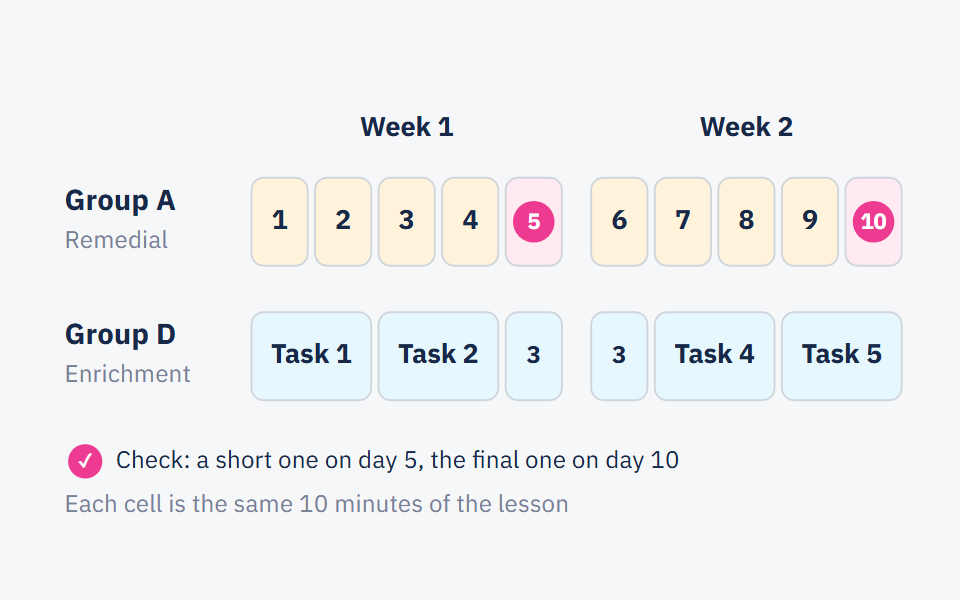
For full practice on adding and subtracting after that, the Grade 6 fractions worksheet has ten problems built from one goal. And a student for whom three minutes weren't enough, who is back to two days later, belongs in a small group in the remedial plan: ten minutes a day on strips before the rule. The bar model for word problems uses the same idea of equal parts.
When strips are not enough
- When the student counts pieces without seeing the fraction as one number: the guide warns that with fraction strips, considerable care is needed so that students don't simply count the parts of the strip that match the numerator and the denominator without understanding how the two together indicate a single quantity. So always ask about size: “More or less than a half?”
- When the strips are not the same length: if the third is cut from a longer whole than the half, the student learns something false. The guide reports a study in which using dot paper to add fractions led students to add numerators without finding a common denominator more often; a drawing that does not show the need for equal units can reinforce the mistake.
- When the fix happens once and never comes back: if the student doesn't estimate before calculating in the following days, the old rule returns. Estimating before every problem is what keeps the fix.
If you see a student with a steady difficulty that goes beyond fractions to many areas of maths, and it lasts after weeks of support, talk to your school counsellor or the school's learning support specialist, and don't decide the cause on your own.
Frequently asked questions
- Why do students add the numerators and the denominators?
- Because they apply what they know about adding whole numbers to fractions, and don't yet see that the denominator sets the size of the piece and the numerator counts the pieces, as the IES fractions guide explains. The mistake is reinforced because the same method is correct for multiplication.
- How do I teach adding fractions with unlike denominators?
- Start with an estimate (is the sum more than a half?), then cut both fractions into pieces of the same size, then count the pieces, and name the rule last. The three steps are drawn on this page.
- What other fraction mistakes are common?
- The IES guide lists, among others: putting the larger denominator in the answer without converting, as in (wrong; the sum is ); changing the denominator without changing the numerator; and giving a whole number the denominator of the fraction next to it, as in turning into , which is also wrong.
- Should I teach the least common multiple rule before the strips?
- We suggest the reverse: strips first, so students see why they need pieces of the same size, then the rule as a name for what they saw. A student who memorised the rule before its meaning goes back to adding denominators when they forget it.
Sources
Every fact in this post that we did not produce ourselves comes from one of these sources.
- Developing Effective Fractions Instruction for Kindergarten Through 8th Grade (Siegler et al.), IES Practice Guide NCEE 2010-4039 — Institute of Education Sciences, What Works Clearinghouse (via ERIC), 2010-09
- Improving Mathematical Problem Solving in Grades 4 Through 8 (Woodward et al.), IES Practice Guide NCEE 2012-4055 — Institute of Education Sciences, What Works Clearinghouse (via ERIC), 2012-05
Written with String's editorial team: we use AI for research and first drafts, and a person checks every fact and every source before anything is published. How we write
Grade 6 mathematics · Jordan
Teaches Grade 6 mathematics in Jordan and writes here about teaching maths from inside the classroom.