How to read your child's report card and what to ask the teacher
Read every mark twice: against last term's mark and against the class average, then read the teacher's comment and the days absent. Pick only one or two subjects to ask the teacher about, with five specific questions, and open the talk with your child by asking what they think, not by giving your verdict.
Reading the report card: a one-page sheet
A free printable PDF, no sign-up.
The report card has arrived. Before you say anything to your child, take a quarter of an hour alone with it. A mark on its own does not tell you what happened; it does when you set it beside two other numbers: last term's mark, and the class average. Below is a sample report card read line by line, five questions to take to the teacher, and what to say to your child and what to avoid.
- Definition
- Report card: A summary the school issues at the end of a term, usually with a mark for each subject, and sometimes a teacher's comment, the number of days absent, and a grade for behaviour or effort. Its layout varies from school to school and country to country.
What each part of the report card tells you, and what it does not
A mark is not a pure measure of what your child has learned. The report “B-flation”, published by Gallup and the US nonprofit Learning Heroes in November 2023, says report cards measure much more than achievement, including attendance, participation and effort. In the same survey of nearly 2,000 parents of US public-school students, 79% said their child gets mostly B's or better, and 88% believed their child was at or above grade level in reading (89% in maths). The standardized tests the report cites suggest that somewhere between 20% and 50% of students are demonstrating the knowledge and skills appropriate for their grade. These are American figures, not Arab ones, but the point holds anywhere: a good mark does not always mean a child has mastered what they should.
| The part | What it tells you | What it does not tell you |
|---|---|---|
| The subject mark | Where your child stood this term, if you read it beside last term and the class average | Which skills they have mastered and which not yet, or how much of it is tests and how much homework and participation |
| The teacher's comment | What caught the teacher's attention about your child | What exactly it means, if it is general, such as “Needs to focus more” |
| Days absent | How many days they missed, and whether that is more than last term | Which lessons they missed, and whether they caught up |
| Behaviour and effort | A general picture of how they work in class | The reason for any drop — that is a question for the teacher |
Do not skip the absence line. The UK Education Endowment Foundation's 2018 guidance report “Working with Parents to Support Children's Learning” says most parents underestimate the number of days their child has been absent, and that in one study 72% of parents of students with higher-than-average absence did not know their children had missed more school than their classmates.
A sample report card, read line by line
The report card below is a sample we wrote for this post, not a real student's report and not any particular school's form. Marks are out of 100, with the class average for each term.
| Subject | Their mark last term | Class average last term | Their mark this term | Class average this term |
|---|---|---|---|---|
| Arabic | 84 | 79 | 86 | 80 |
| Maths | 81 | 78 | 72 | 70 |
| Science | 78 | 77 | 85 | 76 |
| English | 90 | 83 | 88 | 82 |
| Social studies | 75 | 77 | 76 | 79 |
Maths teacher's comment: “Needs to focus more.” Days absent: 9 this term, 3 last term.
Now read it with both comparisons at once. The chart below shows, for each subject, how far the mark sits from the class average in both terms, and beside it the change in the child's own mark.
- Maths: a big drop, but nearly the whole class dropped. The mark fell from 81 to 72 — 9 marks. But the class average also fell, from 78 to 70 — 8 marks. So the distance from the class moved only from +3 to +2. Most likely this term's unit was harder for everyone; ask about it, and do not start with worry.
- Social studies: a small rise hiding a quiet signal. The mark rose from 75 to 76, but it sits below the class average in both terms: by 2, then by 3. It is the only subject below the class twice. It deserves the question more than maths does.
- Science: clear progress. From 78 to 85 — 7 marks — while the class average fell from 77 to 76. That is effort worth naming to your child.
- Arabic and English: steady. A change of 2 marks in each, still about 6 marks above the class. Nothing here needs a question.
- Absence: from 3 days to 9. Three times as many. Ask the school which lessons they missed, and whether any were in maths.
- The comment “Needs to focus more.” It is general, and says neither when nor in what. Write a question beside it, and do not punish it before you understand it.
The steps: fifteen minutes alone before any conversation
Read it alone first
Somewhere quiet, before you say anything to your child. If a number upsets you, wait until you are calm.
Write two numbers for each subject
The change from last term, and the distance from this term's class average. If the report does not give the class average, ask the teacher roughly where your child stands in the class. If it uses grades or words (excellent, very good) rather than numbers, compare levels: did it go up or down a level?
Circle what deserves a question
We suggest three reasons to circle a subject — thresholds to help you choose, not rules from research: a drop of 5 marks or more that the class did not share, a subject below the class average two terms running, or a clear rise in absences.
Write one question beside the teacher's comment
One question turns a general comment into something you can understand: “In which lesson? What does it look like?”
Pick one or two subjects only
A talk with the teacher about five subjects ends without a single step. In the sample: social studies first, then maths and the absences.
Five questions to take to the teacher
In the Learning Heroes letter that opens the same report, grades reflect many factors, including effort, homework completion and behaviour, as well as mastery of the learning standards — and asking teachers to unpack those factors is how parents can know where to help. Hence the five questions, for each subject you picked:
| The question | A useful answer sounds like |
|---|---|
| 1. What makes up the mark in this subject? How much is tests, and how much homework and participation? | “Half is two tests, the rest homework and participation. Most of the marks were lost on the second test.” |
| 2. What have they mastered in this subject, and what not yet? | A skill by name: “Reads maps well, but does not yet link an event to its cause.” Not “average level”. |
| 3. Could I see a piece of their work that shows this? | A test paper, homework or exercise book, with the teacher pointing to the place. |
| 4. When you wrote “Needs to focus more”, when do you see that, and what does it look like? | “In the last part of the last lesson, they drift off from the explanation.” A situation described, not a label for the child. |
| 5. What is one thing we can do at home, and when do we check in again? | A small, specific step and a date: “Two questions from the lesson each evening, and we talk again in three weeks.” |
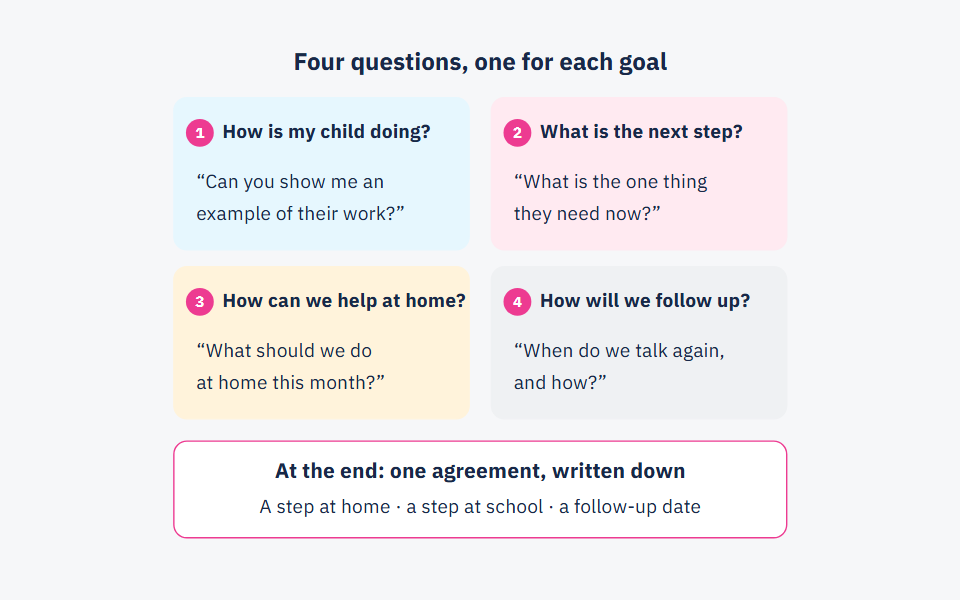
If you are going to a parents' evening, the parent-teacher meeting question card shows how to close it with a written agreement. And to see the other side, our teachers' blog has a post on report card comments that suggests each comment carry one strength and one next step, with no labels on the child.
How to talk to your child about the report card
Start by asking what they think, then with what went well. For children aged 6 to 10, UNICEF advises praising them by focusing on their actions rather than on them as a person, and lists scoring low grades among the everyday moments to check in on how your child feels. Its page for ages 11 to 13 suggests asking, “What do you think should be done?”, avoiding things like “Other children don't have these issues”, and choosing a different time if they are having a bad day.
| Say | Avoid |
|---|---|
| “Tell me first: what do you think of your report?” | “What is this?” |
| “Science went up 7 marks. What did you do differently this term?” | “You're clever at science.” That praises a trait, not what they did. |
| “Maths was harder for the whole class. Which lesson was hardest for you?” | “How did you drop 9 marks?” |
| “What do you think we should do about social studies?” | “From tomorrow, no phone until it improves.” In our view, a threat before you know the reason ends the conversation. |
| “I'll ask your teacher about social studies, so we can understand it together.” | “Look at your cousin — all his marks are over ninety.” |
Keep the talk under ten minutes. End with one step your child chooses, and write it down. If your child uses String for Families, its daily read describes each evening where they were right and where they hesitated in what they played from their syllabus — information between one report card and the next.
When this reading is not enough, and when to ask the counsellor
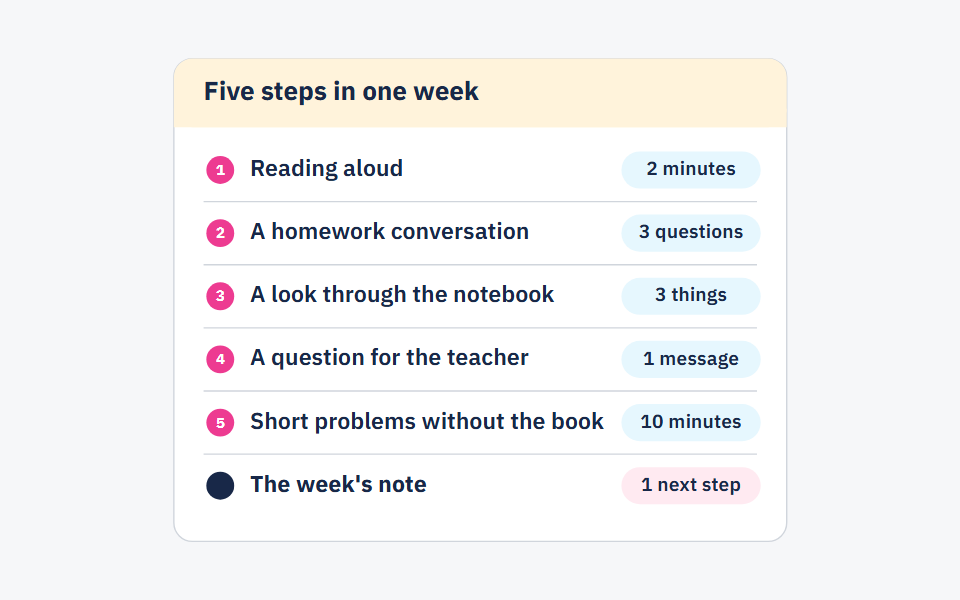
This method fails when you read the report card on its own. It is one snapshot at the end of a term, and comparing with the class average does not tell you whether the whole class is at its grade level. So put what you see at home beside it: how to know your child's level gives five short observations over a week, which you can take to the teacher along with the five questions.
And watch what follows the report card, not just the number. UNICEF says that if anxiety starts interfering with school, home or play, a child may need support from a mental health professional. If you see that after the report card, talk to the school counsellor or your child's doctor, and do not wait for the next report.
Frequently asked questions
- How do I read my child's report card?
- Compare each mark with last term's mark and the class average together, then read the teacher's comment and the days absent. The subject that deserves a question is one that dropped when the class did not, or stayed below the class average two terms running.
- What should I do if my child's grades drop?
- Do not punish on the same night. First check whether the class average dropped too, then ask your child what they think, ask the teacher what they have not mastered yet, and agree one step and a date to check in.
- Should I compare my child's grades with their siblings or friends?
- No. Compare their mark with their own mark last term, and with the class average only to understand how hard the term was. UNICEF advises avoiding phrases like “Other children don't have these issues”.
- What does “needs to focus more” mean on a report card?
- You cannot know until you ask. Ask the teacher when they see it and what it looks like: in which lesson, at what point in it, and what your child is doing then. An answer that describes a situation gives you something to do.
Sources
Every fact in this post that we did not produce ourselves comes from one of these sources.
- B-flation: How Good Grades Can Sideline Parents — Gallup and Learning Heroes, 2023-11
- Working with Parents to Support Children's Learning: Guidance Report — Education Endowment Foundation, 2018
- Mental health conversation starters: 6–10 years — UNICEF Parenting, undated (read 2026-10-22)
- Mental health conversation starters: 11–13 years — UNICEF Parenting, undated (read 2026-10-22)
- What is anxiety? — UNICEF Parenting, undated (read 2026-10-22)
Written with String's editorial team: we use AI for research and first drafts, and a person checks every fact and every source before anything is published. How we write
Founder and CEO, String
“I grew up in a house of teachers.” I spent a year designing the STEM program for one of the largest school groups in Saudi Arabia, have written curriculum by hand, trained robotics coaches and sold software into schools, then left that job to build String in Amman.