A weekly study timetable your child will keep (free printable)
The timetable a child keeps is short and repeats: today's homework first, then a quarter of an hour reviewing a lesson from two days ago with the book closed. Write it together in one sitting, try it for a week, then change one thing.
Weekly study timetable — printable
A free printable PDF, no sign-up.
- Definition
- Weekly study timetable: One page that sets, for each day of the week, when your child studies, what, and how: today's homework, then review of an earlier lesson, and a short self-test.
The full template: a week for a Grade 5 child
This week was written for this post as an example; it is not about a real child. Each day's session starts at the same time, after lunch and some rest, and takes 40 minutes: 20 for homework, a 5-minute break, and 15 for review. The weekend here is Friday and Saturday; move it to match your school's week.
| Day | Homework — 20 minutes | Closed-book review — 15 minutes | Total with the break |
|---|---|---|---|
| Sunday | Today's homework | Last Wednesday's science lesson | 40 minutes |
| Monday | Today's homework | Last Thursday's Arabic lesson | 40 minutes |
| Tuesday | Today's homework | Sunday's maths lesson | 40 minutes |
| Wednesday | Today's homework | Monday's English lesson | 40 minutes |
| Thursday | Today's homework | Tuesday's science lesson | 40 minutes |
| Friday | Day off | Day off | — |
| Saturday | — | The weekly quiz: five questions from different lessons of the week, then marking them together | 20 minutes |
Closed-book review: for five minutes they write down everything they remember from the lesson, or answer three questions that they or you wrote. Then they open the book, check their own answers, and spend the rest of the time on what they forgot.
If there is no homework: the review stays as it is, and nothing is added in place of the homework.
Why this order? In the Association for Psychological Science's summary (January 2013) of a review by John Dunlosky and colleagues of the scientific evidence for ten techniques students commonly use, two received the highest overall utility rating: spreading study out over time, and practice testing. Rereading, highlighting and summarising seemed to give minimal benefit. The summary says students would benefit just by replacing rereading with delayed retrieval practice. The timetable uses both: review comes two days later, not the same day, and it starts with the book closed.
How to fill in each box
Fix what doesn't move first
Write in school hours, meals, sleep and regular activities, then find one time that repeats on every school day. The same time every day turns the session into a habit rather than a decision made each evening.
Homework first, in blocks that fit their age
Start with homework because it is due tomorrow. If it needs more than one block, take a short break and do a second block rather than one long sitting. The times are in the next section.
Pick the review lesson by counting back
Each day, review a lesson from two school days before: Tuesday for Sunday's lesson, Wednesday for Monday's, Sunday for last Wednesday's. That way each lesson comes back after a gap, not on the day it was taught.
Make the review a test, not a reread
The book is closed at the start; they write what they remember, answer questions, or explain the lesson to you in their own words. Then they open the book and check. If they need questions, write three together at the end of each new lesson, ready for its review two days later.
Leave one day free, and one for the weekly quiz
The day off is what makes the timetable possible week after week. The weekly quiz is twenty minutes of questions from all the week's lessons, which shows you both what has stuck and what needs another review next week.
Times by age
There is no single number per age that research has settled. These are our suggested starting points; adjust them after a week to what actually happens. The first reference is how long the teacher expects homework to take, so ask.
| Stage | Block length | Whole session | Self-test form |
|---|---|---|---|
| Grades 1 to 3 | 10 to 15 minutes | One or two blocks | Spoken: you ask three questions, or they read to you and retell it in their own words |
| Grades 4 to 6 | 20 minutes | Two blocks and a break, as in the example above | They write what they remember, then check the book |
| Grades 7 to 9 | 25 to 30 minutes | Two or three blocks | Flashcards: question on one side, answer on the other |
| Grades 10 to 12 | 30 to 45 minutes | Depends on the homework, within a clear limit | Past exam questions, solved before looking at the answers |
For secondary school, the Education Endowment Foundation's guidance report “Working with Parents to Support Children's Learning” (2018) says studies point to an optimum amount of homework of between one and two hours per school day, slightly longer for older pupils, with the effect diminishing as time increases beyond that. At primary level, the evidence is strongest for short, focused homework.
How to write it together in one sitting
We suggest writing it together: a timetable your child helped write is theirs, not one pinned up for them. The same report recommends that parents encourage children to set goals, plan, and manage their time, effort and emotions, and says this kind of support will often be more valuable than direct help with homework.
Pick a calm moment, not straight after an argument
Twenty minutes at the weekend is enough. Print the template and put their school timetable in front of you both.
Ask before you suggest
“When would you like to start?”, “Which subject do you want to review first?”, “When are you tired?” If they don't know, offer two options, not one.
Let them write it in their own hand
You suggest the frame: the times, the day off, the weekly quiz day. They fill in the boxes.
Try it for a week as it is
They tick each session that happened. Don't comment on the ones that didn't; the first week is a trial.
Review it at the end of the week, and change one thing
Ask: “Which session was hardest? Why?” Then change just one thing: the time, the length, or the order.
Three mistakes that turn a timetable into wallpaper
- More hours than the child has in them: a three-hour timetable for a ten-year-old may be abandoned by day three. Start with less than you think they need, then add.
- Review by rereading: the time passes and the child feels they have revised, with the book open the whole time. Start every review with the book closed.
- A week with no slack: every evening is full, so one visit or one sick day wrecks the whole plan. The day off is part of the plan, not a break from it.
If your child uses the String for Families app, count its time in the timetable like any other activity. You can also pick the review lesson from what its daily read says they hesitated on.
When they won't stick to it
A timetable doesn't create the will to sit down. The same summary says these techniques will benefit only students who are motivated and capable of using them. If your child refuses every night, start with one short session a week instead of the whole timetable, and talk to the teacher. If you see worry that comes back whenever studying comes up, or a difficulty that repeats across more than one subject, ask to talk to the school counsellor, and for a specialist's view if the school advises it.
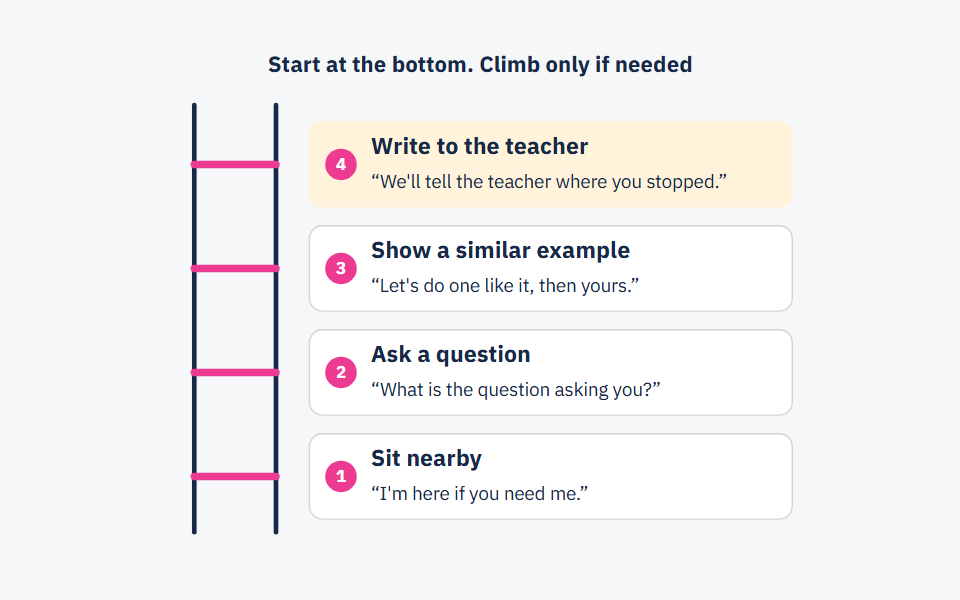
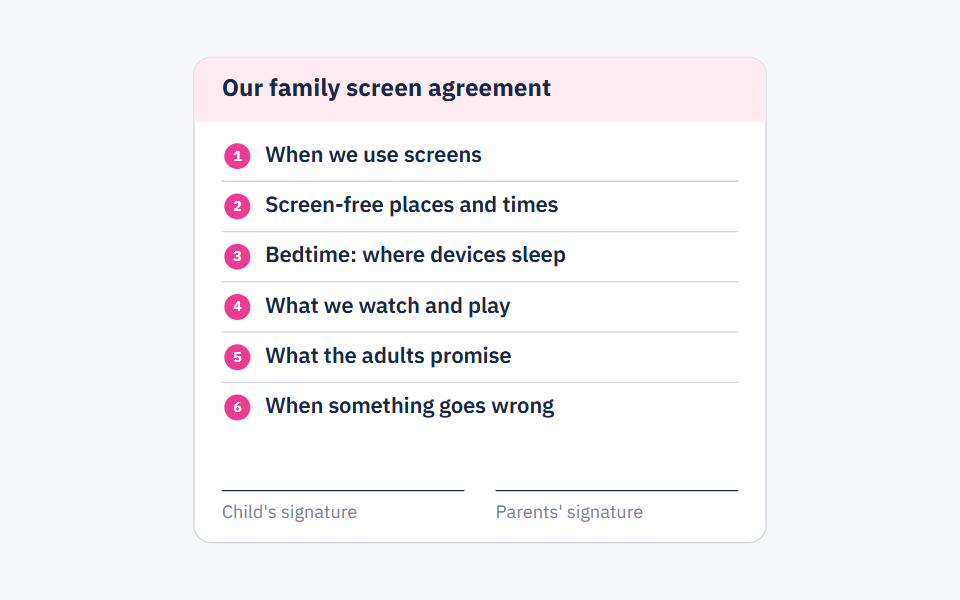
During the homework itself, the homework help ladder sets how much you step in. And if screens are taking the timetable's time, start with a family screen-time agreement.
Frequently asked questions
- How many hours a day should a child study?
- There is no single number for every age. Start with the suggested times in the table above, ask the teacher how long they expect homework to take, then adjust after a week.
- How do I make a study schedule for my child?
- Write it together: a fixed time each day, homework first, then a quarter of an hour reviewing a lesson from two days ago with the book closed, one day off, and one day for the weekly quiz.
- Should every subject be on every day?
- No. The homework decides the day's subjects, and the review covers one lesson only. Every subject comes round in turn over the week.
- Does the timetable change before exams?
- The idea stays the same: short blocks, spaced review and self-testing. There are more review blocks, and they start days before the exam, not the night before.
- Where can I get a printable weekly study timetable PDF?
- At the top of this page: a blank one-page template, no sign-up.
Sources
Every fact in this post that we did not produce ourselves comes from one of these sources.
- Which Study Strategies Make the Grade? — Association for Psychological Science, 2013-01-10
- Working with Parents to Support Children's Learning: Guidance Report — Education Endowment Foundation, 2018
- What is anxiety? — UNICEF Parenting, n.d., read 2026-10-22
Written with String's editorial team: we use AI for research and first drafts, and a person checks every fact and every source before anything is published. How we write
Founder and CEO, String
“I grew up in a house of teachers.” I spent a year designing the STEM program for one of the largest school groups in Saudi Arabia, have written curriculum by hand, trained robotics coaches and sold software into schools, then left that job to build String in Amman.