Helping with maths without contradicting the teacher's method
Ask your child first how the class solves it, help with that same method, and ask a question instead of giving the answer. If you don't know the method, write the teacher two lines and ask for one worked example.
Maths at home — a card for the table
A free printable PDF, no sign-up.
Your child opens their maths book and you see drawn bars, boxes and little arcs over a line, nothing like the way you learned it. The urge is to say, “Forget that, let me show you the easy way.” Tonight, try a different sentence: “Show me how your teacher does it.” Here are three methods you may see in the notebook, each with a drawing and a worked example, then five questions to ask instead of giving the answer, and a two-line note for the teacher when you don't know the method.
Start with one question: how do you do it in class?
Your method is not wrong. But a child who learns one method in class and hears another at home can mix them up in the same problem. So we suggest a clear order: the class method first, and yours afterwards, if they need it, as a second way to compare. That order matches what the Institute of Education Sciences (IES) practice guide on maths problem solving (May 2012) recommends: that students learn more than one way to solve a problem and compare them, because too often students become wedded to just one approach and then flounder when it does not work on a different or harder problem. The class method and yours are not rivals; they are two methods your child can learn from, each at the right time.
If your child can't remember the class method and you can't find it in the notebook, don't invent a third one. Write the teacher two lines:
Good evening. We'd like to help [child's name] with maths homework using the method they learn in class: which method are you using this month for [multiplication / subtraction / word problems]? Could you send us one worked example? Thank you, [parent's name].
Three methods you may see in the notebook
All three are drawings before they are calculations. The same IES guide recommends that teachers teach students to use visual representations to solve problems, including number lines and strip diagrams, and rates the evidence for that recommendation as strong: six studies with middle school students consistently found that using visual representations improved achievement. The IES guide on teaching fractions (September 2010) makes a related recommendation: that teachers use area models and number lines to help students understand why computational procedures with fractions work. The three examples below were written for this post, not copied from a textbook.
1. The bar model: for a word problem
Your child draws each quantity in the problem as a bar, and sees how the quantities relate before choosing an operation. The IES guide notes that strip diagrams suit comparison and fraction problems. The drawing at the top of this page solves this example:
- Draw one bar for Laila; we don't know her number yet.
- Draw three bars of the same length for her brother, because he has three times as many.
- Put a brace over all the bars and write 72 on it: four equal parts make 72.
- One part: . So Laila has 18 books, and her brother has .
- Check: , and 54 is three times 18.
Notice that your child needed no equation with an unknown; the four bars did that job. The bar model: how Grade 6 students solve word problems draws other kinds of problem the same way.
2. The box method (area model): for multiplication
Your child splits both numbers into tens and ones, draws a rectangle divided into cells, multiplies two easy numbers in each cell, and adds the results.
- Split both numbers: 23 is 20 and 3; 14 is 10 and 4.
- Multiply in the four cells: , , , .
- Add: .
If you know long multiplication, the same parts are hidden inside it: , which is , and , which is ; then . That is the comparison that helps your child, once they have solved it the class way.
3. The number line: for subtraction
Your child draws a line, makes easy jumps along it, and adds up the jumps. Here the line runs left to right, with numbers growing to the right.
- Start at 27 and jump to the next ten: 27 to 30 is a jump of 3.
- Jump in tens: 30 to 60 is a jump of 30.
- Finish: 60 to 62 is a jump of 2.
- Add the jumps: . So ; check: .
Some classes jump backwards instead of counting up: , then . Same answer, different drawing, so ask your child which way their class goes.
After the drawing, ask your child to write the number sentence: , or . The same guide recommends showing students how to turn what they drew into mathematical notation; the drawing is a way to the calculation, not a replacement for it.
Five questions to ask instead of giving the answer
The IES guide recommends that teachers give students a list of prompts to ask themselves while they solve, and rates the evidence as strong. It suggests that when a student solves a problem incorrectly, the teacher asks what questions the student should have asked themselves, rather than providing the correct answer. The guide was written for teachers, but the rule works at the kitchen table. Here are five questions; four are adapted from the guide's sample question list, and the fourth is our own:
“What is the problem asking you?”
Ask them to read the problem out loud, then say it in their own words. If they can't, the obstacle is understanding the problem, not the arithmetic, and that is where you start.
“What do you know? What information are you given?”
In Laila's problem: the total is 72, and her brother has three times as many as she does. Let them underline each piece of information.
“Where have you solved a problem like this?”
Let them look in the notebook for an example the teacher solved in class. That example is the class method, written down in front of you.
“Can you draw it the way you draw it in class?”
A bar, a box or a number line. If they draw something you don't recognise, ask them to explain it to you; explaining it to you is practice for them.
“Does the answer make sense? How can you check it?”
In Laila's problem: is ? Is 54 three times 18? For the subtraction: is ? Checking finds the mistake without you saying where it is.
So when do you show them your way?
After they have solved it the class way, not before. Then you can say, “Here's another way I learned. What's the same about the two?” The IES guide recommends giving students opportunities to compare different methods in worked examples, as we did above with long multiplication and the box method. Show your method before they understand the class one, and they may take two half-understood methods back to class tomorrow.
When this doesn't work
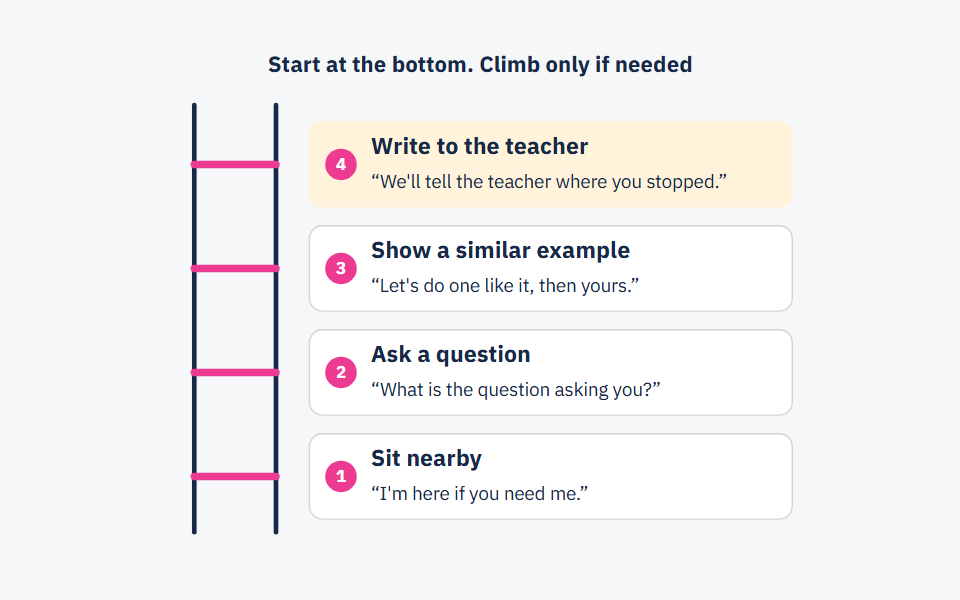
The five questions fail when the skill underneath the problem isn't there yet: a child who doesn't know their times tables won't be helped by “Does the answer make sense?” in a multiplication problem. Don't teach the lesson from the start; tell the teacher what you saw. How much should you help with homework? sets out four rungs of help, the last of which is a note to the teacher.
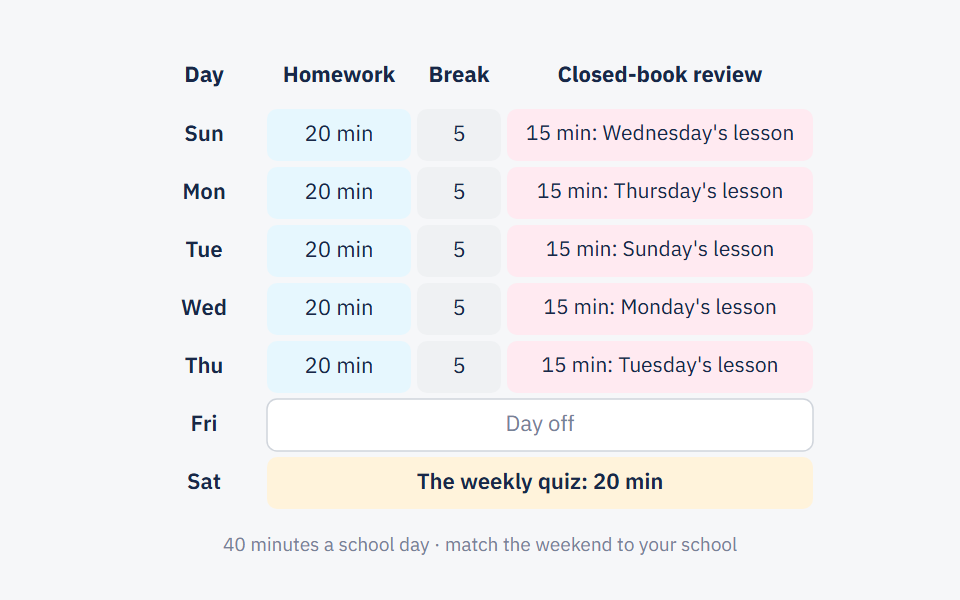
If you see the same difficulty in maths for weeks in a row, or your child starts avoiding homework altogether, ask to meet the teacher and ask what support the school offers. And if the problem is how much homework there is rather than how hard it is, a weekly study timetable can help spread it out.
Frequently asked questions
- How do I help my child with math homework when I don't know the school's method?
- Ask them to show you the teacher's example in their notebook, and ask the five questions instead of explaining. If there's no example, write the teacher two lines asking which method they use, and ask for one worked example.
- What is the bar model in maths?
- A way to solve word problems in which each quantity is drawn as a bar, so the child sees how the quantities relate before choosing an operation. The example on this page: four equal bars make 72, so one bar is 18.
- Should I teach my child the long multiplication I learned?
- Once they have mastered the class method, yes, as a second way to compare. The parts in the box method are the same ones hidden in long multiplication, and comparing the two helps.
- How can I help with maths before a test?
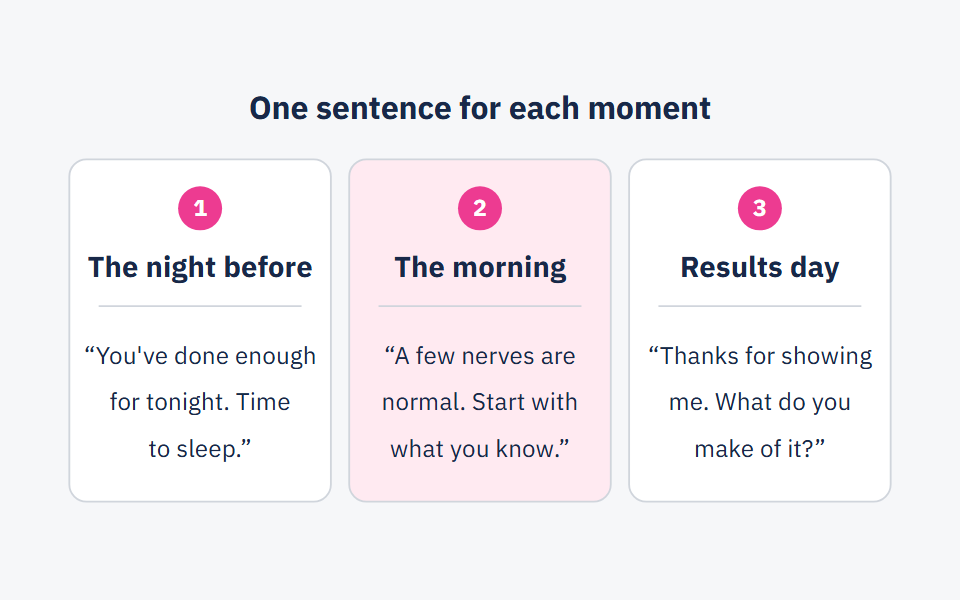
- Let them solve problems from their notebook the class way, and ask “How can you check your answer?” after each one. For the night before the test itself, What to say to your child before an exam has sentences to say and sentences to avoid.
Sources
Every fact in this post that we did not produce ourselves comes from one of these sources.
- Improving Mathematical Problem Solving in Grades 4 Through 8 (IES Practice Guide, NCEE 2012-4055) — Institute of Education Sciences, What Works Clearinghouse, 2012-05
- Developing Effective Fractions Instruction for Kindergarten Through 8th Grade (IES Practice Guide, NCEE 2010-4039) — Institute of Education Sciences, What Works Clearinghouse, 2010-09
Written with String's editorial team: we use AI for research and first drafts, and a person checks every fact and every source before anything is published. How we write
Grade 6 mathematics · Jordan
Teaches Grade 6 mathematics in Jordan and writes here about teaching maths from inside the classroom.