Family rules for AI and homework: a printable agreement
The rule in one line: your child uses AI to understand, not to get the work done for them, and after each use explains what they learned with the screen closed. Read the school's rules first, then write a three-part agreement together tonight.
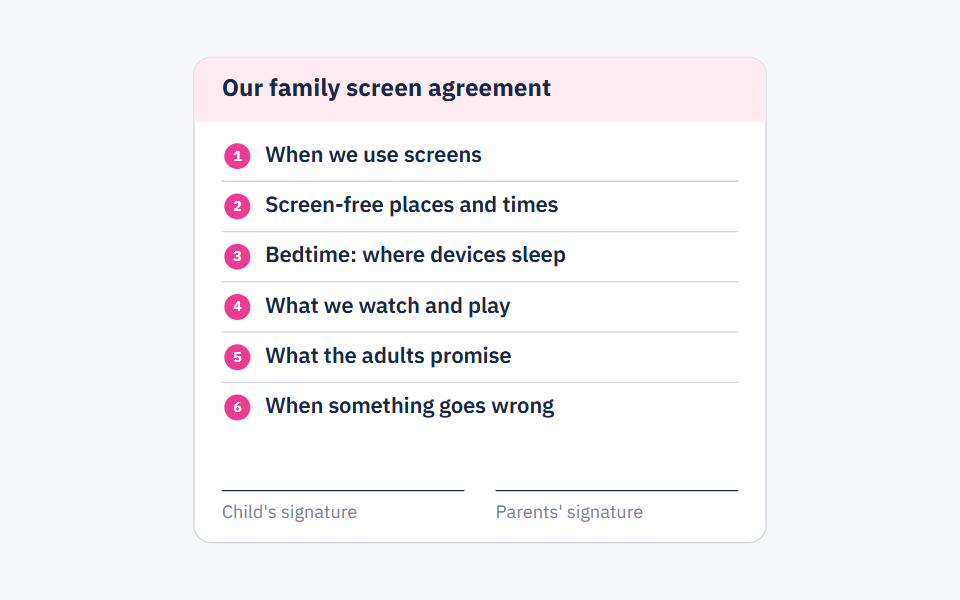
Our family agreement on AI and homework
A free printable PDF, no sign-up.
If you see your child typing a homework question into ChatGPT, it does not mean they are cheating. They may be asking for an explanation of a lesson they did not follow in class, or they may be asking for the answer to copy. The difference between the two is what these rules settle. It is not rare: in the US, 26% of teens aged 13 to 17 said they had used ChatGPT for schoolwork — double the share in 2023 — according to a Pew Research Center survey published in January 2025. 54% of the teens surveyed said using it to research new topics was acceptable; only 18% said the same of writing essays. Those are US figures; we know of no published equivalent for Arab teenagers.
- Definition
- Family AI agreement: A page parents and child write together, saying for each kind of homework task whether using an AI tool is allowed, needs asking first, or is not allowed — and what happens when a rule is broken.
Start with the school's rules, not yours
Schools are writing their rules now. In the UAE, the Sharjah Private Education Authority has introduced an ethical framework for AI use in educational institutions, according to a Khaleej Times report published on 21 October 2026: students may use tools such as ChatGPT to research topics and explore ideas, but may not rely on them to write answers or complete assignments for them, with disclosure of AI use where appropriate and checking of what the tools say. Your child's school may have different rules, so look in three places:
- The student handbook or code of conduct, on the school's website or in the app it uses to reach you.
- The homework instructions themselves: a teacher may write “no help” or “research allowed”.
- The teacher, in a short message if you find nothing: “We are writing family rules for AI and homework. May my child use it to explain an idea they did not understand, or to check an answer they wrote themselves? Is there homework you would rather they did with no AI at all?”
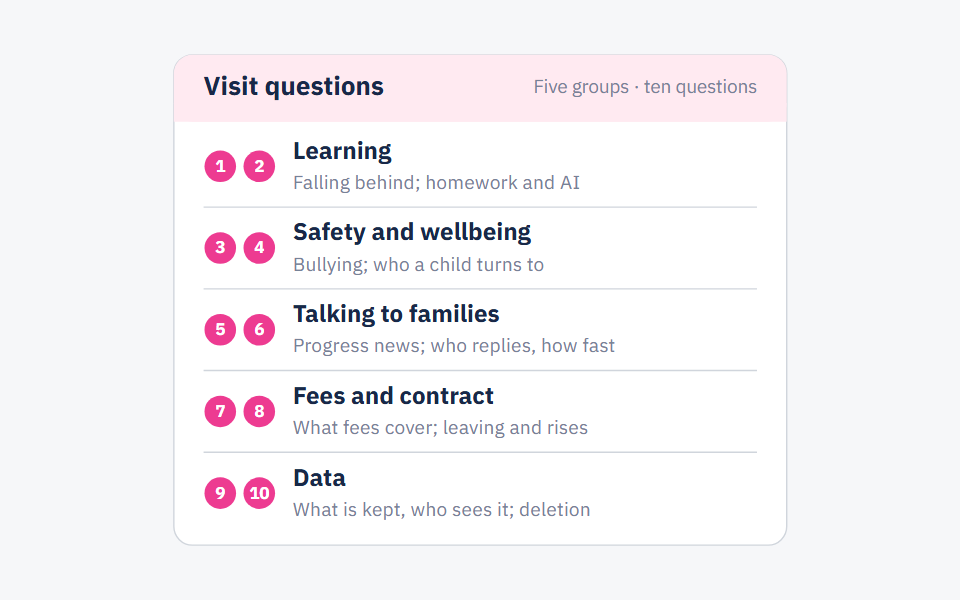
When the school's rule and the home rule differ, the stricter one applies. And do not write into the agreement that the school allows something it has not allowed in writing. If you are choosing a school now, ask for its rule before you enrol: it is question two in ten questions to ask before enrolling your child.
The agreement: three groups, by task
We sorted the tasks your child might give these tools into three groups, each with a word and a mark as well as a colour, so the page still reads when printed in black and white. Every line turns on one question: who is doing the thinking here, your child or the tool?
| Task | Group | Condition or reason |
|---|---|---|
| Explain an idea or lesson I did not understand | ● Allowed | Afterwards I explain it in my own words with the screen closed |
| Give me practice questions to test myself | ● Allowed | I answer them before asking for the answers |
| Check an answer I wrote myself and point to the mistake | ● Allowed | I write my full answer before asking, and I fix the mistake myself |
| Suggest ideas for a project or research | ▲ Ask first | I pick one idea, write it in my own words, and say I used AI |
| Translate a text | ▲ Ask first | To understand something I am reading, not to hand in its translation as homework |
| Correct the language of something I wrote | ▲ Ask first | It points out the mistakes; it does not rewrite the text for me |
| Use a new app or tool | ▲ Ask first | We read its terms and minimum age together |
| Write my essay or report for me | ■ Not allowed | Writing is practice in thinking; if the tool writes it, I practised nothing |
| Solve the homework so I can copy it | ■ Not allowed | Homework tells the teacher what I understood; a copied answer tells them something untrue |
| Answer for me in a test or marked work | ■ Not allowed | The mark is for my work |
| Send it my photo, full name, school name or phone number | ■ Not allowed | What I type into the tool may be stored, and I do not know where |
The disclosure line: when your child uses the tool for an “ask first” task, they write at the end of the homework: “I used an AI tool for: …”. Sharjah's framework itself asks for disclosure where appropriate, and the line teaches your child not to hide what they did.
The two-minute check after every use
One rule makes the agreement work: after every use, even for allowed tasks, your child closes the screen and shows you that the understanding is now theirs.
They close the screen
Do not go through the chat; just ask that the talking now be between the two of you.
“Explain what you understood in two minutes, as if I didn't know it.”
Listen for the steps in their own words, not sentences memorised as the tool wrote them.
“Now solve this similar question on your own.”
Pick another exercise from the same book, or change the numbers in the question. If they solve it, the tool helped the way a teacher helps.
If they cannot
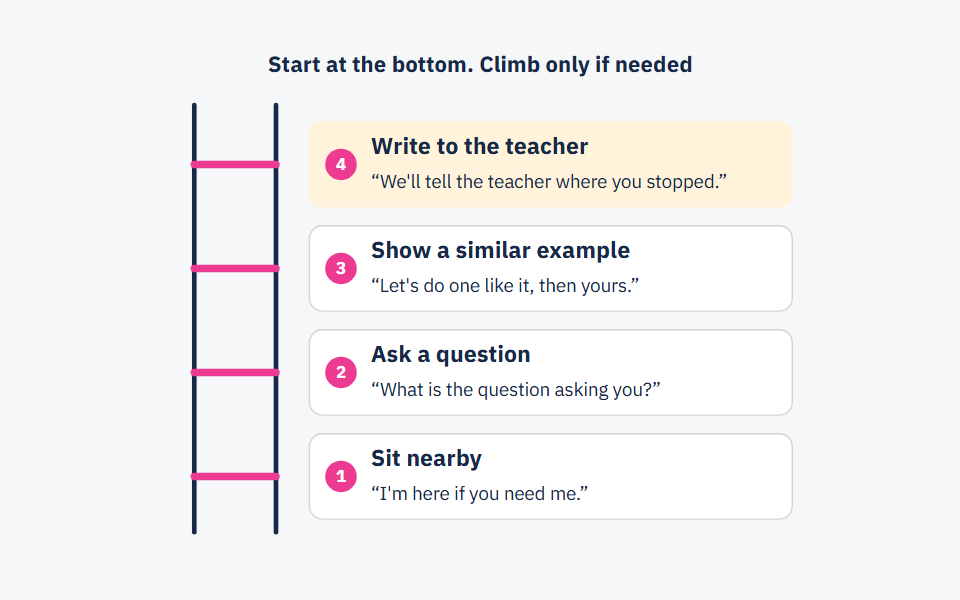
The tool did the thinking this time. That is not a punishment: they go back to the lesson, or write to the teacher about what they did not understand. The homework help ladder has the same steps for when you are the one helping.
When your child breaks a rule: what to say
Start with a question, not an accusation
Say: “Show me what you asked it.” Avoid “You're cheating” — the word ends the conversation before you know what happened.
Ask for the explanation
“Explain this answer to me in your own words.” If they can, the problem is the rule, not the understanding, and the agreement needs a look. If they cannot, the work is not theirs yet.
They redo that part themselves tonight
“We'll set aside what the tool wrote, and you'll write this part yourself, even if it comes out shorter.” A short piece they wrote is more honest than a long one they did not.
If the work was already handed in for a mark
We suggest they tell the teacher themselves, with you beside them: “I want to tell you that I used an AI tool to write … and that wasn't allowed. I can redo it myself if you let me.” What happens next is the school's decision.
A consequence tied to the rule, not a total ban
For example: for one week every “allowed” task becomes “ask first”, then you go back to the agreement. A total ban, in our view, pushes a child to use it in secret, and secrecy is harder to deal with than any broken rule.
Before thirteen, and after
In September 2023, UNESCO's guidance, as reported by UN News, called on governments to regulate generative AI in education, suggested considering an age limit of 13 for its use in the classroom, and said institutions should validate AI tools before students use them. A tool may also set a minimum age in its terms of use; read the terms before your child opens an account. For children under thirteen, we suggest using it with you, on a screen in a family room, on an adult's account rather than their own. After thirteen, “allowed” can widen step by step, while “not allowed” stays as it is.
When the agreement does not work
The agreement fails when it turns into surveillance: reading chats in secret, or asking “Did you use it?” every evening in an accusing tone. It fails when nobody reviews it — tools and school rules change, so set a review date a month out, then once a term. And it fails when adults use the tool to do the child's homework for them: the rule is for everyone.
This agreement is about what is asked of the tool, not about time on screens; time and places have the family screen-time agreement. If you want to see how a teacher writes the rules for a class, an AI policy for the classroom has a template. And if you suspect the homework has moved beyond your child's level, start by finding out where they stand in a week.
Frequently asked questions
- Is my child cheating if they use AI for homework?
- Not necessarily. Cheating is when the tool does the work and it is handed in as theirs, or when they use it where the school has said no. A tool explaining an idea, after which they solve the problem alone, is closer to asking a teacher.
- Is it OK to use ChatGPT for school homework?
- That depends on the school's rules first. Where there are none, using it to understand, practise and check work they wrote themselves is acceptable in this agreement; having it write the work is not. Check the tool's own minimum age in its terms.
- How can I tell if my child used AI for their homework?
- Do not rely on guessing from the style. Ask them to explain what they wrote in their own words, or to solve a similar question with the screen closed. If they cannot, the work is not theirs yet, wherever it came from.
- At what age can my child use AI tools?
- UNESCO's 2023 guidance suggested considering 13 as a minimum age for classroom use, and a tool may set its own minimum age in its terms. Before that, we suggest they use it with you, on your account.
Sources
Every fact in this post that we did not produce ourselves comes from one of these sources.
- About a quarter of U.S. teens have used ChatGPT for schoolwork – double the share in 2023 — Pew Research Center, 2025-01-15
- Sharjah schools introduce new AI rules: what changes for homework and exams — Khaleej Times, 2026-10-21
- UNESCO urges governments to regulate generative AI in education and research — UN News, 2023-09-07
Written with String's editorial team: we use AI for research and first drafts, and a person checks every fact and every source before anything is published. How we write
Founder and CEO, String
“I grew up in a house of teachers.” I spent a year designing the STEM program for one of the largest school groups in Saudi Arabia, have written curriculum by hand, trained robotics coaches and sold software into schools, then left that job to build String in Amman.