Ten questions to ask before enrolling your child in a school
Ask ten questions on five subjects, and listen to the answer, not the brochure: a good answer is a specific example or a written document, a worrying one is a general promise. Take the card with you, and visit on an ordinary school day.
School visit question card
A free printable PDF, no sign-up.
The website, the brochure and the open day say much the same thing about every school. The difference shows when you ask a specific question and listen to the answer. Here are ten questions in five groups, each with what a good answer sounds like and a warning sign. You do not need to be an education expert to ask them; you need the card, and to write down what you heard before you forget it.
The ten questions: the good answer and the warning sign
Learning
| Question | A good answer sounds like | Warning sign |
|---|---|---|
| 1. How do you notice that a child is starting to fall behind in a subject, and what do you do the following week? | A specific way of noticing, such as a short quiz or a notebook review, then a dated step: a support lesson, a small group, or a message to parents | “We follow every student” with no example, or “We wait for the exam results” |
| 2. How long does homework take each night in this grade, and what is your rule on using AI for it? | A rough number of minutes the teachers know, and a written AI rule — or “We're writing it now, and this is what we ask until then” | Nobody knows how long homework takes, or the answer changes from one member of staff to the next |
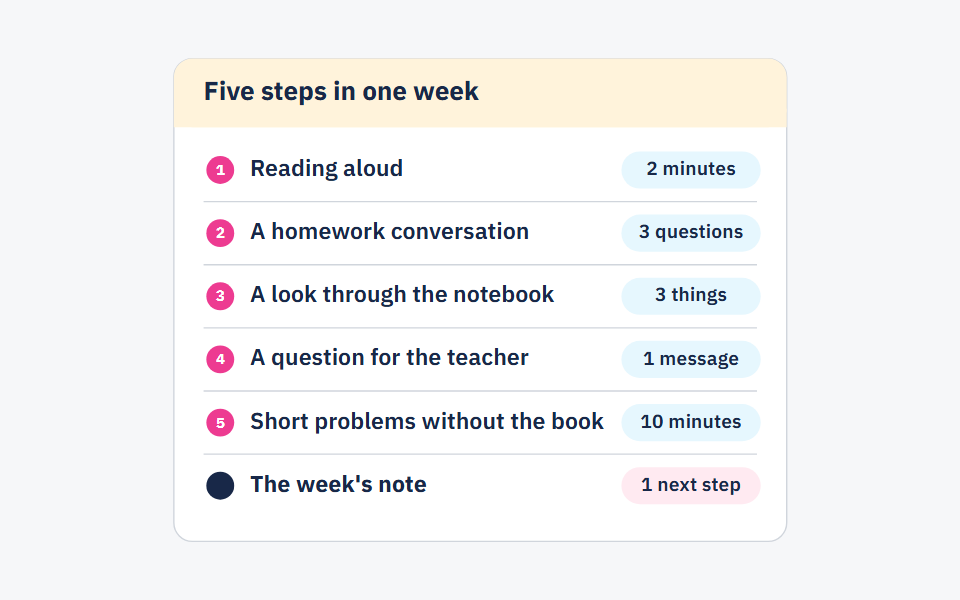
The answer to question two shapes your own evenings: if you know the minutes, you know when to step in — the homework help ladder shows how. If the school has no AI rule, write your own family rules for AI and homework.
Safety and wellbeing
| Question | A good answer sounds like | Warning sign |
|---|---|---|
| 3. What happens when a child is bullied, at school or online? | A written policy that covers both, who is told, when parents hear, and how it is followed up afterwards | “There is no bullying here” |
| 4. Who does a sad or frightened child turn to during the school day? | A named person, such as the school counsellor, a way for the child to reach them, and when parents are told | “The teacher handles everything,” with no person or route named |
The bullying question is not an accusation. UNICEF itself, on its page “Bullying: What is it and how to stop it”, advises parents to ask whether the school has a bullying policy or code of conduct, and notes that it may cover both in-person and online bullying. A school that has a policy is not bothered by the question; it hands you the page.
Talking to families
| Question | A good answer sounds like | Warning sign |
|---|---|---|
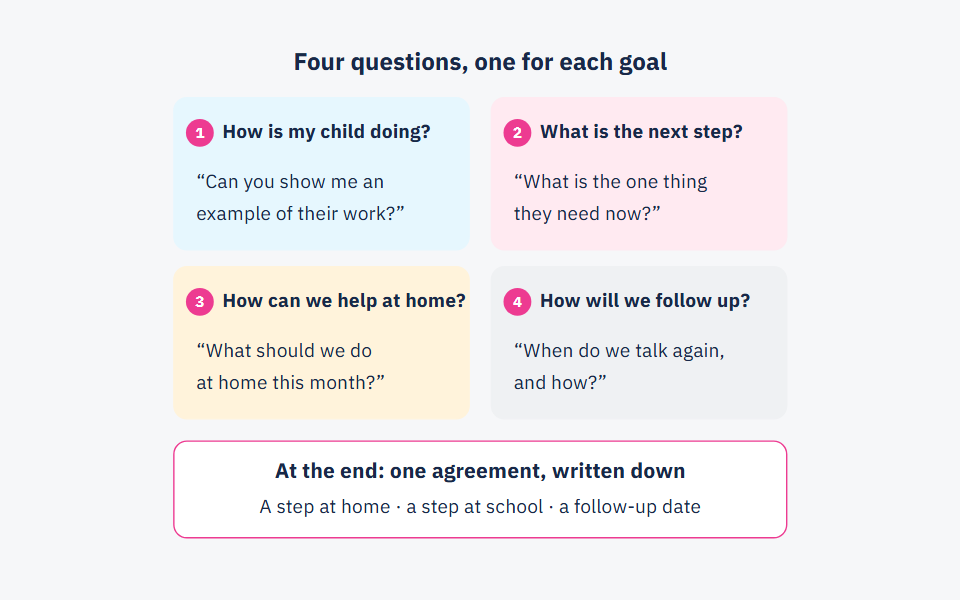
| 5. How and when will I hear how my child is progressing — not only school news? | A fixed rhythm you know: a weekly or monthly note on what they are learning and where they stand, and meetings with teachers each term | The end-of-term report card is all you hear about your child; the rest is general news |
| 6. If I have a question or a concern, whom do I write to, and when can I expect a reply? | One known channel, a name or a role, and a reply time, such as “within two school days” | “Call us any time,” with no word on who answers |
There is evidence behind this question. In a survey of over 1,000 parents in England, cited in the EEF's guidance report on working with parents (2018), what parents most wanted from schools was updates on their child's progress, and most schools provide them. After that, though, there was a mismatch between what parents said they wanted — information about what their child was learning — and what they tended to receive: news on general school activities, policy changes and administrative issues. The report says communication should be two-way, not only messages from the school.
Fees and contract
| Question | A good answer sounds like | Warning sign |
|---|---|---|
| 7. What do the fees cover, and what is paid on top? | A written list: books, uniform, transport, trips, activities, and exam fees if there are any | “We'll let you know later,” or a spoken answer that never gets written down |
| 8. What happens if we leave mid-year, and how are fee increases decided? | Written terms in the contract for withdrawal and refunds, and a date by which any increase is announced before the school year | You only see the contract when you pay |
The rules on private school fees differ from country to country, so we give no country's rule here. Ask for the contract before you pay, read it at home, and ask your country's private education authority which rules apply.
Data
| Question | A good answer sounds like | Warning sign |
|---|---|---|
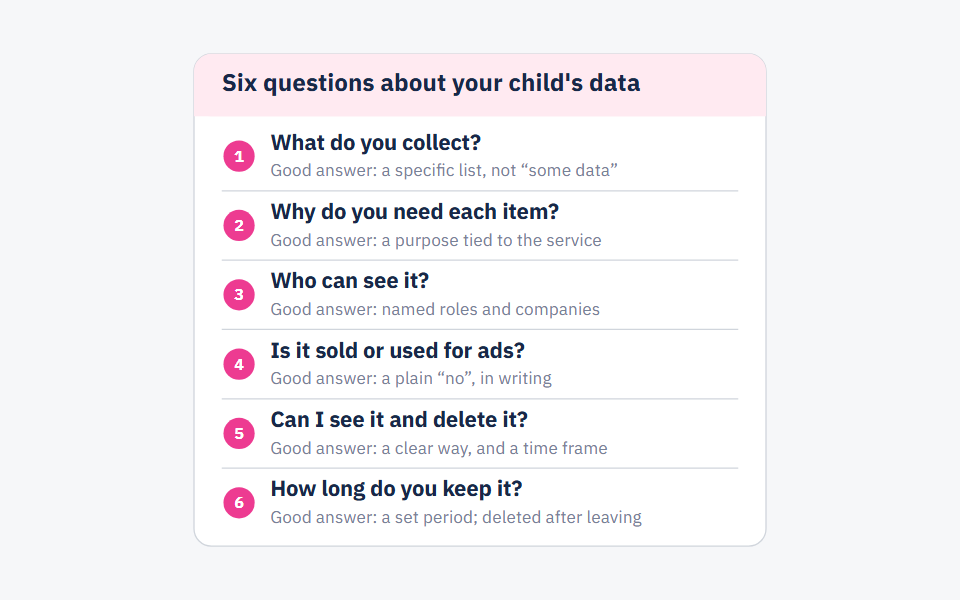
| 9. What data do you keep about my child, which apps do you use, and who can see that data? | A list of the apps, who sees what, and a rule for children's photos that asks your consent before anything is published | “Everything is secure” with no detail, or nobody knows which apps are in use |
| 10. Can I see my child's data, correct it and ask for it to be deleted — and what happens to it after they leave? | Yes, with a known process: whom to write to, and within how many days you get a reply | There is no process, or “Nobody has asked us that before” |
In Jordan, for example, Personal Data Protection Law No. 24 of 2023 gives the data subject the right to access their data, have it corrected and ask for it to be erased, subject to the law's conditions, according to Clyde & Co's reading of the law (October 2023). For more, questions to ask about your child's data has a longer list.
The visit: what to look at in the corridor and the classroom
Ask to visit on an ordinary school day, not only on the open day, and to sit for ten minutes in a class close to your child's grade. Then look at what is not prepared for visitors:
In the corridor and the playground
- Students' work on the walls: is it varied, or identical copies?
- How adults speak to children: by name and calmly, or by shouting from a distance?
- At the gate: were you asked your name and the reason for your visit before you came in?
- At break: are adults watching the playground, and do the children look at ease?
- Toilets and drinking water: clean and open to the children?
In the classroom
- Who talks most: the teacher alone, or the students too?
- What does a student who finishes early do, and one who is stuck?
- If the teacher allows it, ask a student: “What are you learning today?” Do they know?
- Can every student see the board, and can the teacher reach every desk?
- If you are shown notebooks: do they have the teacher's corrections and comments?
After the visit: how to compare two schools
Write the answers down the same day
Put one word next to each question: good, vague, or worrying. Two days later the schools blur together in memory.
Compare the answers, not the buildings
A new playground is seen in a minute; the answer to question one shapes a whole year of your child's life.
Ask every school for the same documents
In England, for example, the government requires schools to publish their admission arrangements, curriculum and behaviour policy on their websites, according to GOV.UK's page on choosing a school. Even where your country's law does not require it, ask for these, plus the bullying policy and the contract, in writing.
Ask the parents of two children at the school
The same page recommends talking to other parents. Ask them two questions: “When did the school last contact you, and why?” and “What happened when you had a problem?”
What a visit cannot show you
A visit is a day the school prepares for, and its answers are promises. The real test is the first few weeks after enrolment: did the news you were promised arrive? Did someone reply in the time they said? Ask for a meeting with the teacher in the first month rather than waiting for the report card. After a month, look through your child's notebooks the calm way set out in how to know your child's level, and compare what you see with what you were told on the visit.
If your child needs particular support for learning or health, ask about it by name: who provides it, how many times a week, and how you will hear what has changed. And ask your child's doctor or the specialist who follows them what the school needs to know.
Frequently asked questions
- How do I choose a school for my child?
- Start with what your child needs, not with school rankings: distance, language, and support if they need it. Then visit two or three schools on an ordinary school day, ask each the same ten questions, and compare the answers.
- What questions should I ask a school before enrolling?
- Ten questions in five groups: how falling behind is spotted and what happens next, homework and AI, bullying, who a child turns to, progress updates, who replies and how fast, what fees cover, leaving and fee rises, and data and its deletion.
- Should I take my child on the school visit?
- Go alone the first time so you can ask freely. The second time, take them if the school allows it, notice how adults speak to them, and ask afterwards: “What did you like? What worried you?”
- How do I know which is the best school for my child?
- No school is the best for every child. The right one answers your questions with examples and written documents, and fits your own child's needs rather than a general ranking.
Sources
Every fact in this post that we did not produce ourselves comes from one of these sources.
- Bullying: What is it and how to stop it — UNICEF Parenting, undated (read 2026-10-22)
- Working with Parents to Support Children's Learning: Guidance Report — Education Endowment Foundation, 2018 (PDF undated in print; year from its text and file metadata)
- Jordan issues first Personal Data Protection Law — Clyde & Co, 2023-10-17
- School admissions: choosing schools — GOV.UK, undated (read 2026-10-22)
Written with String's editorial team: we use AI for research and first drafts, and a person checks every fact and every source before anything is published. How we write
Founder and CEO, String
“I grew up in a house of teachers.” I spent a year designing the STEM program for one of the largest school groups in Saudi Arabia, have written curriculum by hand, trained robotics coaches and sold software into schools, then left that job to build String in Amman.