Assignments that show real understanding in the age of AI
You cannot stop a student using AI at home, but you can ask for what the tool does not know or see: the stages of their work, a context from their surroundings, a short oral explanation, a draft written in class, a critique of two answers, and a decision with reasons. Here are six common tasks, before and after.
Six tasks that show understanding — a teacher's card
A free printable PDF, no sign-up.
- Definition
- Assignment that shows understanding: Homework that asks students to show their route to the answer, to connect it to something the tool cannot know, or to defend it to the teacher, so copying what a tool wrote is not enough to complete it.
In the US, 26% of teens aged 13 to 17 said they had used ChatGPT for schoolwork — double the share in 2023 — according to a Pew Research Center survey published in January 2025. 54% of teens said using it to research new topics was acceptable; only 18% said the same of using it to write essays. These are US figures; we know of no published equivalent for students in the Arab world.
In the UAE, the framework introduced by the Sharjah Private Education Authority lets students use tools such as ChatGPT to research topics, explore ideas and support their learning, but not rely on them to write answers or complete assignments on their behalf, according to a Khaleej Times report published on 21 October 2026. Which leaves the teacher's question: how do you design homework so the difference between the two shows?
Six common tasks, before and after
The six tasks were written for this post, across different subjects, not copied from a textbook. Take the idea, not the topic: each redesign works in other subjects too.
| The common task | Redesigned | What the student shows |
|---|---|---|
| Write an essay on how phones affect students' lives | An outline in class, then a draft, then a final version, with two lines on the most important change between them | The stages of the work: how the idea became a text |
| Write a report on plastic pollution | Count the plastic bottles thrown away in your classroom over two days, compare what you found with the lesson, and suggest one change for your school | Their own context: data the tool does not have |
| Do the ten problems at the end of the lesson | Do four problems; next lesson, explain one the teacher chooses in one minute | A short oral explanation: the steps in their own words |
| Read the text and answer the questions at home | Read the text at home and make handwritten notes; write the answers in class in 15 minutes | Writing in class: understanding at the moment of writing |
| Explain photosynthesis | Here are two answers a tool wrote: mark what is right, wrong and missing in each, and correct the error from the textbook | A critique of two answers: checking what a tool writes against a source |
| List the advantages and disadvantages of solar power | Your school can fund one project: solar panels or a garden. Choose, and give three reasons, the strongest objection and your reply | A decision with reasons: weighing, choosing and defending |
How to write each task, and what it costs you in time
The stages of the work: ask for the draft, not only the final text
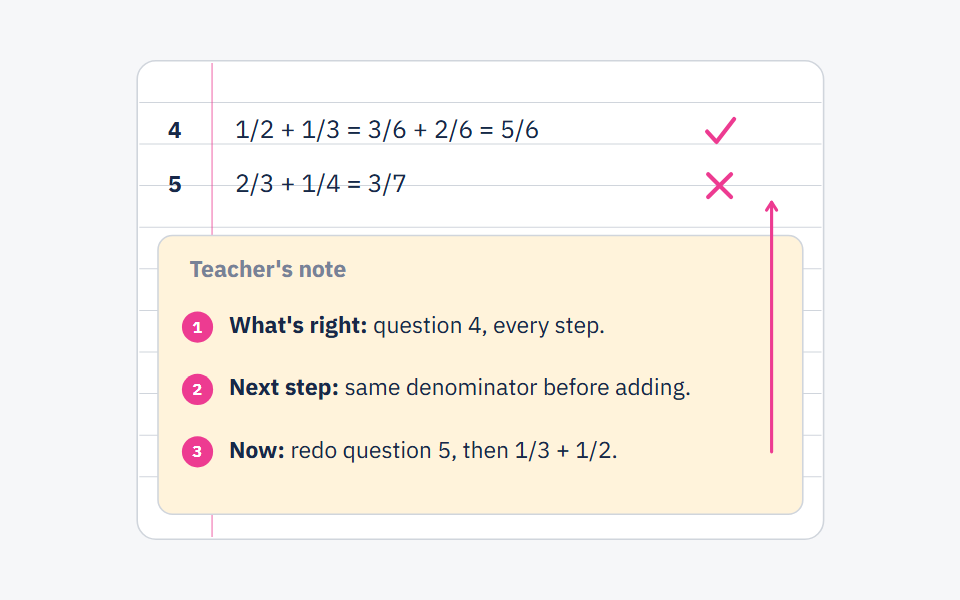
Write on the task sheet: “Outline in class (10 minutes), draft at home, final version after my comments. Hand in all three together, and write two lines: what is the most important thing you changed between the draft and the final version, and why?” What you check is the difference between the stages, not every line of each. Your comment on the draft needs two sentences; feedback phrases that still sound like you has short stems for it.
Their own context: tie the task to what is around them
Ask for data the student collects themselves in the classroom or the school, then compare it with the lesson. Choose something that reveals nothing about their family: the number of bottles in the classroom bin is fine; family income or health is not. If you ask for data from home, let the student choose between home and the classroom.
A short oral explanation: one minute after the homework
Set fewer problems, and say from the start that next lesson you will choose one for the student to explain in a minute. You do not need to hear everyone in one day: five or six students a lesson, or pairs explaining to each other while you move between them. The question that shows understanding: “Why did you do this step?”
Writing in class: make home the preparation
Reading and notes at home, writing in class. Limit the notes to half a page, handwritten, so the student has to actually read the text to write them; then the answer is written in front of you in 15 minutes. It costs you a quarter of a lesson and gives you a text you know the author of.
A critique of two answers: make the tool the lesson material
Put the question into an AI tool twice, or into two tools, and copy the two answers. Check both yourself against the textbook, and if neither has a mistake, add one whose place you know. The student underlines every correct sentence, circles every mistake and corrects it from the textbook with the page number, writes what each answer is missing, then picks the better one and explains why in three lines. Sharjah's framework itself stresses the same thing: verifying the information these tools generate.
A decision with reasons: put the student in front of a real choice
Turn “list the advantages and disadvantages” into a decision in a specific situation with limits: one budget, two projects, reasons from the lesson, an objection and a reply. The strongest version ends with a minute in which the student defends the choice to a classmate who chose the other option.
Do not use all six in one unit. We suggest one or two per unit, starting with the one that suits your subject: the oral explanation for maths and science, stages and writing in class for languages, the decision with reasons for social studies.
Why we do not build on AI detectors
“AI Detectors Don't Work. Here's What to Do Instead.”, a page by MIT Sloan Teaching & Learning Technologies, says these tools have high error rates and can lead instructors to falsely accuse students of misconduct. It reports, citing a 2023 study, that 61% of TOEFL essays written by non-native English speakers were wrongly flagged as AI-generated, and that OpenAI shut down its own AI detection software because of its poor accuracy. That matters for Arab students who write homework in English as a second language.
The academic integrity principle in the TeachAI toolkit says teachers should not use technologies that purport to identify the use of generative AI to detect cheating and plagiarism. Instead, the MIT Sloan page recommends, among other things: be clear with students about if, when and how they should use AI, and design assignments in stages, with revision after feedback and connections to real-world contexts. That is what the six redesigns do.
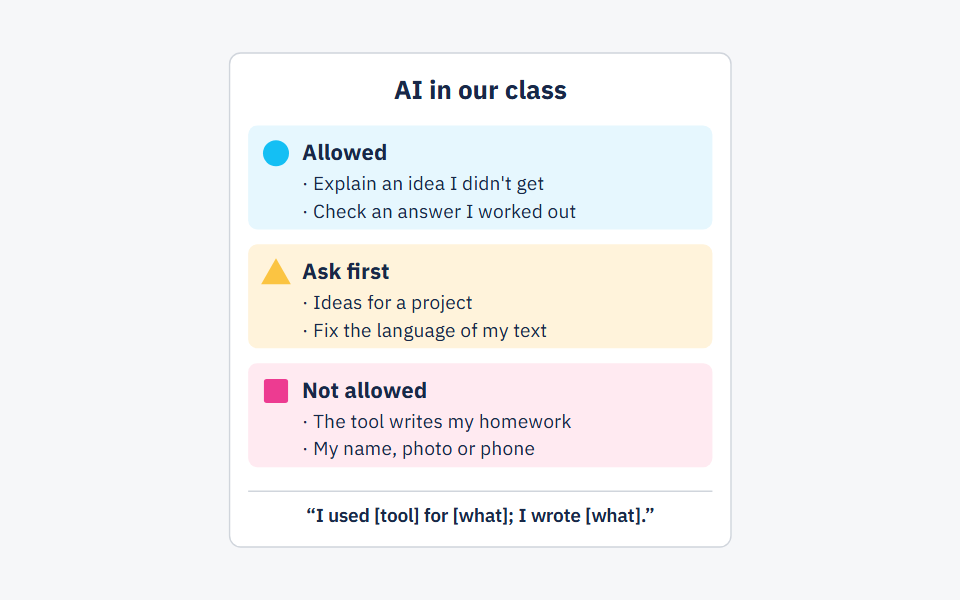
If you suspect a piece of homework, do not start with an accusation. Ask the student to explain what they wrote in their own words, or to solve a similar problem in front of you. What is and is not allowed belongs in your classroom AI policy, together with a line in which the student says when they used a tool and what for.
What these redesigns do not do
None of the six makes using a tool impossible. A tool can write the two reflective lines in the first task, invent numbers for the second, and write a reasoned decision for the sixth. What is hard to hand over to a machine is the moment the student is in front of you: the oral minute, the writing in class, the defence of a decision. So give every homework task a moment in class where you check what was written at home.
The redesigns have a price: lesson time that was not spent before. In large classes, spread the oral explanations over a week and let pairs check each other. Younger classes need a simpler form: the oral explanation and writing in class work at any age, but we suggest critiquing a tool's answers only for students who have used one with their teacher — UNESCO's guidance, as reported by UN News in September 2023, suggests considering an age limit of 13 for using these tools in the classroom.
Frequently asked questions
- How can I tell if a student used AI for homework?
- Do not rely on detectors; MIT Sloan reports high error rates. Ask the student to explain what they wrote in their own words, or to solve a similar problem in front of you, and look at their drafts if you asked for them.
- Should I ban students from using AI for homework?
- A total ban cannot be enforced at home. Set out what is and is not allowed on a page students read, and design homework so their understanding shows.
- What assignments can ChatGPT not do?
- There is no written assignment a tool cannot produce something for. The hardest to hand over are those that need what it does not know — your class's data, your discussion in the lesson — and those completed in front of you in class.
- Don't these tasks add to my marking?
- Some reduce it: four problems instead of ten, half a page of notes instead of a report. Others move the time into the lesson, like the oral explanation. That is why we suggest one or two per unit, not all six.
Sources
Every fact in this post that we did not produce ourselves comes from one of these sources.
- AI Detectors Don't Work. Here's What to Do Instead. — MIT Sloan Teaching & Learning Technologies, Undated page (read 2026-10-22)
- Principles for AI Guidance (AI Guidance for Schools Toolkit) — TeachAI, 2025
- About a quarter of U.S. teens have used ChatGPT for schoolwork – double the share in 2023 — Pew Research Center, 2025-01-15
- Sharjah schools introduce new AI rules: What changes for homework and exams? (Nandini Sircar) — Khaleej Times, 2026-10-21
- UNESCO calls for regulations on AI use in schools — UN News, 2023-09-07
Written with String's editorial team: we use AI for research and first drafts, and a person checks every fact and every source before anything is published. How we write
Founder and CEO, String
“I grew up in a house of teachers.” I spent a year designing the STEM program for one of the largest school groups in Saudi Arabia, have written curriculum by hand, trained robotics coaches and sold software into schools, then left that job to build String in Amman.