A school exam calendar that prevents pile-ups
Collect the date of every graded assessment from teachers through one form with one deadline, and put them in a grid: classes in the rows, weeks in the columns. Pile-ups show before they happen, and a rule your school decides — such as no more than two graded assessments a day per class — settles them.
Assessment calendar: the period grid
A free printable PDF, no sign-up.
This template is for the academic head or exams coordinator in a school where each teacher sets test dates alone. The result is familiar: a class with three tests on Tuesday and nothing for the rest of the week, and parents who hear about a test the evening before.
- Definition
- School exam calendar: One schedule the school owns, holding the date of every graded test and project in every class, built before the period starts and published to teachers, students and families.
The template: a grid of classes and weeks
Each cell holds the number of graded assessments that class has that week. The numbers in the example are sample data, for four classes over a six-week period, in a school that has decided on no more than four graded assessments per class per week.
| Class | Week 1 | Week 2 | Week 3 | Week 4 | Week 5 | Week 6 |
|---|---|---|---|---|---|---|
| 7A | 2 | 3 | 6 | 1 | 2 | 4 |
| 7B | 1 | 2 | 4 | 2 | 3 | 5 |
| 8A | 2 | 3 | 3 | 4 | 1 | 2 |
| 8B | 4 | 1 | 5 | 2 | 2 | 3 |
Three cells go over the limit: classes 7A and 8B in week 3, and class 7B in week 6. Nobody sees this in teachers' separate schedules, because each teacher sees only their own test. When a cell shows up, look at the days of that week.
| Day | Before | After |
|---|---|---|
| Sunday | Maths test (major) + short science quiz | Maths test (major) |
| Monday | Short Arabic quiz | Short Arabic quiz |
| Tuesday | English test (major) + social studies test (major) + computing project due | English test (major) |
| Wednesday | — | Social studies test (major) |
| Thursday | — | — |
Before: 6 assessments in the week, 3 of them on Tuesday, two of those major tests. After: 4 in the week and no more than one a day. The short science quiz moved to Sunday of week 4 and the project deadline to that Thursday, so week 4 now has three assessments instead of one — still under the limit.
The rule: a school decision, not a law
The rule below is our suggestion, not official guidance; if your education ministry or your school's leadership has rules on the number of tests, those come first. What matters is that the school agrees its rule in a meeting, writes it down, and publishes it to teachers and families before the period starts.
- No more than two graded assessments a day per class, and no more than one of them major. In this rule, a major test is one worth more than 10% of the subject's term grade, or one that takes a full lesson.
- No more than four graded assessments a week per class.
- Official exam weeks, monthly or final, have their own timetable: enter them in the grid as they are, and set no project deadlines in the week before them.
- Ungraded practice does not count towards the limit. A practice quiz is a form of what John Dunlosky and colleagues, in a review published in January 2013, call practice testing. Together with spreading study out over time, it received the highest overall utility rating among the ten learning techniques they reviewed — so do not let the rule become a reason to cut it.
A calendar published early has another benefit, as we see it: students know their dates weeks ahead, so they can spread revision over several days instead of one night — the distributed practice the same review rates so highly.
Collecting dates: one form, one deadline
Send the form three weeks before the period starts
Its fields: teacher, subject, class or classes, type of assessment (major, short or project), date, weight in the term grade, the lessons it covers, and a fallback date. What the teacher puts in the test itself — questions and marks — belongs in the unit test blueprint.
Close the form after five school days
Anything that arrives after the deadline takes the empty cells only. No teacher announces a date to students before it has gone through the form.
Build the grid and shade what goes over
One coordinator owns the grid: they count each class's assessments for each week, then look at the days behind the shaded cells and mark any day with more than two assessments or more than one major test.
Resolve pile-ups in a published order
A major test comes before a short one, the earlier form entry before the later, and a project deadline moves before a test does, because it is easier to move. The coordinator suggests a new date to the teacher, and the principal settles anything not agreed.
Publish the calendar a week before the period starts
Teachers get the whole grid; students and families get their own class's calendar only.
After publication, changes go through the coordinator only
With at least a week's notice, announced to families on the same channel the calendar was published on, giving the old date and the new one.
In String OS, every class has a calendar, and the school has one calendar that holds them all, so the dates sit in one place.
Publishing to families: before the period, on the same channel every time
The Education Endowment Foundation's guidance report “Working with Parents to Support Children's Learning” (UK, 2018) says that in secondary school the evidence is strongest for giving parents factual information about their children's progress and about upcoming tasks such as tests. In a trial the report describes, in UK secondary schools with 15,000 students, the dates of upcoming tests were part of weekly texts to parents, and parents who received them were nearly three times as likely to talk to their child about revising for an upcoming test.
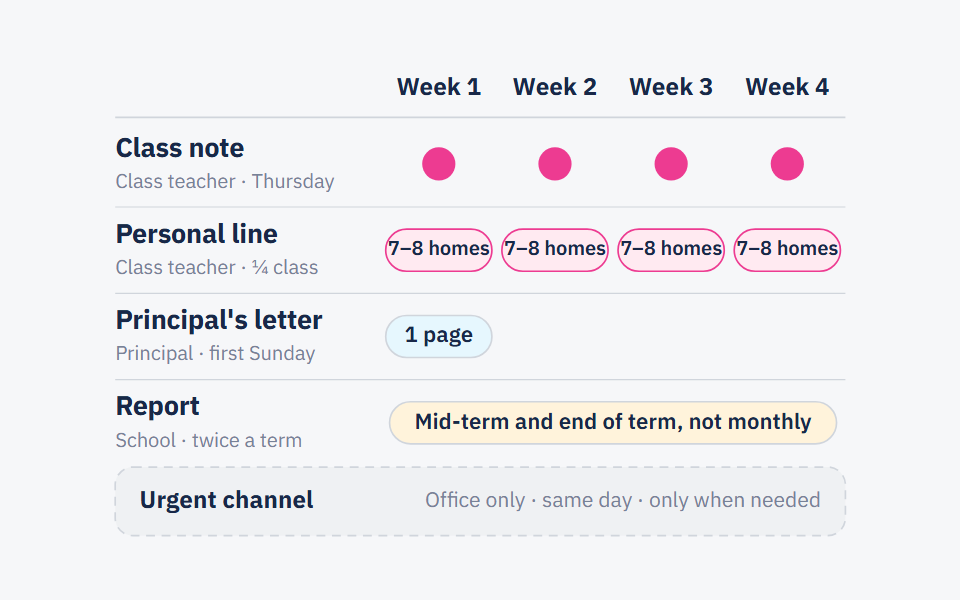
- The whole period once: their own child's class calendar, not the whole school grid, in the principal's letter at the start of the period.
- Next week's tests every week: in Thursday's class note, as in a weekly parent-communication rhythm.
- A tip parents can use: the report suggests messages about study — a reminder to revise for an upcoming test, or to make a revision plan — rather than curriculum content parents do not know how to respond to.
- Every change on the same channel: with the old date and the new one, so families never hold two calendars.
Three mistakes that bring the pile-ups back
- A calendar built after teachers announce their dates. Once students know a test date before the coordinator does, moving it looks like a climb-down in front of the class. Put the form before any announcement.
- Counting only major tests. A class with one major test, three graded quizzes and a project due in the same week is piled up, even if its week looks light on the exam timetable.
- A grid everyone can edit. If every teacher can change the calendar, it goes back to how it was. One person edits; everyone else asks.
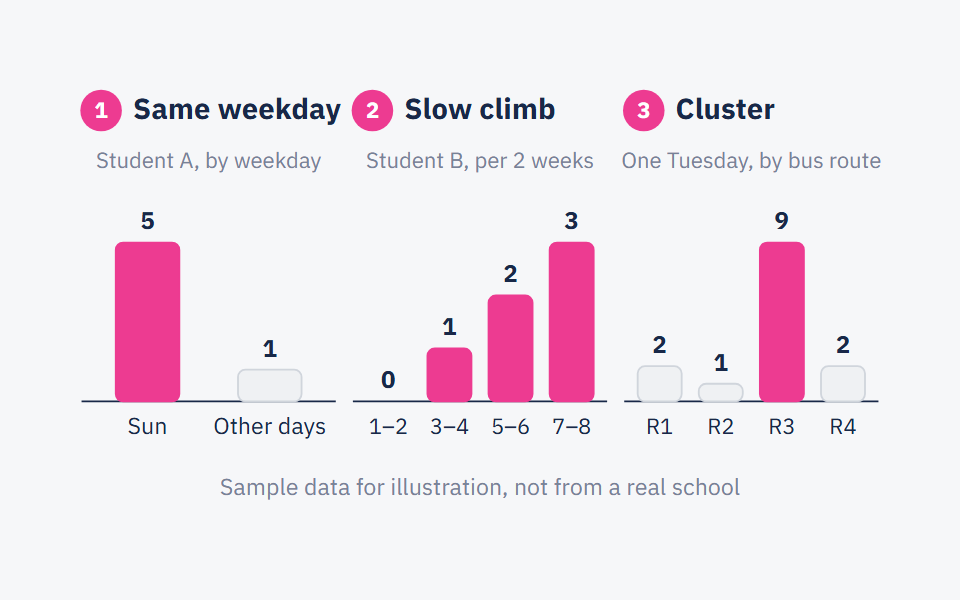
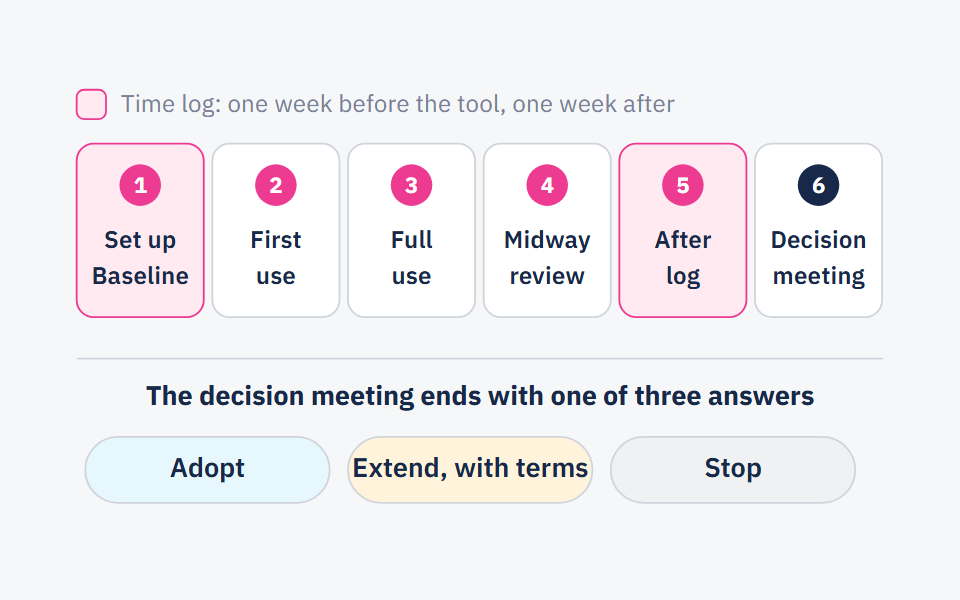
Before each major test, the checks before you print an exam help the teacher review the paper itself. If absences cluster on test days, that is one of the patterns in how a school can spot absence patterns early. And if the school decides to move the calendar onto a platform, try it for one period with a six-week pilot plan.
Frequently asked questions
- How many tests a day is reasonable for a student?
- No single number suits every school, and your education ministry's rules come first if it has them. We suggest no more than two graded assessments a day per class, only one of them major — with the school writing down and publishing whatever rule it decides.
- How do I make a school exam calendar?
- Send teachers one form three weeks before the period, close it after five days, put the dates in a grid of classes and weeks, resolve whatever breaks the rule, and publish it a week before the period starts.
- When should the exam calendar go out to families?
- A week before the period starts: their child's whole class calendar. After that, next week's tests come in the class note every week.
- Do short quizzes go on the calendar?
- Graded ones do, because they are part of a student's load. Ungraded practice quizzes do not count towards the limit, and should not be cut because of it.
Sources
Every fact in this post that we did not produce ourselves comes from one of these sources.
- Working with Parents to Support Children's Learning: Guidance Report (Matthew van Poortvliet, Nick Axford and Jenny Lloyd) — Education Endowment Foundation (EEF), 2018
- Which Study Strategies Make the Grade? (on Dunlosky, Rawson, Marsh, Nathan and Willingham, Psychological Science in the Public Interest, January 2013) — Association for Psychological Science, 2013-01-10
Written with String's editorial team: we use AI for research and first drafts, and a person checks every fact and every source before anything is published. How we write
Founder and CEO, String
“I grew up in a house of teachers.” I spent a year designing the STEM program for one of the largest school groups in Saudi Arabia, have written curriculum by hand, trained robotics coaches and sold software into schools, then left that job to build String in Amman.