A six-week pilot plan before your school adopts any platform
Pilot the platform for six weeks in two or three classes, with criteria written before you start and teacher time measured before and after, then close with a decision meeting that has three possible answers: adopt, extend with terms, or stop. Here is the plan week by week, with a page to print.
The six-week pilot plan
A free printable PDF, no sign-up.
This plan is for the principal or academic head who has come out of the demos with one or two platforms and wants to know, before signing, whether it will work in their own school's classes. Six weeks is enough for a structured pilot without eating the term, and it ends in a meeting that produces one written decision.
A pilot is one stage of a longer path. In a US study by The Decision Lab in 2022 of more than 225 edtech decision-makers in school districts, reported by EdSurge in June 2024, the decision moves through four stages: find the need, evaluate, pilot, purchase. The pilot barriers it names include too little time to test programs properly, feedback gathered without structure, hesitation to drop a program after an initial trial, and keeping a tool because of how much has already been invested in it. The plan below is built to avoid those four.
What you need before week one
- A need written in one sentence. For example: “Our Grade 8 teachers write a short quiz every week and mark it by hand, and we want that to take less time.” A pilot that does not know what it is testing does not end in a decision.
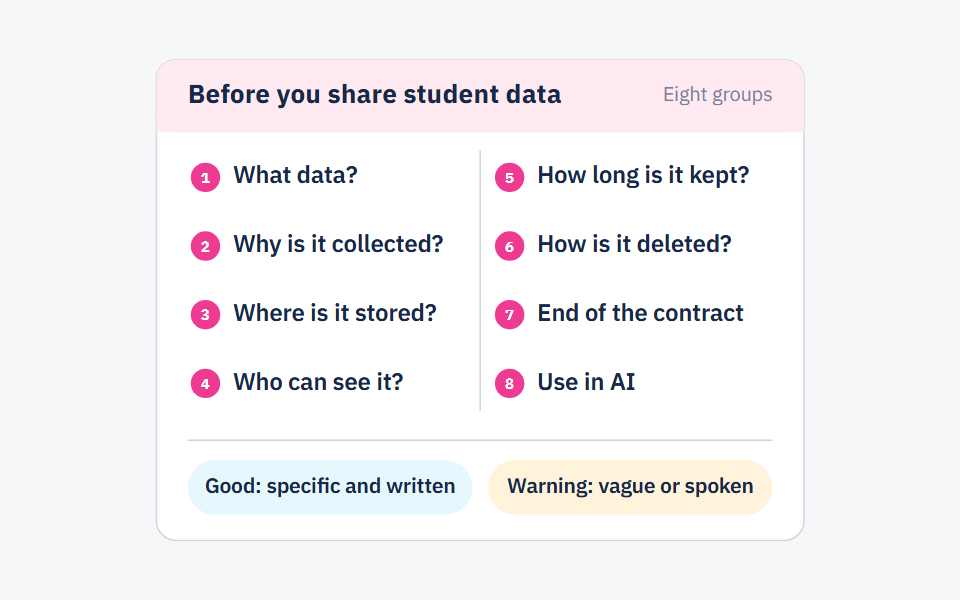
- A platform that has passed evaluation. That means it has answered the student data questions in writing before any student logs in. Do not leave those questions until after the pilot.
- Two or three classes, and two or three teachers. Include at least one keen teacher and one doubtful one; a pilot run by enthusiasts alone measures their enthusiasm.
- One person who owns the pilot. They collect the logs, sit in on lessons and write the decision page. Ideally, not the person who proposed the platform.
- Decision criteria written in advance. Three to five criteria, each with a clear threshold, written before week one and not changed after it. The example below is a full page of them.
- A written agreement with the platform. How long the pilot runs, who supports the teachers during it, and what happens to the data if you decide to stop.
The plan, week by week
| Week | What happens | Who | What you collect |
|---|---|---|---|
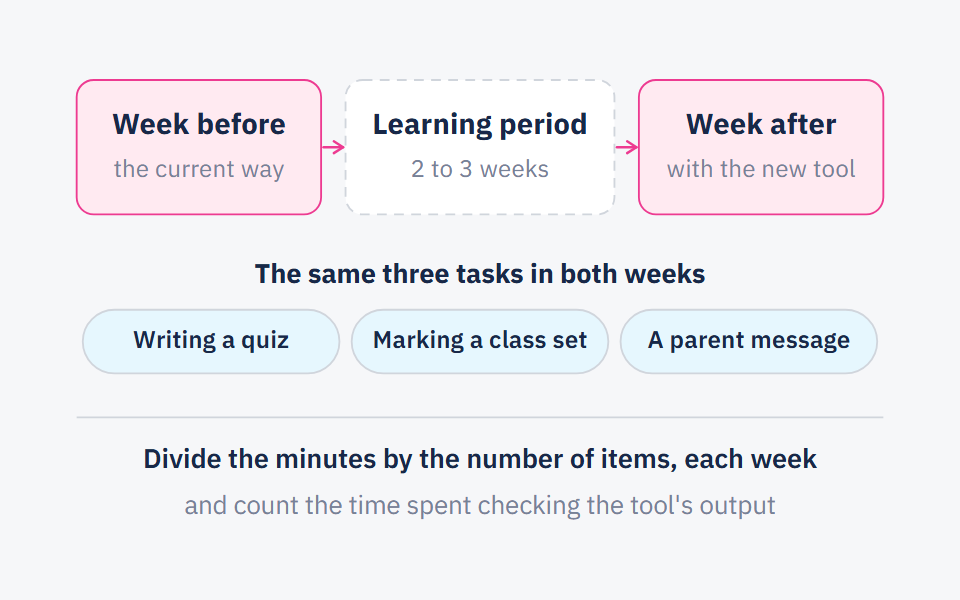
| 1. Set-up and baseline | Accounts created and one short training session. Teachers log the time three tasks take the current way, before they use the platform for them | The pilot lead, the teachers and the platform's team | The “before” time log, and teachers' answers to a short fixed set of questions |
| 2. First use | Each teacher uses the platform for at least one task; the pilot lead sits in on one lesson per teacher | Teachers and the pilot lead | The problem log: what broke, when, and how long it took to fix |
| 3. Full use | The platform is used for all three tasks, and students answer a few short questions | Teachers and students | Students' answers, and the problem log |
| 4. Midway review | A short meeting with one question: has a red line appeared that stops the pilot? The criteria do not change | The pilot lead and the teachers | A decision to continue or stop early |
| 5. After log | Teachers log the time the same three tasks take with the platform, including the time spent checking what it produces | Teachers and the pilot lead | The “after” time log, and a ten-minute interview with each teacher |
| 6. Decision meeting | The pilot lead writes one page, the meeting is held, and the decision and its reason are written down | The owner or principal, the pilot lead, the teachers | The decision page |
Why does the “after” log come in week five, not week two? Because in their first days with any new tool, teachers are still learning it, and timing those days measures the learning, not the tool. The full method for the log, with its three tasks and the arithmetic, is in how to measure the teacher time a tool really saves.
What to measure: four measures are enough
- Time. Minutes per item for the three tasks before and after the platform, including the time spent checking what the platform produces.
- Use. How many of the pilot teachers are still using the platform in week five without being reminded. This measure tells you what a survey cannot.
- Opinion, with fixed questions. Five short questions for teachers in weeks one and five, and three for students in week three, worded the same way every time. The study EdSurge reported recommends structured surveys, interviews and observation that give clear, usable data.
- Problems. A log of every fault or question: when it happened, how long it took to fix, and who fixed it. Any problem with student data is a red line that stops the pilot at once.
The need: three Grade 8 science teachers write a short quiz every week and mark it by hand. These are example criteria, not pilot results.
| Criterion | We adopt if | We stop if |
|---|---|---|
| Time | Minutes to write and mark the quiz went down for at least two of the three teachers, checking time included | Time went down for no teacher, or went up |
| Use | All three teachers are still using it in week five | Two teachers stopped using it before week five |
| Teachers' view | Two of the three answer “yes” to “Do you want to keep using it?” | All three answer “no” |
| Students | Students handed in the quiz on the platform at the same rate as on paper, or higher | They handed it in at a lower rate, and the midway review found no reason |
| Data | No problem with student data, and the data questions answered fully in writing | Any data problem, or an incomplete answer |
Anything in between: we extend the pilot by four weeks with one written condition, then decide. Nothing that was not written here before week one is added to the criteria afterwards.
The decision meeting: one hour, three answers
Send the decision page two days before the meeting
One page: the criteria and their thresholds, what was measured against each, what teachers and students said, and the problem log. Whoever reads it for the first time in the meeting judges on impressions.
Start with the teachers who ran the pilot
Let them speak before the leadership does, so nobody simply follows the most senior person in the room. The study EdSurge reported lists groupthink among the barriers at the purchase stage.
Compare against the written criteria, not impressions
Read each criterion and its threshold, and write next to it: met, not met, or in between.
Choose one of three answers
Adopt, with a plan for the rest of the staff. Or extend with terms: a set period and a written condition. Or stop, with a written request to export the data you need and then delete it.
Write the decision and its reason in two lines
Whoever reviews it next year will need the reason more than the result.
In the meeting, watch for the two barriers the same study names: hesitating to drop a program after an initial trial, and keeping it because of how much has already been invested in it. Stopping after six weeks costs less than stopping after a year.
When a pilot is not enough
- Six weeks measure the start, not the year. A pilot will not show how the system copes with exam season or with a teacher who joins mid-year. Ask a school that has used the platform for at least a year.
- Volunteers are not the whole staff. What worked for three teachers who chose to try it may need more support with everyone else, so plan for that in the roll-out.
- Time saved is not guaranteed. In a Gallup and Walton Family Foundation survey of 1,952 US K-12 educators, published on 14 October 2026, 29% of those who used AI tools in the 2025–26 school year said it made no difference to their time, and 7% said it cost them time instead of saving it. Measure before you assume.
- A free trial can end before the decision. Agree in writing what happens to the data after the last day, as in the end-of-contract question in the student data questions.
Frequently asked questions
- How long should an edtech pilot last?
- Six weeks is usually enough for weekly, repeated tasks: a week to set up, three weeks of use, a week to measure and a week to decide. If the platform handles termly work such as report cards, extend the pilot to cover at least one of those deadlines.
- How many classes should take part?
- Two or three classes with their teachers are enough for a structured pilot. More is hard for one person to follow; fewer turns the result into one teacher's opinion.
- Should we tell parents about the pilot?
- Yes, if students will use the platform or their data will reach it. A short message is enough: which platform, why, for how long, what data it receives, and whom to ask if they have a question.
- How do I choose a learning platform for my school?
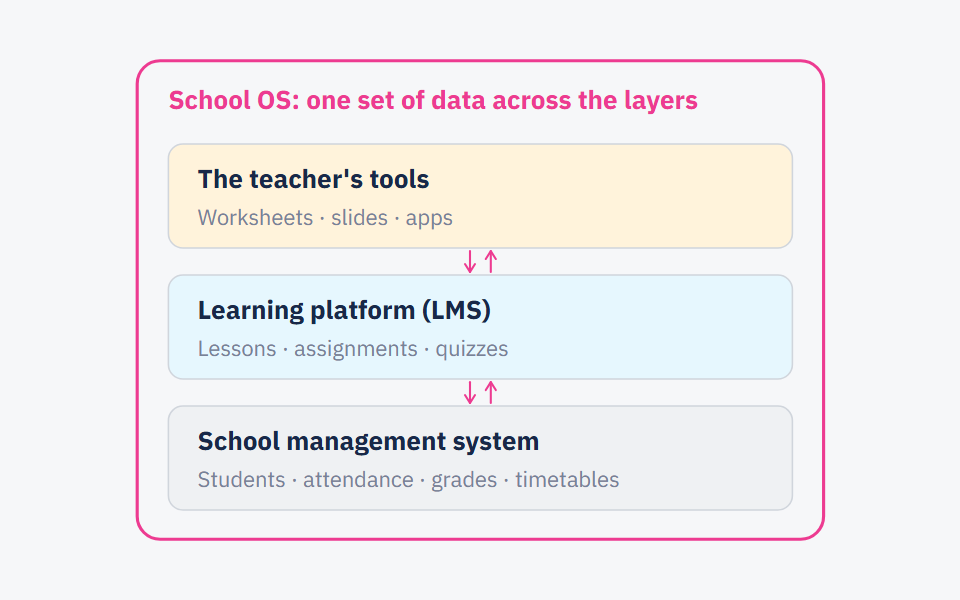
- Write the need in one sentence, send the data questions in writing, narrow the options to two, then pilot one with this plan. If you are not sure which kind of system you need, start with the difference between a school management system, an LMS and a school OS.
Sources
Every fact in this post that we did not produce ourselves comes from one of these sources.
- How District Leaders Make Edtech Purchasing Decisions (Caitlin McLemore and Jayden Rae) — EdSurge, 2024-06-24
- Teachers Using AI Say It Frees Up Time for What Matters Most (Megan Brenan) — Gallup, with the Walton Family Foundation, 2026-10-14
Written with String's editorial team: we use AI for research and first drafts, and a person checks every fact and every source before anything is published. How we write
Founder and CEO, String
“I grew up in a house of teachers.” I spent a year designing the STEM program for one of the largest school groups in Saudi Arabia, have written curriculum by hand, trained robotics coaches and sold software into schools, then left that job to build String in Amman.