A weekly parent-communication rhythm your school can keep
Five kinds of message, each with a fixed sender, day, length and one channel: a class note every Thursday, a personal line to every family once a month, the principal's letter at the start of each month, a report twice a term, and an urgent channel used only for what cannot wait. Here is the full calendar, with a page to print.
Our school's parent-communication rhythm
A free printable PDF, no sign-up.
This calendar is for the principal or academic head whose school reaches parents from every direction at once: a teacher posting in a group, the office sending a text, a printed notice in the school bag, then weeks of silence. The answer is not more messages. It is a fixed rhythm that parents and teachers both know: what arrives, when, from whom, and where.
- Definition
- Parent-communication rhythm: A fixed schedule a school agrees on, giving each kind of message it sends home one sender, one day, one length and one channel, so parents know where to find each piece of news and when to expect it.
The calendar: five kinds of message on one page
This is a starting point we suggest, not an official form. Change the days to fit your school's week, and keep the rule as it is.
| Message | Sent by | When | Length | Channel | What it holds |
|---|---|---|---|---|---|
| Weekly class note | Class teacher | Every Thursday before the end of the day | Five lines at most | The class channel in the school's app or platform | What the class learned this week, next week's dates and tests, and one thing to do at home |
| Personal line | Class teacher, and a subject teacher when needed | A quarter of the class each week, so every family hears once a month | One or two sentences | A private message to the parent | One thing the student can improve now, with an example from their work |
| Principal's monthly letter | Principal | First Sunday of each month | One page, about 300 words | Email or the app, and a printed copy on request | What changed at school, the month's dates, one decision and the reason for it, and a question for parents |
| Report | Teachers, signed by the principal | Twice a term: at mid-term and at the end | One page per student | The app, or a sheet handed over at a meeting | Where the student stands in each subject, and the next step |
| Urgent channel | The office only | The same day, only when needed | Two sentences | Text message or phone call | A closure, a safety matter, a change to today's timetable, or a sick child |
The rule that makes the calendar work: one channel per kind of message. If test dates arrive once in the class group, once by text and once on paper, parents cannot tell which is the latest. If the urgent channel is used to remind families about a sports day, nobody opens it quickly on the day something urgent really happens.
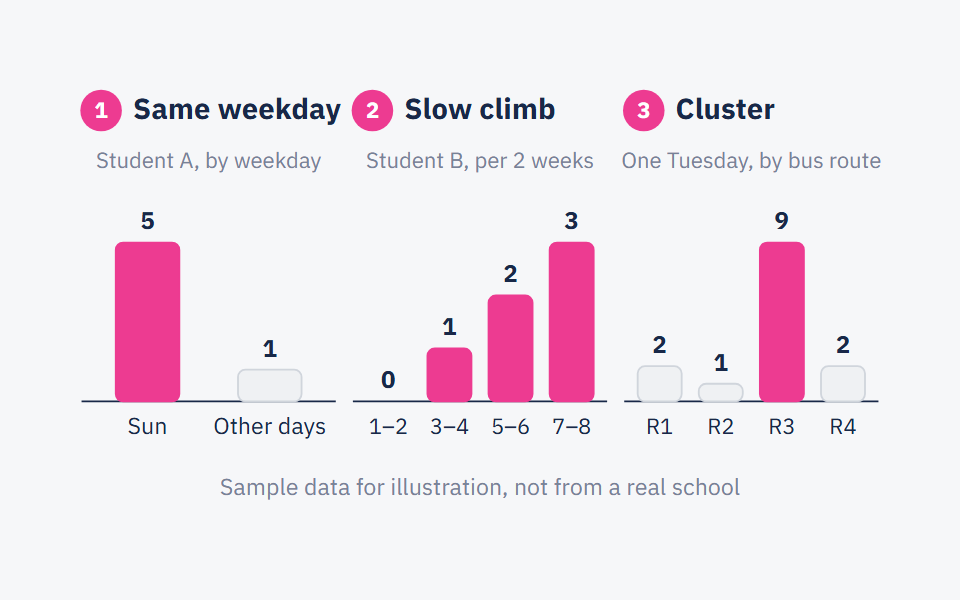
Messages that do not appear in the calendar still have a place in it. An absence message is a personal line that states the total days missed, as in how a school can spot absence patterns early. And the test dates in the class note come from the school exam calendar, not from each teacher's memory.
Two ready examples: the class note and the principal's letter
Both examples were written for this post; the class and the dates are made up. Put your own class's details in the brackets.
Grade 5B — Thursday. This week we compared fractions in maths and read a story about water in Arabic. Next week there is a short science quiz on Tuesday on the parts of a plant. At home: ask your child which is bigger, a half or a third, and why. Any questions: [teacher's name], on the class channel.
A personal line, for example: “[Student's name] writes out every step of the working, and still forgets the unit in the final answer. If you ask about the unit in each problem this week, that is enough.”
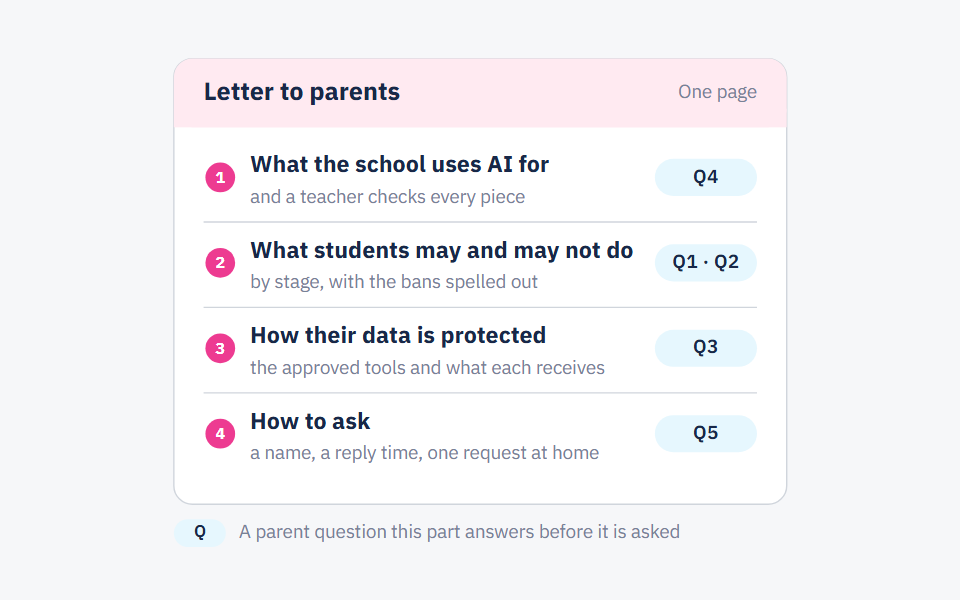
- What changed this month: one paragraph on what happened at school that matters to parents, not a list of events.
- Next month's dates: tests, meetings and holidays in a short table, with the date and the day.
- One decision and its reason: a new start time, say, or a new rule on phones, and who to ask about it.
- One question for parents: answered in a line, such as “What would you like to know about your child's learning that you do not hear now?”
Why this shape: what the evidence says
The Education Endowment Foundation's guidance report “Working with Parents to Support Children's Learning” (UK, 2018) says that well-designed school communications with parents can improve attainment and other outcomes, attendance among them. Its examples include weekly texts from school to parents and short termly letters. Messages are likely to work better, it says, when they are personalised, linked to learning and positive, and communication should run both ways.
The report describes a trial in UK secondary schools involving 15,000 students. Parents received a weekly text for a year, 30 in all, giving the dates of upcoming tests, whether homework was handed in on time, and what their children were learning. Children whose parents got the texts made one month's additional progress in maths and had reduced absenteeism, and their parents were nearly three times as likely to talk to them about revising for an upcoming test.
In the US, a working paper by Matthew Kraft and Todd Rogers, published by the Harvard Kennedy School in October 2014, tested weekly one-sentence individualised messages from teachers to the parents of high school students in a credit recovery programme. The share of students who failed to earn course credit fell from 15.8% to 9.3%, mainly because fewer dropped out. Messages about what students could improve had larger effects than messages about what they were doing well.
The EEF report also warns that there is such a thing as too many texts, and suggests that a school chart how many messages already go out before it adds any. It cites a survey of more than 1,000 parents in England: after news of their child's progress, what parents most want is to know what their child is learning, while what they tend to receive is news of general school activities, policies and administration.
None of this evidence prescribes a particular calendar; the one above is our suggestion, built on three of its findings: a short weekly message about learning, a personal line about improvement, and a limited number of messages. The Harvard study sent the personal line every week. That is a heavy load for a class teacher with 30 students, so we suggest a quarter of the class each week — seven or eight lines — which reaches every family once a month. Anyone who can do more should.
How to launch the rhythm in two weeks
Count what goes out now
Ask teachers and the office for every message sent to parents over two weeks: who sent it, on which channel, and why. You will usually find more channels than you expected, and messages repeated in more than one place.
Give each kind one channel and one sender
Fill in the calendar with your school's own channels. Write down, plainly, what is no longer sent on each channel; a rule nobody writes down is a rule nobody keeps.
Write a template for each message
The five-line class note, the personal line, and the four parts of the principal's letter. Messages to parents: ready templates gives teachers wording for the other situations.
Announce the rhythm to parents in one letter
In the principal's first letter: what will arrive, when, from whom, where to ask, and when you will reply. Ask who needs a phone call or a voice message instead of text, or messages in another language.
Ask parents after six weeks
Three short questions: Do the messages reach you? Too many or too few? What would you like to know that you do not hear? The EEF report notes that around half of parents say they have not been consulted about how they can be involved.
Track whether it is kept, not how much is sent
One question at the weekly leadership meeting: did every class note go out on Thursday? A class whose note did not go out needs help, not a general reminder to everyone.
In String OS, class and school messages reach parents in the family app, alongside attendance, grades and absence requests.
When the rhythm breaks
- An urgent channel used for everything. The first reminder about a concert sent on it teaches parents to ignore it. Limit sending on it to one or two people in the office.
- A rhythm that depends on every teacher's energy. It stops in exam week. A fixed template and five lines make the note a short job; the leadership's weekly check makes it a habit.
- Parents who are not reached by writing. The EEF report says face-to-face conversations, phone calls and text messages are likely to work better with less involved parents than generic emails or letters home.
- One-way traffic. The calendar describes what leaves the school; parents also need to know where they can write and when they will hear back — within two working days, for example.
- A new subject on the wrong channel. When the school has something that needs explaining, such as what to tell parents about its use of AI, it belongs in the principal's letter, not on the urgent channel or in the class group.
Frequently asked questions
- How often should a school communicate with parents each week?
- One group message from the class each week is usually enough, with personal lines spread across the weeks and one letter from the principal a month. Anything beyond that should be for something that cannot wait.
- What is the best way for a school to communicate with parents?
- Whatever every family can reach, as long as each kind of message has one channel: one for routine messages, and a text or call for urgent ones. With less involved parents, the EEF report says conversations, calls and texts work better than generic email.
- Should teachers answer parents' messages at any hour?
- No. Say in the announcement letter when messages are answered — within two working days, for example — and that urgent matters go to the office, not to the teacher.
- What goes in the principal's monthly letter?
- Four parts on one page: what changed this month, next month's dates, one decision and its reason, and one question for parents to answer.
Sources
Every fact in this post that we did not produce ourselves comes from one of these sources.
- Working with Parents to Support Children's Learning: Guidance Report (Matthew van Poortvliet, Nick Axford and Jenny Lloyd) — Education Endowment Foundation (EEF), 2018
- The Underutilized Potential of Teacher-to-Parent Communication: Evidence from a Field Experiment (Matthew A. Kraft and Todd Rogers), HKS Faculty Research Working Paper RWP14-049 — Harvard Kennedy School, 2014-10
Written with String's editorial team: we use AI for research and first drafts, and a person checks every fact and every source before anything is published. How we write
Founder and CEO, String
“I grew up in a house of teachers.” I spent a year designing the STEM program for one of the largest school groups in Saudi Arabia, have written curriculum by hand, trained robotics coaches and sold software into schools, then left that job to build String in Amman.