A home reading plan: 15 minutes a day by age
Set aside a quarter of an hour each evening: you read to your child, you take turns, or they read alone, depending on age, then talk for a few minutes with one question that fits. Start tonight with a book they choose and one question after it.
The weekly reading chart — printable
A free printable PDF, no sign-up.
Your child does not need an hour of reading a day, or a big library. They need a fixed time, a book that fits, and a short conversation afterwards. The fifteen minutes in this plan are a routine we suggest because it fits an ordinary evening; they are not a number from research. They are close to what UNICEF's page “How to teach your child to love reading” says: that 10 to 15 minutes a day with a book is enough to spark a young child's interest. What the research agrees on more clearly is what happens between the two of you while you read.
- Definition
- Shared reading: An adult and a child reading one book together — one reads, or they take turns — stopping to talk about the words, the pictures and what happens, so the child is never only a listener.
The plan by age: who reads, and how the minutes go
In 2018 the UK's Education Endowment Foundation published a guidance report for schools, “Working with Parents to Support Children's Learning”. It says that for young children, shared reading should be central to what schools ask of parents, and that the conversations between parent and child during it are thought to be the key ingredient of its success. It suggests a focus that changes with age: in early primary, activities on reading itself, such as letter sounds and word reading; in later primary, shared reading that builds comprehension; in secondary, independent reading. The three bands below follow that order, with independent reading brought forward a little: at ten a child can read alone, but the talk afterwards stays.
| Age | Who reads | The fifteen minutes | What you do while reading |
|---|---|---|---|
| 4 to 6 | You, aloud | 10 reading, then 5 talk | Point at the pictures, change your voice for each character, and let them finish a sentence they know by heart |
| 7 to 9 | You take turns: a page each | 12 reading, then 3 talk | If they stop at a word: wait a moment, give a clue rather than the answer, then praise them when they get it |
| 10 to 12 | They read alone, with you nearby reading your own book | 12 reading, then 3 talk | Do not interrupt; they mark each word they did not understand and ask you about it afterwards |
The method in the 7-to-9 row is what the same report calls “pause, prompt, praise”: pause to let the child work out a word if they get stuck, give a prompt or clue but not the answer, and praise them when they concentrate and solve it. A clue can be “Look at the first letter” or “What would fit the picture?”
The reading week: Arabic and English in one chart
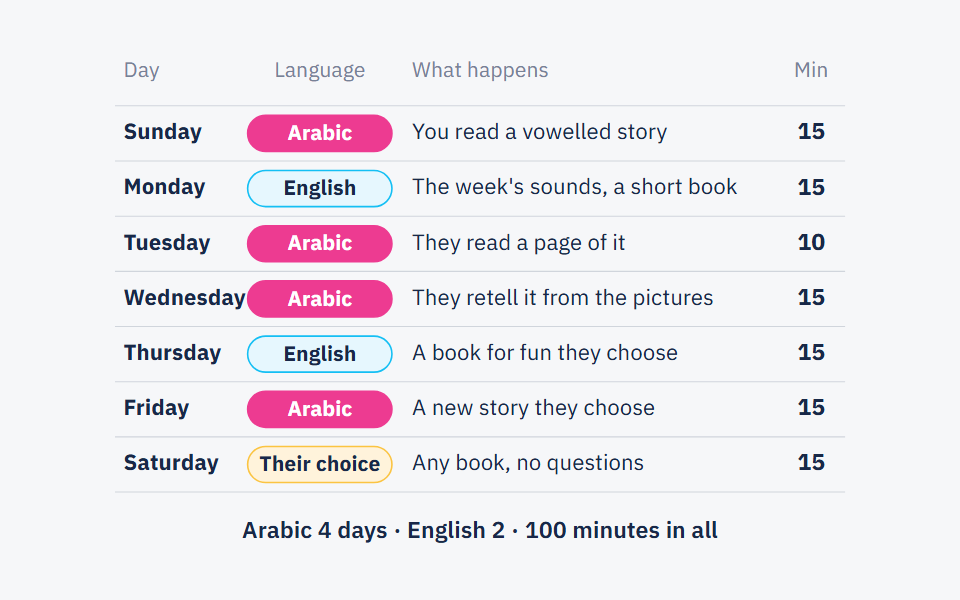
If your child studies Arabic and English, do not mix the two languages in one session. Give each day one language, and give the language they need most more days, with easier books. The example below is a split we suggest for an eight-year-old girl learning both languages; she is not a real child. Change it to suit your own child and your country's weekend.
| Day | Language | The book | After reading |
|---|---|---|---|
| Sunday | Arabic | The week's book, chapter one | The three questions for her age |
| Monday | Arabic | The week's book, continued | One question about a new word |
| Tuesday | English | A short picture story | The three questions — in Arabic if you prefer |
| Wednesday | Arabic | The week's book | She tells you what has happened so far, in two sentences |
| Thursday | English | The same story, read again | “What did you notice this time that you missed the first time?” |
| Friday | Her choice | Any book she likes, even a comic | No questions; reading for fun |
| Saturday | — | She picks next week's book from the shelf at home or the library | The five-finger check on one page |
Why this split: four days for Arabic because most of her subjects are taught in it, and two for English with one story read twice — a second reading of a known book is easier and leaves attention free for the meaning. One day has no questions, so reading does not become more homework.
If you do not read English, you can still take the English days: your child reads the page aloud, then explains in Arabic what happened in it, and you ask the three questions in Arabic. If they can retell a story in another language, they understood it rather than only read its words. Balancing the two languages over a longer stretch has a post of its own.
Three questions after reading, for each age
The EEF report suggests parents ask a range of questions — who, what, where, when and why; mix closed questions, answered in a word, with open ones that need a fuller answer; ask the child to summarise what has happened and predict what comes next; and link the story to real life. From those kinds we chose three questions per age, easiest first:
| Age | First question | Second question | Third question |
|---|---|---|---|
| 4 to 6 | “Who is in the story?” | “What do you think will happen next?” | “Has anything like this happened to you?” |
| 7 to 9 | “Tell me what happened in two sentences.” | “Why do you think the character did that?” | “Which word was new? What do you think it means?” |
| 10 to 12 | “What was the most important thing that happened today, and why?” | “Do you agree with the main character's decision? Why?” | “If you wrote the next chapter, what would happen in it?” |
- One question is enough on a tired evening. Three is the most, not the rule.
- Answer too. Give your own view of the character's decision after they give theirs, and it becomes a conversation, not a test.
- Do not correct an opinion. “Why did the character do that?” has no single right answer; just ask, “What in the story made you think so?”
How to pick a book at the right level: the five-finger check
The five-finger check is a rule of thumb, not a scientific test, and we know of no research that shows how accurate it is. But it gives you an answer in a minute, at the library or in front of the shelf at home. The National Literacy Trust's page “Reading with your child” advises letting children choose their own books, because it tells you what they enjoy — so leave the choice to them, and use the check to decide who reads the book: them, the two of you, or you.
Open a page from the middle of the book
Not the first page, which may be easier than the rest.
Your child reads it aloud
They raise a finger for every word they cannot read, or can read but do not know the meaning of.
Count the fingers
None or one: the book is easy, theirs to read alone for fun. Two or three: just right to read together, taking turns. Four or five: hard for now — read it to them, or save it for a month.
The check has limits. It measures words, not understanding, so ask one question about what happened on the page. Do not apply it to a book you read aloud to a four-to-six-year-old: in our view, a young child can follow harder stories by ear than they can read by eye, and the check measures reading, not listening. Our advice, if your child is just starting to read Arabic, is to choose books with full vowel marks (tashkeel): an unvowelled word may be hard because they do not know its vowels, not because they do not know its letters.
When the plan does not work, and when to ask the school
The plan fails when reading becomes a punishment or a test: “No games until you read”, or ten questions after every page. If your child refuses to read, drop the questions for a week, read to them yourself, and let them choose whatever they like. UNICEF's page says that if they are only reading comics right now, that's okay. A fixed time matters more than the book: after dinner or before bed, with the phone and television off.
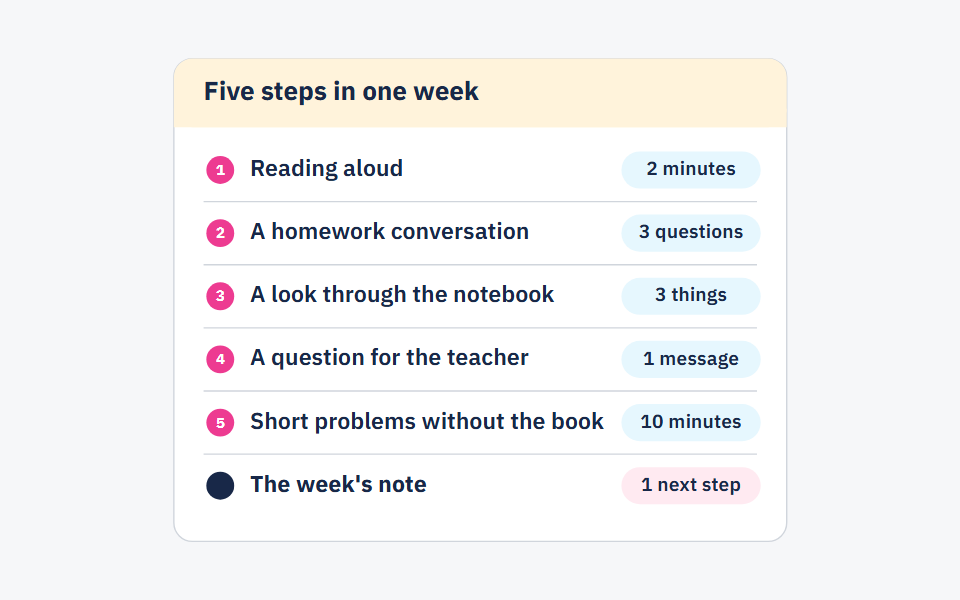
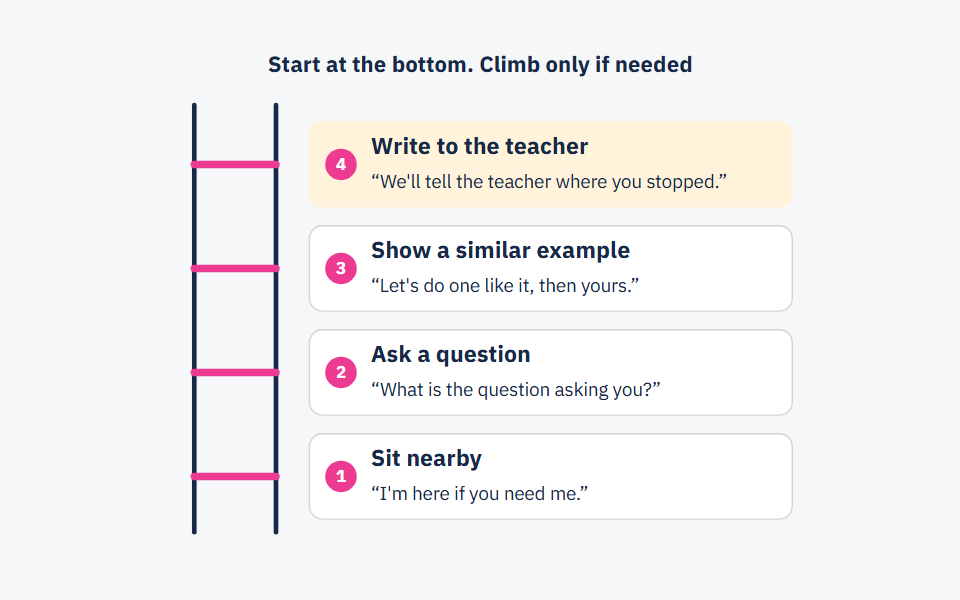
This plan is a home routine, not a diagnosis. If over several weeks you notice that your child still reads letter by letter after learning the letters at school, or avoids reading every time, talk to their teacher or the school counsellor, and ask for a specialist's view if the school advises it. How to know your child's level gives a calm way to observe this for a week before that conversation. And if reading is part of the homework, the limits of your help are in the homework help ladder.
Frequently asked questions
- How do I get my child to read?
- Give reading a fixed time each day, let them choose the book, and read your own book in front of them. Do not turn the talk afterwards into a test: one question is enough on tired days.
- Are 15 minutes of reading a day enough?
- Fifteen minutes is a routine we suggest because it fits an ordinary evening — not a ceiling and not a number from research; if your child wants to keep going, let them. In one programme described in the EEF report, for children below school age, parents spent 20 minutes a day on shared reading and language activities.
- Should I keep reading aloud to my child after they can read?
- Yes. UNICEF's page suggests taking turns reading aloud as children grow. In our view, reading them a book above their level introduces words and stories they cannot reach alone yet.
- What if my child doesn't like reading?
- Start with what they like: a topic they care about, comics, a magazine. Read to them some of the time even at ten, and drop the questions until they come back to books by choice.
Sources
Every fact in this post that we did not produce ourselves comes from one of these sources.
- Working with Parents to Support Children's Learning: Guidance Report — Education Endowment Foundation, 2018 (PDF undated in print; year from its text and file metadata)
- How to teach your child to love reading — UNICEF Parenting, undated (read 2026-10-22)
- Reading with your child — Words for Life (National Literacy Trust), undated (read 2026-10-22)
Written with String's editorial team: we use AI for research and first drafts, and a person checks every fact and every source before anything is published. How we write
Founder and CEO, String
“I grew up in a house of teachers.” I spent a year designing the STEM program for one of the largest school groups in Saudi Arabia, have written curriculum by hand, trained robotics coaches and sold software into schools, then left that job to build String in Amman.