Active learning in a maths lesson: five strategies with steps and timings
Active learning in maths means every student solves, writes and explains during the lesson, not only listens. Here are five strategies, from five minutes to twenty, each run on a Grade 6 lesson, with its steps, its exact sentences and the mistake that ruins it.
Active learning in a maths lesson — desk card
A free printable PDF, no sign-up.
- Definition
- Active learning: Teaching that engages students in the process of learning through activities or discussion in class; it emphasises higher-order thinking and often involves group work.
That definition comes from a review Scott Freeman and colleagues published in PNAS in May 2014. They analysed 225 studies and called it the largest and most comprehensive meta-analysis of undergraduate STEM education published to that date. Average exam scores were about 6% higher in active learning sections, and failure rates were 21.8% against 33.8% under traditional lecturing. But every one of those studies was of university students in science, technology, engineering and mathematics courses, not of Grade 6 pupils, so do not carry the numbers into your classroom. What you can take is an idea to test for yourself: students solve and explain during the lesson, instead of watching someone else solve.
The five strategies in one table
You do not need twenty strategies; five you know well are enough. Each one here is run on a Grade 6 maths lesson, with its minutes and what you say. The examples were written for this post, not copied from a textbook; change the numbers to fit your lesson.
| Strategy | Where it goes | Minutes | What it tells you | Preparation |
|---|---|---|---|---|
| Mini whiteboards | The review, or straight after modelling | 5 | Every student's answer at one moment | Boards, or paper in clear sleeves, once a year |
| Think, pair, share | After the worked example | 6 | How students explain the idea in their own words | One good question |
| Find the mistake | Guided practice | 6 | Whether students can see a mistake they might make themselves | One wrong worked example, written in advance |
| Card sort | Practice | 15 | How students connect different forms of the same idea | Printed cards cut into envelopes, reused every year |
| Gallery walk | An application lesson at the end of a unit | 20 | Whether students know more than one way to solve | Large sheets and sticky notes |
1. Mini whiteboards: every student's answer in five minutes
Lesson: comparing and ordering decimals. Goal: students compare two decimals and order a set of them. In “Classroom Assessment: Minute by Minute, Day by Day” (ASCD, November 2005), Dylan Wiliam describes teachers having all students write their answers on individual dry-erase boards and hold them up when asked, so the teacher sees the whole class's answers, not just those of whoever raises a hand.
Set up the boards once a year
A small whiteboard, or a sheet of white paper in a clear plastic sleeve, a dry-erase pen and a tissue. One board per student.
Ask the first question (30 seconds)
“Write a decimal between and . Write it, then turn your board face down. Nobody lifts it until I say.”
Lift together (10 seconds)
“Three, two, one: boards up.” Scan row by row. A student who writes “there is no number between them” is treating decimals as whole numbers, and that is what you will come back to.
Decide before you go on (30 seconds)
In “Principles of Instruction” (Spring 2012), Barak Rosenshine writes that the optimal success rate for student achievement appears to be about 80%. We suggest using it as a decision rule: if about eight boards in ten are right, move on and follow up the rest on their own. If far fewer are, model the example again a different way.
Three more questions (3 minutes)
“Which is bigger: or ?”, then “Order from smallest to largest: , , ”, then “Write another way.” The second question catches students who think the longer number is the bigger one.
The trap: boards going up at different times, so latecomers copy a neighbour and you see a class that is all correct. Lifting together on one signal is what makes the boards measure anything.
2. Think, pair, share: a minute of silence before anyone talks
Lesson: ratio. Goal: students write a ratio between two quantities in simplest form, and tell a part-to-part ratio from a part-to-whole ratio. Among the ways to involve every student that Rosenshine lists in the same article: have each student tell the answer to a neighbour, or write a short summary and share it with one.
Write the question on the board
“A class has 12 girls and 18 boys. Write the ratio of girls to boys, then the ratio of girls to all the students in the class, both in simplest form.”
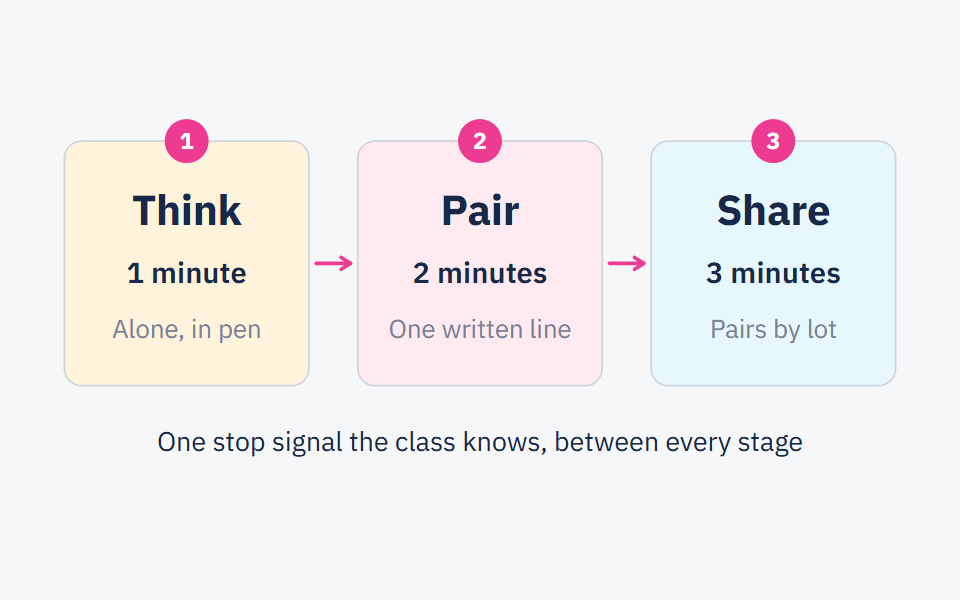
Think: one silent minute
“One minute, on your own, answer in pen in your notebook. No talking yet.” The written answer is what stops the faster student doing the thinking for both.
Pair: two minutes
“Compare your answer with your partner's. If they differ, do not just pick the right one; find the step where you first disagree.” In this question the disagreement usually sits in the second ratio: whoever wrote the same ratio twice did not count the whole class.
Share: three minutes
Pick pairs at random, not from raised hands; Wiliam describes teachers drawing names written on sticks from a cup. “I'll pick a pair, and one of you will explain what your partner said, not what you said.” Write both ratios on the board in the students' words.
The trap: cutting “think” to ten seconds, so “pair” becomes a private lesson from the faster student. The full steps, with ready questions for other subjects, are in the think-pair-share guide.
3. Find the mistake: one wrong worked example on the board
Lesson: order of operations. Goal: students evaluate a numerical expression in the correct order of operations. The Education Endowment Foundation's guidance report “Improving Mathematics in Key Stages Two and Three” recommends worked examples and says they may be complete, incomplete or incorrect — deliberately containing common errors for learners to uncover — and that analysing and discussing them deepens understanding.
Show the wrong working (30 seconds)
Write on the board: . Then say: “There is one mistake in this working. Don't solve it again; put your finger on the step where the mistake starts.”
On your own: one minute
Each student circles the wrong step and finishes the sentence: “The person who wrote this thought that…”
In pairs: two minutes
Pairs write the correct working beside the wrong one, and one sentence starting “The mistake was…”
With the class: two minutes
One pair reads its sentence. Write the correct working beside the wrong one, mark the wrong one clearly, and do not erase it until the right one is beside it.
Quick check: 30 seconds
On boards or in notebooks: “Where is the mistake in ?” A student who finds the new mistake alone has taken the idea, not just the case.
The trap: inventing a mistake nobody makes, so the activity becomes an easy game. Take the mistake from exit tickets or notebooks, and show it without the student's name.
4. Card sort: fourteen cards and an argument about each
Lesson: equivalent fractions, decimals and percentages. Goal: students convert between a fraction, a decimal and a percentage for common values. The same EEF report says that teachers who know the common misconceptions can plan for them before they arise, for example by comparing examples of a concept with non-examples. The two cards with no partner here are the non-examples.
Before the lesson: print and cut once
One set of cards in an envelope per pair. The fourteen cards in the figure above: four groups of three, and two cards — and 40% — with no partner.
Explain the task: one minute
“There are fourteen cards in the envelope. Make groups of three cards with the same value. Two cards have no group; find them and say why. And don't put a card in a group until one of you has said the reason out loud.”
Sort in pairs: 8 minutes
Walk and listen for reasons, not results. Your question for anyone placing cards fast: “How do you know this one equals that one?”
Pair with pair: 3 minutes
Neighbouring pairs compare their groups. Any disagreement is settled by working on paper, not by a vote.
With the class: 3 minutes, on the two cards only
“Where did you put ? Why is it not equal to ?” Whoever put it with read the digit 5, not its value — and whoever put with made the same mistake.
The trap: giving the answer to a stuck pair. Sorting is slow at first, and that slowness is the learning. Give a stuck pair one card in its right place, then walk away.
5. Gallery walk: five problems, two methods each
Lesson: a percentage of a quantity. Goal: students find a percentage of a quantity in two ways and choose the better one. The EEF report recommends teaching students to use and compare different approaches, since much can be learned by examining different ways of solving the same problem.
In groups: 6 minutes
Five groups, each with one problem on a large sheet: 20% of 45, 15% of 80, 30% of 70, 75% of 48 and 40% of 35. The task is to solve it two different ways — say, once starting from 10% and once from the equivalent fraction.
The walk: two minutes at each sheet
Sheets go on the walls and groups move on your signal. “At each sheet, write one sticky note: a step that convinced you and why, or a question about a step you didn't follow. ‘Great’ doesn't count.” Give each group one pen colour, so you know who wrote what.
Back to your own sheet: two minutes
Each group reads the notes on its working and fixes what needs fixing.
With the class: 4 minutes
Pick two sheets that use different methods and ask: “When would you start from 10%, and when from the fraction?” The question about choosing is the point of the whole walk.
The trap: the walk turning into wandering and chat. A set task at each sheet, an announced time and one colour per group prevent it. It is also the longest of the five, so use it once a unit, not every week.
When these strategies will not help
- Before you have taught the idea: Rosenshine writes that the most effective teachers moved on to hands-on activities “always after, not before, the basic material was learned.” A card sort in the first lesson on percentages is guessing, not discussion.
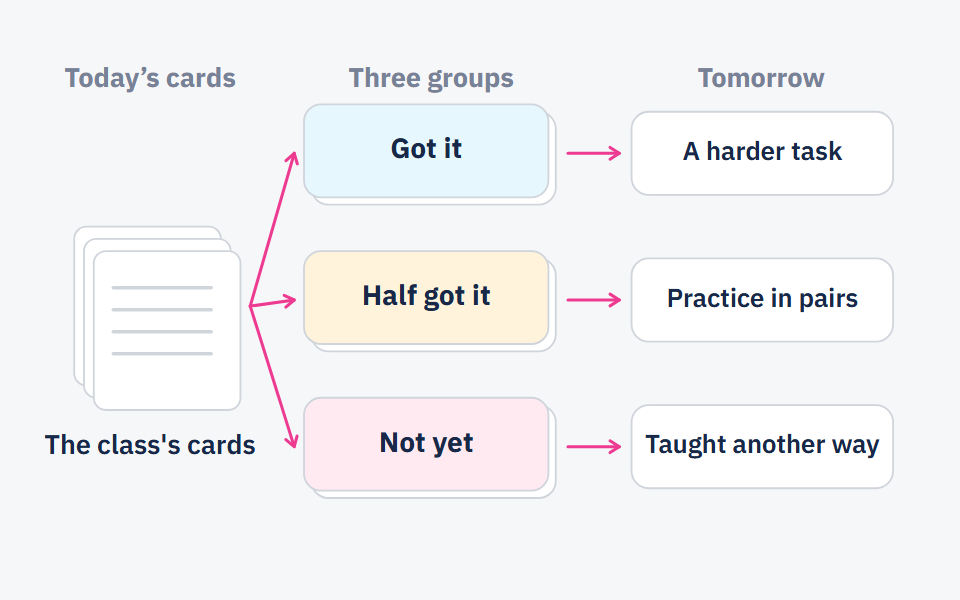
- When nothing changes afterwards: every strategy here ends in a decision — move on, model again, or pull a small group. If you are not ready to change the next step based on what you see, it is an activity, not assessment.
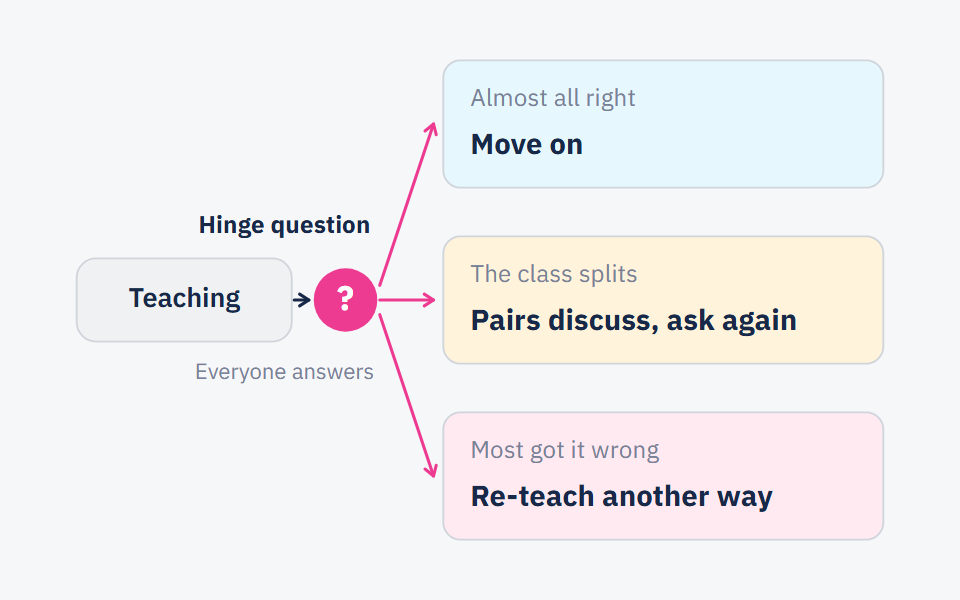
- When the activity becomes the goal: busy students are not necessarily learning students. Ask yourself after each one: what do I now know about their understanding that I didn't before? The hinge question is a way to answer that with one question in the middle of the lesson.
Frequently asked questions
- What are good active learning strategies for maths?
- Activities where students solve, write and explain during the lesson. The easiest to start with are mini whiteboards and think-pair-share, because they need no change to the room and little preparation.
- Does active learning mean the teacher stops explaining?
- No. Modelling with a worked example comes first; the strategies then show you what students understood and make it stick. Each strategy in this post takes 5 to 20 minutes of a lesson, not the whole lesson.
- Does active learning work in large classes?
- Mini whiteboards, think-pair-share and find the mistake work in any class, because students stay in their seats. A card sort needs only an envelope per pair. A gallery walk needs wall space and room to move.
- Is there a printable PDF of these active learning strategies?
- Yes, at the top of this page: a one-page card with the five strategies, their minutes, the teacher's sentence and the trap for each, no sign-up.
Sources
Every fact in this post that we did not produce ourselves comes from one of these sources.
- Active learning increases student performance in science, engineering, and mathematics (Freeman et al.), PNAS 111(23) — Proceedings of the National Academy of Sciences (via PubMed Central), 2014-05-12
- Principles of Instruction: Research-Based Strategies That All Teachers Should Know (Barak Rosenshine) — American Educator, 2012 (Spring issue)
- Classroom Assessment: Minute by Minute, Day by Day (Dylan Wiliam) — ASCD, Educational Leadership, 2005-11-01
- Improving Mathematics in Key Stages Two and Three: Guidance Report (Henderson, Hodgen, Foster, Kuchemann) — Education Endowment Foundation, 2017 (PDF undated; file named 2017)
Written with String's editorial team: we use AI for research and first drafts, and a person checks every fact and every source before anything is published. How we write
Grade 6 mathematics · Jordan
Teaches Grade 6 mathematics in Jordan and writes here about teaching maths from inside the classroom.