What your school should tell parents about its use of AI
Tell parents four things in one letter: what the school uses AI for, what their children may and may not do with it, how their data is protected, and who to ask. Before you send it, prepare straight answers to the five questions they will ask; the full letter and the answers are below.
Letter to parents about AI — template to fill in
A free printable PDF, no sign-up.
This page is for the principal or owner, and for whoever writes to parents on the school's behalf. If your teachers or students use AI tools, parents are hearing about them from their children anyway. A clear letter means they learn the rules from the school first, not from a group chat.
Telling families has a basis in published guidance. TeachAI's Principles for AI Guidance, under the principle of balancing benefits and risks, cites guidance from the Allen Institute for AI that school administrators can train staff on AI and inform families about AI use. And the ethical framework announced by the Sharjah Private Education Authority in the UAE sets out expectations for students, teachers, school leaders, parents and IT teams, as Khaleej Times reported on 21 October 2026.
The full letter, in four parts
The text below is a template written for this post, not a real school's letter. Fill in the brackets and cut whatever does not apply to your school; a letter that promises what the school does not do is worse than no letter at all.
Dear parents and guardians,
We are writing to tell you how we use AI tools at [School name] this year, what we allow your children to do with them and what we do not, and how we protect their data.
1. What the school uses AI for. Our teachers use [tool name or type] to draft worksheets, quizzes and lesson plans, and to write one text at more than one reading level. A teacher checks every piece of material before it reaches your child, and remains responsible for it. No final grade is given, and no decision is made about a student, by an AI tool alone.
2. What your children may and may not do. In grades [… to …], students use AI in teacher-led classroom activities, with school-approved tools only. In grades [… and above], they may use it to research a topic, generate ideas or ask for a concept to be explained, when the teacher allows it for that task, and they note at the end which tool they used and what for. A student may not present text or an answer produced by a tool as their own work, and may not use AI in a test unless its instructions say so.
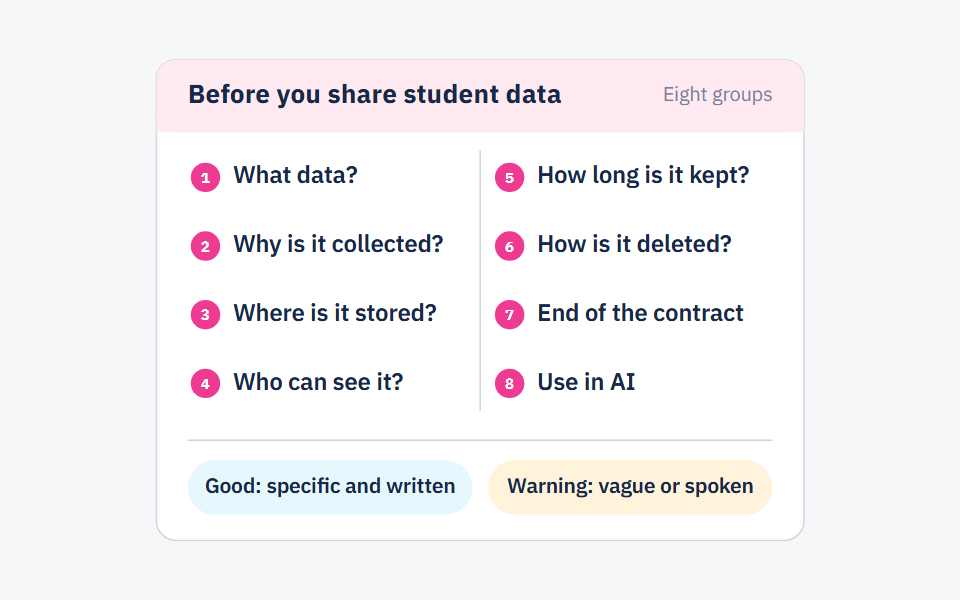
3. How we protect your children's data. We use only tools the school has approved after the provider answered our questions in writing: what data it collects, why, who can see it, and when it is deleted. The tools approved today are: [the list, and what each one receives]. Teachers do not enter students' names or grades into any tool that is not approved. We will tell you whenever we add a tool to this list.
4. How to ask. For any question about AI at school, contact [name and role] by [email or phone], and we will reply within [number] working days. [Optional: We will hold an open meeting for parents on [date] for anyone who wants to see these tools and ask about them.] We ask one thing of you at home: that your child attempts their homework on their own before turning to any tool.
With thanks, [Principal's name] — [date]
How to write each part
Use: name the tasks, not only the tools
“We use AI” raises more questions than it answers. Name the tasks: worksheets, quizzes, texts at different levels. Say that a teacher checks, and that decisions about a student stay with a person — TeachAI's principle of agency, which requires that decisions supported by AI rely on human approval, written in words parents use.
Students: divide by stage, and spell out what is banned
Parents read this part first. Tie the stages to your school's grades, and check the minimum age in each tool's terms: UN News reported on 7 September 2023 that UNESCO's guidance includes considering an age limit of 13 for using these tools in the classroom. If the school has a written AI policy, copy the rules from it; do not write new rules into the letter.
Data: a list, not reassurance
“Your children's data is safe” answers nothing. The answer is a list of the tools by name, and what reaches each one. According to the same report, UNESCO's guidance stresses the need for educational institutions to validate AI systems for student use. The questions to put to a provider before approving its tool are in the questions a school asks before sharing student data.
Asking: a person's name and a reply time
A letter with no name in it sends parents to the teacher at the classroom door. Give one name, and a reply time the school can actually keep.
Five questions parents will ask, with a straight answer to each
These are the questions we expect parents to ask after the letter; we drew them from its parts. Each has an answer frame to fill with what is true at your school, and a line to avoid because it raises worry instead of answering.
| The question | Answer frame | Avoid saying |
|---|---|---|
| 1. Does my child use AI at school? | “Yes, in [activity], with [tool], which the school has approved, and with the teacher supervising. Students under [age] do not use any tool on their own.” | “A little, depending on the teacher.” That means there is no rule. |
| 2. Is using AI for homework cheating? | “The teacher says for each task whether it is allowed, and for what. What is never allowed is presenting the tool's work as your own. Anyone who used a tool says so at the end of the task.” | “We have software that detects it.” See the paragraph below. |
| 3. What data about my child reaches these tools? | “[Tool] receives [only what it receives], for [purpose], and it is deleted after [period]. No student's name or grade goes into a tool that is not approved.” | “Your data is safe,” without saying what data or where it goes. |
| 4. Do teachers mark work or write reports with AI? | “Teachers use it for [tasks]. The teacher reads everything they send and takes responsibility for it, and no final grade is given by a tool alone.” | “Nobody uses it,” unless that is true. |
| 5. What should I do at home? | “Ask your child to attempt the homework alone first, and if they used a tool, to explain to you what they learned. The school's rules are attached for you to build home rules on.” | “Ban all use.” They may hide their use instead of stopping it. |
The second question is where your answer is tested first. TeachAI's principles advise that teachers should not use technologies that claim to identify the use of generative AI to detect cheating and plagiarism, because their accuracy is questionable, with a risk of false positives and negatives: they may flag a student who did not use a tool, and miss one who did. They also advise teachers to be transparent about their own uses of AI, and clear about when students may use it. If you are asked how the school will know, our suggested answer is: from the task itself — a student explaining a step out loud, or writing part of an answer in class.
The fifth question needs a longer answer than the letter can give. If you want to send parents something to build on, family rules for AI and homework has a ready agreement they can write with their children.
Three mistakes that make parents more worried
- A letter that opens with the risks. Start with what the school uses and why, then the rules. A letter that opens with warnings makes the reader look for danger in the rest of it.
- A promise the school cannot keep. “No student will use AI for homework” is a promise about what happens at home, which the school does not control. Write what the school itself does: what it allows, what it asks, and how it checks.
- Technical words. “Language model” and “data processing” are words a parent does not need. Write about AI the way you write about the school bus: who, when, and under what rule.
When to send it, and what comes after
- At the start of term, or before the first use with students. A letter that arrives after parents have heard from their children reads as a response, not an announcement.
- Whenever the list of tools changes. Two lines are enough: the tool, who uses it, and what data reaches it.
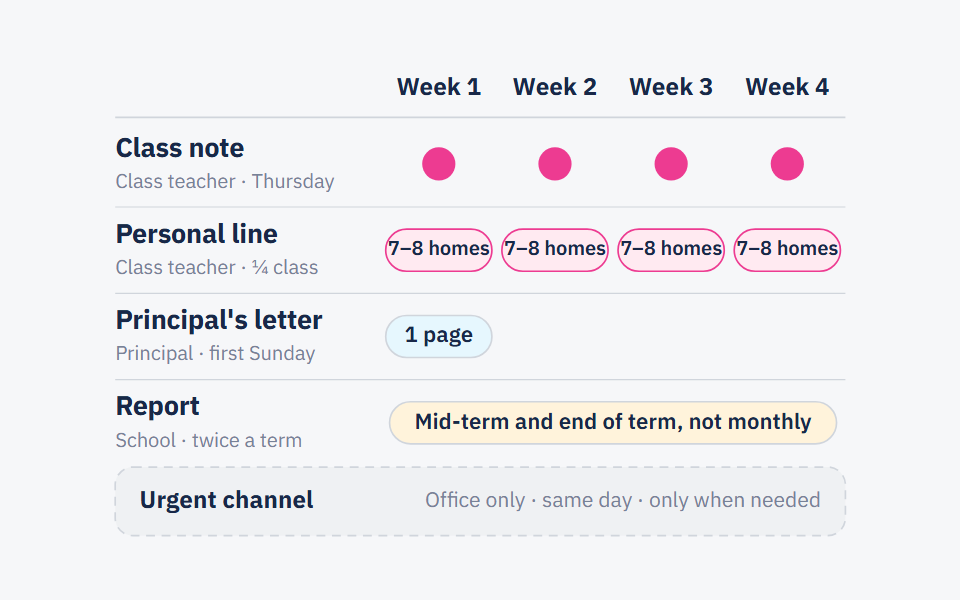
- In the principal's monthly letter after that. Do not make AI a separate letter every month; fold it into the rhythm your school uses to talk to parents.
- After six weeks, ask parents. Two questions are enough: was the letter clear, and what still worries you? TeachAI's evaluation principle lists feedback from parents among what guidance and policies benefit from.
This letter has one limit it cannot get past: it does not replace the rules themselves. If the school has no written agreement on what is allowed, the letter will describe something that does not exist. Start with the policy template, then send the letter. And if AI is one of the priorities in your school development plan this year, say in the letter what the school intends to do about it.
Frequently asked questions
- What should a school's letter to parents about AI include?
- Four parts: what the school uses AI for, what students may and may not do at each stage, how their data is protected with the list of approved tools, and who parents can ask and how soon they will get a reply.
- Can a parent opt their child out of AI use at school?
- That depends on your country's law and your school's policy. If the school allows it, say in the letter how a parent asks for it and what the student does instead. Do not promise an option the school cannot provide.
- Should the letter name the AI tools the school uses?
- Yes, for the tools students use or that receive their data; a name lets a parent read the tool's terms and ask about it. For tools a teacher uses to prepare material without student data, describing them is enough.
- Where can I get a letter to parents about AI as a PDF?
- At the top of this page: the letter on one page to print and fill in, free and with no sign-up.
Sources
Every fact in this post that we did not produce ourselves comes from one of these sources.
- Principles for AI Guidance (AI Guidance for Schools Toolkit) — TeachAI, 2025
- UNESCO calls for regulations on AI use in schools — UN News, 2023-09-07
- Sharjah schools introduce new AI rules: What changes for homework and exams? (Nandini Sircar) — Khaleej Times, 2026-10-21
Written with String's editorial team: we use AI for research and first drafts, and a person checks every fact and every source before anything is published. How we write
Founder and CEO, String
“I grew up in a house of teachers.” I spent a year designing the STEM program for one of the largest school groups in Saudi Arabia, have written curriculum by hand, trained robotics coaches and sold software into schools, then left that job to build String in Amman.