The first 30 days: helping teachers adopt a new platform
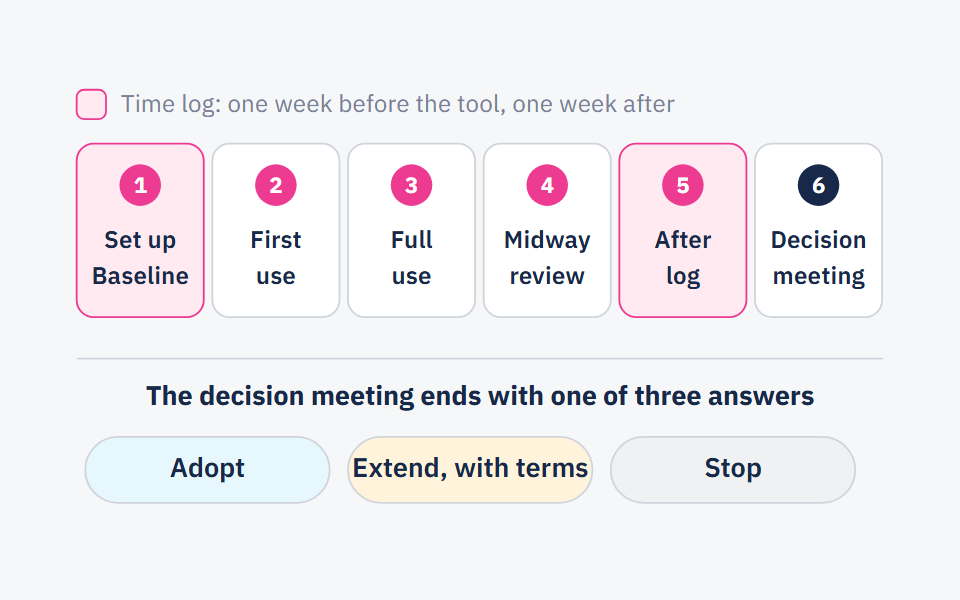
Prepare for a week before you start, then give teachers one small task a week, name a champion in each department, and drop an old task for every job the platform takes over so it never becomes extra work. Watch one number every Thursday: how many teachers used it for a real lesson that week.
The 30-day plan for a new platform
A free printable PDF, no sign-up.
This plan is for the principal or academic head who has decided to adopt a platform after piloting it in a few classes and now has to bring the rest of the staff along. Thirty days is enough to get the platform working in classrooms, as long as each week asks for one clear thing.
The Education Endowment Foundation's guide to implementation in schools, in its second edition (December 2019), names two things that can sink any change in a school: the change becomes an “add on” task on top of the day-to-day work and fades as priorities compete, and teachers applying it for the first time feel awkward and “incompetent”, experienced ones included. In The Decision Lab's 2022 study of more than 225 edtech decision-makers in US school districts, as reported in an EdSurge article sponsored by ISTE (June 2024), a lack of buy-in from the people involved and resistance to change are among the barriers at the purchase stage. The plan below is built on that: one small task each week, and for every new job, an old one that stops.
- Definition
- Teacher adoption of a platform: Teachers using the platform in their real work with students without being reminded — not each of them having an account or attending a training session.
Week zero: what to set up before teachers start
- A list of what stops. For every job the platform takes over, an old task stops on the same day. If the weekly quiz moves to the platform, do not also ask for a paper copy in the teacher's file. The EEF guide asks a plain question at the preparation stage: what can we stop doing to create the space, time and effort for the new work? Write your answer down and announce it at the first meeting.
- A champion in each department. Choose someone colleagues trust and already go to with questions, not necessarily the most technical person. The same guide suggests recruiting the school's opinion-leaders, and advocates who champion a change by modelling it and helping others use it. We suggest relieving each champion of one duty a month in return for their time.
- Accounts ready and tested. Each champion logs in with an ordinary teacher account and does all four weeks' tasks before colleagues do. A fault one champion finds alone is a fault a whole department does not find in the middle of a lesson.
- Twenty protected minutes a week. Take them from a meeting that already exists, such as the department meeting. Do not add a new one.
- One support channel. One person or one group for questions, and a promise of an answer the same day.
- One sentence on why. Why this platform, and which problem it solves in this school. The sentence written at the start of the pilot will do.
The plan, week by week: one task each week
| Week | The teacher's task | The champion's role | The principal's role |
|---|---|---|---|
| 0. Prepare | Nothing yet; hears, in one meeting, why the platform and what stops | Does all four weeks' tasks first and notes where they got stuck | Announces the stop list and explains the number they will watch each Thursday |
| 1. First use | Makes one thing for a real lesson this week, even if students do not see it yet | Sits with the department for twenty minutes, each at their own device | Uses the platform in front of staff, for example by sending the weekly note from it |
| 2. With students | Uses what they made in one lesson with one class | Is nearby for the first lesson for anyone who asks, and logs every problem | Fixes the logged problems before Thursday, or says when they will be fixed |
| 3. Replace the old | The platform replaces one task from the stop list | Collects what colleagues made and picks one example to show in week four | Checks the old task has really stopped and is not being asked for twice |
| 4. Share and review | Shows one thing they made at the department meeting, in two minutes | Runs the show-and-tell and collects objections in writing | Holds a listening session and sets the task for month two |
Why one task a week? Because training alone, the EEF guide says, is unlikely to be enough to change what a teacher does in class; it needs follow-on support inside the school, and the guide names coaching and mentoring that provide ongoing modelling, feedback and support. A small task makes that support possible: each week the champion knows what to ask about, and the teacher knows exactly what is expected.
Note the order of weeks one and two: teachers make something on their own before they stand in front of a class with it. We put them in this order because, in our view, the awkwardness the guide describes is lighter in front of a screen than in front of thirty students.
The one number to watch every Thursday
Watch the share of teachers who used the platform for a real lesson this week, out of all the teachers the plan covers. This is a number we suggest, not a published standard, and we choose it because it measures what you actually want: the platform reaching the classroom.
- Counts: a quiz students answered, a worksheet printed and handed out in class, slides used in a lesson, homework that reached students.
- Does not count: logging in, anything made in the training session, material that never reached students.
Collect it the simplest way: the champion asks colleagues one yes-or-no question every Thursday, or you read it from the platform's usage report if that report separates what was made from what reached students. The EEF guide notes that simple, quick measures find more acceptance among staff than complicated ones, and that clear, achievable short-term measures show the early signs of success.
Show the number by department, never by teacher name; the point is to see where support is needed, not to announce who is behind. We know of no published benchmark for this share, so what matters is its direction week on week. If it stays flat or falls in a department for two weeks running, sit down with that department's champion before you add any new task.
Week two. 18 of you used the platform for a real lesson this week, out of 40 — that is 45%. In science, every teacher used it; in Arabic, two out of seven. The champions logged three problems: images were slow to upload, fixed yesterday; some students forgot their passwords, and form tutors will hand out login cards on Sunday; printing from a phone does not work, and we are waiting for the company's answer. Next week's task: use the platform instead of the weekly paper quiz with one class, and there is no longer any need for a paper copy in your file.
The school, the numbers and the problems in this example are imaginary, and the note was written for this post.
How to hear objections without starting an argument
You will hear objections, and some of them will be right. The EEF guide separates technical problems, which a school's usual routines can solve, from unfamiliar ones that need dialogue, involvement, negotiation and an answer worked out with the people concerned. So hear the objection first, then sort it.
Collect objections in writing, in one place
A sheet or a form that reaches the champion and the principal together. An objection voiced in the corridor and never written down is never fixed or answered.
Sort each objection into one of four kinds
A fault fixed within days; a training gap the champion closes with a short session; a real cost, meaning the platform added work, which is only solved when something else stops; or a question that needs a written answer.
Spend ten minutes with the most doubtful teacher
Ask: what would make this worth your time? Then write the answer down. The doubtful see what the enthusiasts miss.
Answer every objection within a week, in writing
Say what changed because of it, or why nothing did. Silence reads as a no.
Keep objections out of the whole-staff meeting
That meeting is for the next task and the number. Objections are discussed with the person who raised them, or in the department meeting.
| What you may hear | Kind | What you do |
|---|---|---|
| “I don't have time for something new” | Real cost | Show them the stop list, and ask which other task takes their time and could stop |
| “I don't know how to use it in front of students” | Training gap | That is why use with students comes in week two, not week one, with the champion nearby for the first lesson |
| “The page crashes when the whole class logs in” | Fault | Log it with the time and the class, send it to the company the same day, and tell the teacher when it will be fixed |
| “Where does my students' data go?” | Question | Give them the platform's written answers to the student data questions, not a spoken promise |
| “We tried a platform before and it was dropped” | Question | Write down what is different this time, and show the Thursday number to everyone every week |
When thirty days is not enough
- Thirty days is a start, not full adoption. The EEF guide asks schools to plan for sustaining a change from the outset, and to take regular “pulse checks” so the strain of implementation does not wear down the school's readiness. At the end of week four, write the task for month two, and keep the Thursday number.
- If after three weeks the number is still only the champions, do not add a task. Look for the cause in the task and in the platform before you look for it in the teachers, and go back to the problem log and to what the doubtful teachers said.
- A platform does not save everyone time. In a Gallup and Walton Family Foundation survey of 1,952 US K-12 educators, published on 14 October 2026, 29% of those who used AI tools in the 2025–26 school year said it made no difference to their time, and 7% said it cost them time. Those figures are about AI tools in the US, not about your platform, but the lesson holds: measure the time yourself, as in how to measure the teacher time a tool really saves.
- A mandate does not replace a plan. You can require everyone to use the platform, but what brings it into the classroom is the small task, the support close at hand, and the old task that stopped. If you have not yet settled between one platform and several tools, start with one platform or many tools: how a school decides.
Frequently asked questions
- How long does it take to train teachers on a new platform?
- A short first session is enough if weekly support follows it: twenty minutes a week with the champion, for four weeks. Training alone is unlikely to change what happens in class, the EEF guide says; the support that comes after it is what changes it.
- Should using the platform be compulsory from day one?
- Make the weekly task compulsory, not everything. One small task everyone is expected to do is clearer than “use the platform”, and it gives you a number you can follow.
- How do I choose the champion in each department?
- Choose the person colleagues already ask when they get stuck, and who will use the platform in their own class. They do not need to be the most technical; it is enough that they have done the four weeks' tasks before everyone else.
- What do I do with a teacher who refuses the platform outright?
- Hear their reason in a ten-minute conversation and sort it: a fault, a training gap, a real cost or a question. If the cost is real, the answer is to take another task off them, not to push harder.
Sources
Every fact in this post that we did not produce ourselves comes from one of these sources.
- Putting Evidence to Work: A School's Guide to Implementation, second edition (Jonathan Sharples, Bianca Albers, Stephen Fraser and Stuart Kime) — Education Endowment Foundation (EEF), 2019-12
- How District Leaders Make Edtech Purchasing Decisions (Caitlin McLemore and Jayden Rae) — EdSurge, 2024-06-24
- Teachers Using AI Say It Frees Up Time for What Matters Most (Megan Brenan) — Gallup, with the Walton Family Foundation, 2026-10-14
Written with String's editorial team: we use AI for research and first drafts, and a person checks every fact and every source before anything is published. How we write
Founder and CEO, String
“I grew up in a house of teachers.” I spent a year designing the STEM program for one of the largest school groups in Saudi Arabia, have written curriculum by hand, trained robotics coaches and sold software into schools, then left that job to build String in Amman.