World Arabic Language Day: seven classroom activities for every subject
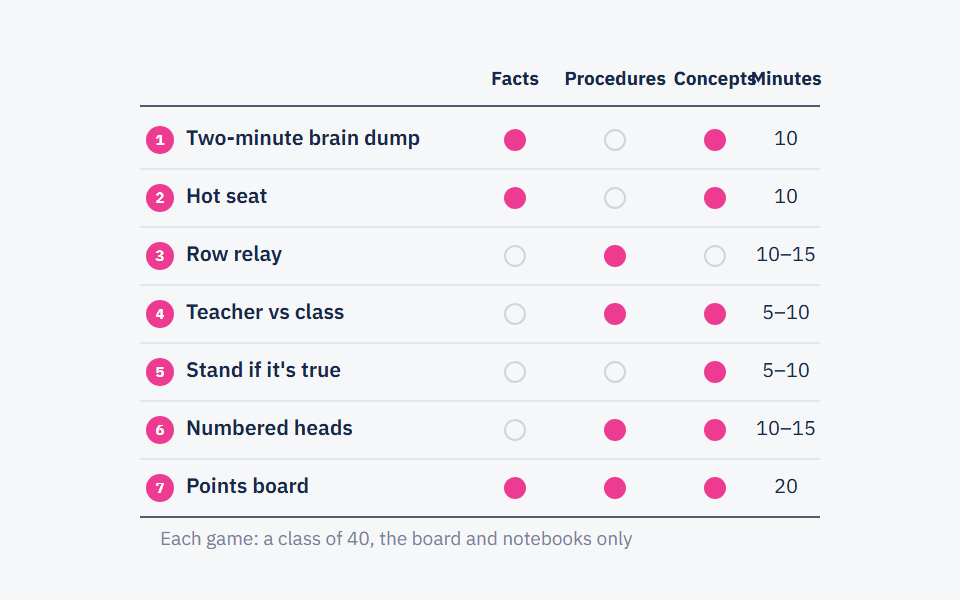
World Arabic Language Day falls on 18 December every year, the day the UN General Assembly decided to make Arabic one of its official languages. Here are seven activities that bring Arabic into maths, science and English lessons — not just the Arabic class — each with its minutes and materials.
World Arabic Language Day — seven activity cards
A free printable PDF, no sign-up.
World Arabic Language Day lands in a busy teaching week, so it is usually left to the Arabic teacher alone. But Arabic is the language of maths and science in many classrooms, and the terms of those subjects are exactly what students need to understand rather than memorise. Here are seven short activities that bring the day into a maths, science or English lesson without leaving the lesson behind, each with its subject, minutes and materials — plus a plan for the whole week and printable cards.
The date: 18 December, and why that day
The United Nations marks Arabic Language Day on 18 December every year. As a UN News story from 18 December 2019 (in Arabic) explains, the date is the day the General Assembly decided to make Arabic the sixth official language of the UN, alongside Chinese, English, French, Russian and Spanish. Another UN News story, from 18 December 2023 (in Arabic), says the resolution was adopted in 1973, that UNESCO established the international day in 2010, and that Arabic is spoken by more than 400 million people.
In 2026, 18 December is a Friday. If Friday is a school holiday where you teach, hold the activities on Thursday 17 December, or spread them across the week from Sunday 13 to Thursday 17.
The seven activities in one table
Pick the activity that serves your lesson that week, not one that interrupts it. We wrote these activities for this post, and the minutes are our estimate for an ordinary class; adjust them to yours.
| Activity | Subject | Minutes | Materials |
|---|---|---|---|
| 1. Arabic words in maths | Maths; works in English too | 10 | The board |
| 2. Square Kufic on grid paper | Maths: area, perimeter and symmetry | 25 | Squared paper, pencil, ruler |
| 3. Numbers in words | Maths | 10 | Notebooks |
| 4. A science glossary in formal Arabic | Science | 15 | A three-column page in the notebook |
| 5. A short read-aloud | Any subject | 5 | A paragraph from the subject's textbook |
| 6. Two-way translation | English | 15 | Four sentences on the board or screen |
| 7. Word of the day and its root | Any subject | 2 a day | A fixed corner of the board |
In the maths lesson: three activities
1. Arabic words in maths (10 minutes)
Write three words students know in English on the board — algebra, algorithm and cipher — and ask them to guess the Arabic origin before you tell them. Encyclopaedia Britannica says al-Khwārizmī lived in Baghdad and worked at the House of Wisdom; that his book on algebra, “The Compendious Book on Calculation by Completion and Balancing”, was translated into Latin in the 12th century and gave its title to the term algebra; and that his name, rendered in Latin as Algoritmi, gave us algorithm. Merriam-Webster traces the English cipher, through Medieval Latin, to the Arabic ṣifr (صِفر), glossed as “empty, cipher, zero”.
- How: once students know the origins, each writes one sentence in Arabic using «الجبر» (algebra) or «الخوارزمية» (algorithm) in today's lesson, such as «الخوارزمية خطوات مرتّبة نصل بها إلى الحلّ» (an algorithm is a set of ordered steps that lead to the answer).
- Why it works: students tie a term they use to a meaning and a story, instead of memorising its letters.
- In a lesson taught in English: the same activity in reverse — students know the English word and discover its Arabic origin.
2. Square Kufic on grid paper (25 minutes)
Britannica describes Kufic as an angular script in which the earliest surviving copies of the Qur'an were written, also used for inscriptions on buildings, with varieties that include squared Kufic. Because square letters are drawn on a grid, it makes a ready lesson in area, perimeter and symmetry.
- How: each student writes a short word of two or three letters on squared paper, using only horizontal and vertical strokes, and shades its squares. Then they answer three questions: how many squares did you shade? What is the perimeter, if the shape is one piece? Does it have a line of symmetry?
- A worked example: three columns, each 5 squares tall, with an empty column between each pair, joined along the bottom row by two squares. The area is squares. The perimeter is 36 units: the rectangle around the shape has perimeter , and each gap between columns adds , so . The shape has one vertical line of symmetry.
- Why it works: the grid turns every letter into a count of squares, so students measure what they drew themselves.
3. Numbers in words (10 minutes)
Pick three problems from today's exercise and have students write the numbers in them as words in formal Arabic. Arabic numbers change form with the gender of what they count, so this is real language practice inside a maths lesson. Here are correct examples to start from:
- 2026: «ألفان وستة وعشرون».
- 13 male students: «ثلاثة عشر طالباً»; 13 female students: «ثلاث عشرة طالبة».
- From 1973 to 2026: «ثلاث وخمسون سنة» (53 years), because .
- More than 400 million: «أكثر من أربعمئة مليون».
In science and other subjects: two activities
4. A science glossary in formal Arabic (15 minutes)
Students build a three-column glossary of the unit's terms: the term in formal Arabic, its English equivalent, and a one-sentence definition in their own words. Start with an example showing that words travel both ways: Merriam-Webster traces the English alkali to the Arabic al-qili (القِلْي), “the ashes of the plant saltwort”. In an acids-and-bases lesson taught in Arabic, these substances are called «القلويات».
- How: choose five terms from the current unit, and ask for definitions in the students' words, not the textbook's. Then two students read their definitions of the same term, and the class picks the clearer one.
- Why it works: writing the definition in your own sentence shows you what you had not understood about the term.
5. A short read-aloud (5 minutes)
Read the class one paragraph in formal Arabic from your subject's textbook — a definition or a unit introduction — and before you start, ask students to catch three words from it to explain afterwards. We suggest a paragraph of 80 to 120 words, read once at a calm pace.
- How: after the reading, each student writes the three words and what each means as they understood it; then you read the paragraph a second time so everyone can check.
- Why it works: students hear the term inside a full sentence, not alone in a list.
In the English lesson: two-way translation
6. Two-way translation (15 minutes)
Write four short Arabic sentences. Each pair of students translates them into English; then pairs swap translations, and each pair turns what it received back into Arabic without seeing the original. At the end, the class compares the returning sentences with the originals: where did the meaning change, and why?
- «يبدأ الدرس بعد خمس دقائق.» (The lesson starts in five minutes.)
- «قرأت الكتاب الذي أعرتني إياه.» (I read the book you lent me.)
- «لم يكن الامتحان صعباً كما توقّعنا.» (The exam was not as hard as we expected.)
- «كلما تدرّبت أكثر، سهلت عليك المسائل.» (The more you practise, the easier the problems get.)
- Why it works: the return trip shows what differs between the two languages in word order, tense and negation — exactly where students go wrong when they write in English.
A whole week: the word of the day, and a Sunday-to-Thursday plan
7. Word of the day and its root (2 minutes a day)
Keep a fixed corner of the board for one word a day from your subject's terms: the word, its root, and two more words from the same root. A maths example: «مُعادَلة» (equation), from the root ع د ل, which also gives «تعادُل» (balance) and «عَدْل» (justice). Then ask: what meaning do the three words share? An equation has two equal sides.
| Day | Activity | Subject |
|---|---|---|
| Sunday 13 December | Word of the day, and Arabic words in maths | Maths |
| Monday 14 | Word of the day, and the science glossary | Science |
| Tuesday 15 | Word of the day, and two-way translation | English |
| Wednesday 16 | Word of the day, and numbers in words | Maths |
| Thursday 17 | Word of the day, square Kufic, and a short read-aloud at the end | Maths and any subject |
The plan suits a teacher who teaches more than one subject, or a team of teachers sharing one class who split the days between them. If your week only has room for one activity, choose the word of the day: it is the shortest, and it stays after the week is over.
When the activity becomes decoration
An activity fails when it interrupts the lesson instead of serving it: ten minutes on where “algebra” comes from, on a day when students need practice with equations, is time lost — unless it ends with a sentence that uses the term in today's lesson. It also fails when it turns into correcting students' Arabic in a maths lesson; just say the sentence back correctly and move on. And if some students in your class have a first language other than Arabic, pair them with classmates who speak it, and let English be the bridge.
If you want Arabic to stay in the classroom after the day itself: why Arab teachers deserve tools that start in Arabic gives our view, and twenty Arabic prompts for lesson prep shows how to write your requests to AI tools in formal Arabic.
Frequently asked questions
- When is World Arabic Language Day?
- On 18 December every year, according to the United Nations. In 2026 it falls on a Friday.
- Why is Arabic Language Day on 18 December?
- Because it is the day the UN General Assembly decided to make Arabic the sixth of its official languages, as UN News (in Arabic) reports; the resolution was adopted in 1973.
- What activities suit Arabic Language Day at school?
- Short activities inside ordinary lessons: Arabic words in maths, square Kufic on grid paper, numbers in words, a science glossary in formal Arabic, a short read-aloud, two-way translation, and a word of the day with its root.
- How can I mark Arabic Language Day in a maths lesson?
- Pick one of three: the origins of words such as algebra and algorithm in ten minutes, square Kufic on grid paper for a lesson on area, perimeter and symmetry, or writing the numbers in the day's problems as words in formal Arabic.
Sources
Every fact in this post that we did not produce ourselves comes from one of these sources.
- Arabic Language Day — United Nations, n.d., read 2026-10-22
- يوم اللغة العربية: نقاش حول مساهمة الذكاء الاصطناعي في ازدهار اللغة العربية وتجويد طرق تعليمها، وفعاليات في مقر الأمم المتحدة — أخبار الأمم المتحدة (UN News, Arabic), 2019-12-18
- الأمم المتحدة تحتفل باللغة العربية: لغة الشعر والفنون — أخبار الأمم المتحدة (UN News, Arabic), 2023-12-18
- al-Khwārizmī — Encyclopaedia Britannica, 2026-08-24 (last updated)
- Kūfic script — Encyclopaedia Britannica, n.d., read 2026-10-22
- cipher (etymology) — Merriam-Webster Dictionary, n.d., read 2026-10-22
- alkali (etymology) — Merriam-Webster Dictionary, n.d., read 2026-10-22
Written with String's editorial team: we use AI for research and first drafts, and a person checks every fact and every source before anything is published. How we write
Founder and CEO, String
“I grew up in a house of teachers.” I spent a year designing the STEM program for one of the largest school groups in Saudi Arabia, have written curriculum by hand, trained robotics coaches and sold software into schools, then left that job to build String in Amman.