The mid-year break: calm learning ideas without pressure
Pick one idea a day from your child's age band, mostly under half an hour, and let your child choose it. The kitchen, the shop, a story and a quiz practise reading, maths and writing without a single worksheet.
The break idea card — for the fridge
A free printable PDF, no sign-up.
Whether your country calls it the mid-year break, the winter break or the end of the first term, it is a few weeks in which your child needs rest first. Do not turn it into a third term. It is enough to keep a little reading, maths and talk going at home, in the form of play. Below are twelve ideas, three for each age, each with what it practises and how long it takes. Tonight, put the card on the fridge and let your child pick tomorrow's idea.
Four rules that keep it play, not homework
UNICEF's page “How to teach your child to love reading” says it is important for children to see reading as something fun and pleasurable rather than a difficult task. The rules below are our suggestion for carrying that over to every idea in the break:
- They choose. Offer the three ideas for their age and let them pick one for the day.
- One idea a day, no more. And days with nothing too; the break is for rest.
- Stop while they are still enjoying it. If they are bored, the idea is over for today.
- No corrections and no marks. If they miscount or misread a word, say it correctly yourself and carry on playing.
Ages 4 to 6: the kitchen, the shop and a story
| The idea | How | What it practises | Time |
|---|---|---|---|
| Kitchen maths | While you cook, ask, “How much rice do we need?”, show them how you measure it, then count the pieces of fruit on their plate together. These are examples from UNICEF's page on maths for little ones. | Counting, comparing amounts | 10 minutes |
| The shopping list | Before the shop, they write or draw the list with you, then cross off each thing you buy. Words for Life suggests writing a shopping list with your child before you go. At the shop, ask, “Which orange is bigger?” | First writing, names of things, comparing | 10 minutes |
| A bedtime story | A book they choose, read aloud by you, then one question: “What do you think happens next?” The same Words for Life page suggests ten minutes of sharing stories as part of the evening routine. | Listening, new words | 10 minutes |
Ages 7 to 9: word and number games
| The idea | How | What it practises | Time |
|---|---|---|---|
| I spy | In the car or while waiting: “I spy something red and round”, or “I spy three things that match”. UNICEF lists it for ages 5 to 8 as a way to practise language and maths skills. | Describing, shapes, counting | 10 minutes |
| A turn-taking story | You say a sentence, they say the next, until the story is done; then they draw it if they like. It is one of the ideas on the same page for the same ages. | Building sentences, ordering events | 15 minutes |
| Double the recipe | Pick a cake recipe and ask them to make it for twice as many: if it needs 2 cups of flour and 3 eggs, double is cups and eggs. Then they do the measuring. | Multiplying, measuring | 30 minutes with the baking |
Ages 10 to 12: a quiz, a journal and a plant
| The idea | How | What it practises | Time |
|---|---|---|---|
| The family quiz | They write ten questions on what they studied this term, the adults answer, then you swap roles. Writing a question and knowing its answer means they have recalled the lesson. | Recalling what they learned | 20 minutes |
| The trip journal | After a day out, one page: three things they saw, two new words, and one number from the day — a distance, a time or a price. | Writing, noticing | 15 minutes |
| Grow something | Seeds in a cup on the windowsill. Every two days they measure the shoot with a ruler and write the number in a small table. Growing a plant is one of UNICEF's ideas for ages 9 to 12. | Measuring, recording | 5 minutes a day |
The quiz has solid backing: in a 2013 review of ten learning techniques, published in a journal of the Association for Psychological Science, practice testing and spacing study over time received the highest utility rating, while rereading and highlighting seemed to give minimal benefit. A family quiz is practice testing in the form of a game.
Ages 13 and up: they lead
| The idea | How | What it practises | Time |
|---|---|---|---|
| Chef for the day | They choose a dish for the family, you shop for it together, then cook it as a team; it is one of UNICEF's ideas for teens. We add a budget you agree on in advance. | Planning, budgeting | 2 hours, once |
| A reading club | You each pick an article, a poem or a chapter, then talk: “What did you find interesting about it? What did you learn?” — the two questions on the same page. | Reading, discussion | 30 minutes |
| A project they choose | A short video they film, a model they build, a skill they learn. They set the goal and the plan; you ask about it and take an interest. | Planning, managing time | Their call |
Your part here is asking and taking an interest, not managing. The UK Education Endowment Foundation's 2018 guidance report “Working with Parents to Support Children's Learning” says that as children get older, parents' encouragement for and interest in their learning matter more than direct involvement.
What research says about the break, and what it does not
The same EEF report says the decline in children's reading that can occur over the summer holidays is well documented, particularly for children from low-income families. But that is about the long summer break. We know of no study on the short mid-year break, so do not treat it as a loss to make up. The aim is smaller: to keep reading and talk a habit at home until school starts again.
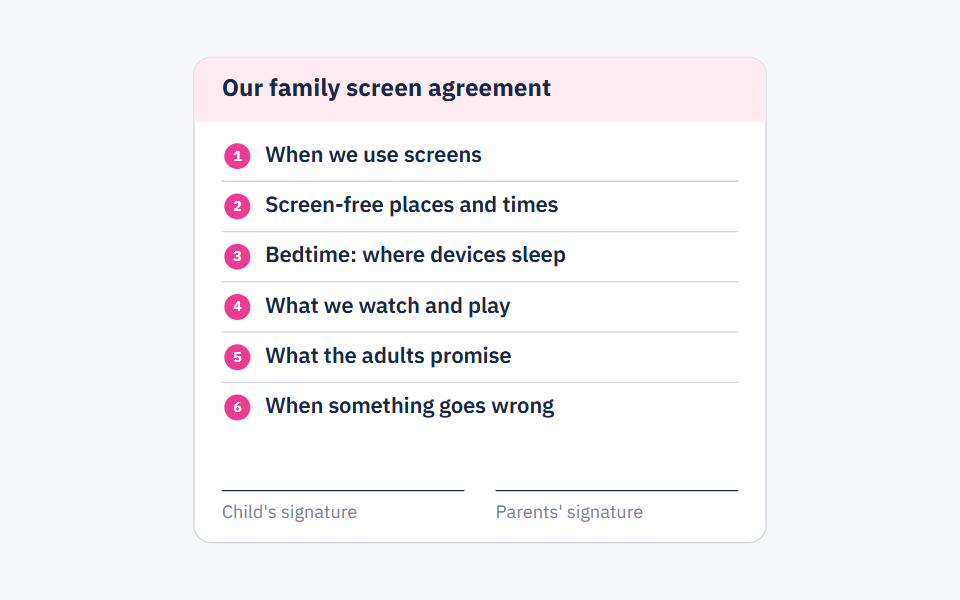
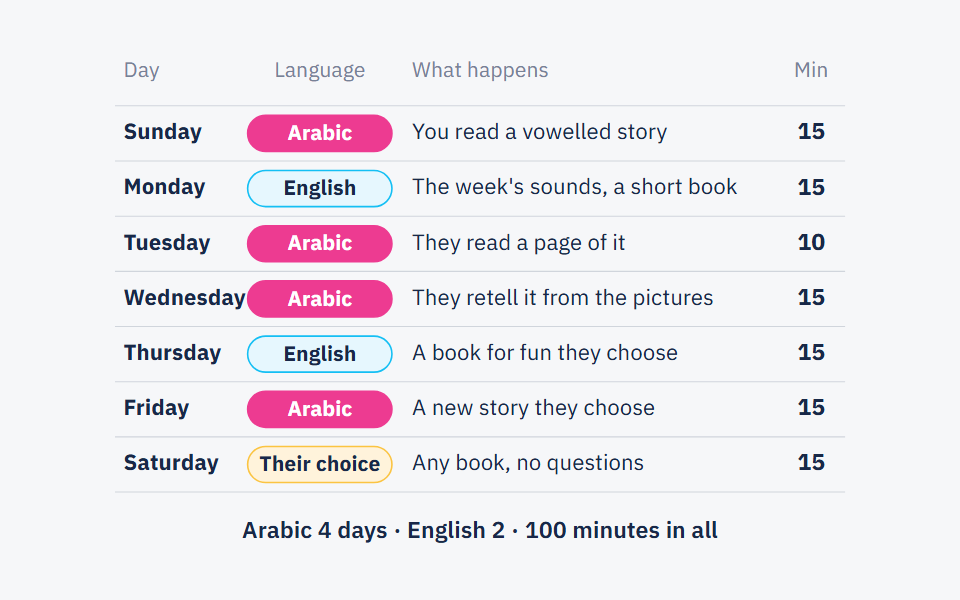
These ideas fail when they become a compulsory timetable, or when they come after a long day of screens and your child is tired. So agree on screens for the break in advance; the family screen-time agreement is a template you write together. If the school has sent holiday homework, we suggest doing it in short sessions in the first days, and leaving the rest of the break for play. For daily reading during the break and after, there is a home reading plan by age, and if your child reads in two languages, reading in Arabic and English shows how to split the week between them.
Frequently asked questions
- What can I do with my kids during the mid-year break?
- One idea a day that your child picks from their age band: cooking, a story, a quiz or a small project. And some days of rest with nothing planned.
- Should my child study during the break?
- If the school has sent homework, do it in short sessions at the start of the break. After that, play that involves reading, maths and talk is enough, without organised study.
- How many minutes a day is enough?
- Between 10 and 30 minutes for most of the ideas — times we suggest, not numbers from research. What matters most is stopping while your child is still enjoying it.
- What if my child refuses every activity?
- Let them rest for a couple of days, then offer them the card to choose from, or ask them to teach you something they like. A game they suggest is one they are more likely to finish.
Sources
Every fact in this post that we did not produce ourselves comes from one of these sources.
- Screen-free activities for children — UNICEF Parenting, undated (read 2026-10-22)
- How to introduce maths to your toddler — UNICEF Parenting, undated (read 2026-10-22)
- How to teach your child to love reading — UNICEF Parenting, undated (read 2026-10-22)
- How can I help my child learn at home? — Words for Life (National Literacy Trust), undated (read 2026-10-22)
- Working with Parents to Support Children's Learning: Guidance Report — Education Endowment Foundation, 2018
- Which study strategies make the grade? — Association for Psychological Science, 2013-01-10
Written with String's editorial team: we use AI for research and first drafts, and a person checks every fact and every source before anything is published. How we write
Founder and CEO, String
“I grew up in a house of teachers.” I spent a year designing the STEM program for one of the largest school groups in Saudi Arabia, have written curriculum by hand, trained robotics coaches and sold software into schools, then left that job to build String in Amman.